A traditional fashion catalog shoot runs 6 to 10 weeks from first planning call to final deliverables. When it's done, you have images for one season, locked to one set of models, one set of locations, and one creative direction. If anything changes, you reshoot.
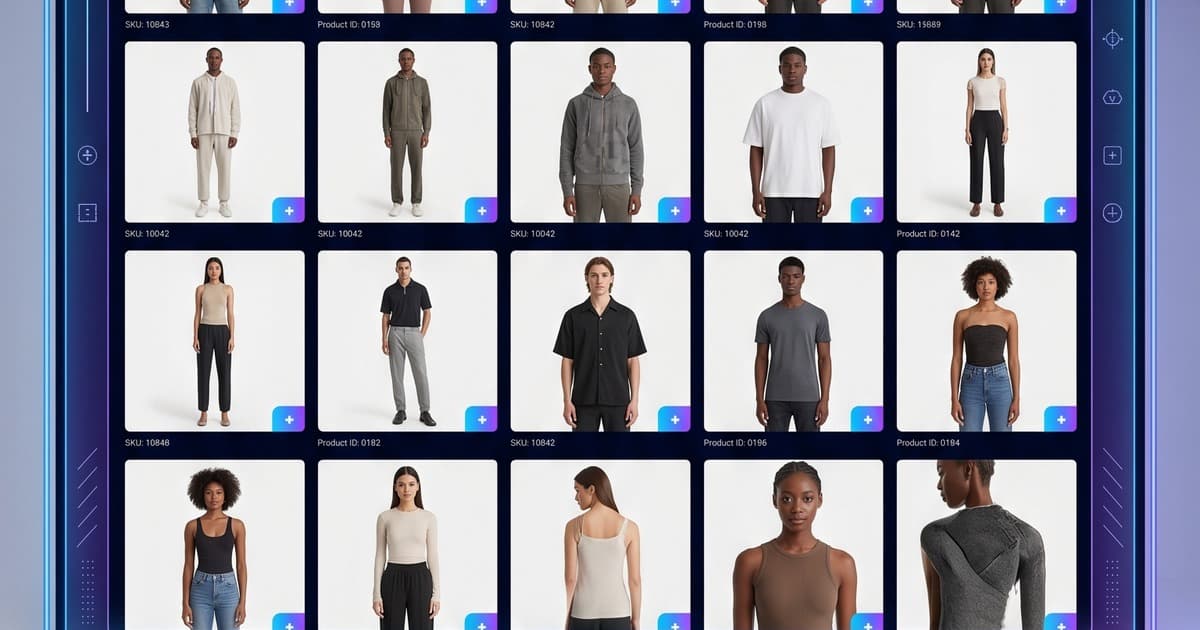
AI catalog production breaks every one of those constraints. Fashion brands are now generating complete catalogs in days, not months, with on-model photography across every SKU, consistent styling throughout, and the ability to refresh everything for the next season without booking a single studio.
This is not a future capability. Brands doing 200+ SKUs per season are already running this workflow today. Here is how it works.
Why Traditional Catalog Production Is Structurally Broken
The cost and timeline problem with fashion catalogs is not about inefficiency. The process itself is the bottleneck.
A typical production timeline looks like this:
| Phase | Duration |
|---|---|
| Creative brief + mood board | 1 week |
| Talent casting and booking | 1-2 weeks |
| Location scouting or studio booking | 1 week |
| Sample collection + logistics | 1-2 weeks |
| Shoot day(s) | 1-3 days |
| Raw selects + retouching | 1-2 weeks |
| Final delivery + asset formatting | 3-5 days |
| Total | 6-10 weeks |
For a brand with 200 SKUs across a season, this math breaks down fast. You might be able to shoot 30-40 looks per day in a well-run studio, which means multiple shoot days just for one collection. Add size inclusivity requirements (the same jacket photographed on three different body types), multiple colorways per style, and regional catalog variations, and you are looking at costs in the tens of thousands per season before a single image goes live.
And when a buyer calls asking for a look in burgundy that you only shot in navy, the answer is: "We'd have to reshoot."
The structural problem is that traditional catalog production is one-to-one: one shoot produces images for one set of variables. When those variables change, the shoot has to happen again.
How AI Catalog Production Works
AI catalog production flips the model from one-to-one to one-to-many. You shoot the product once, under controlled conditions, and the AI generates every variation you need from that source image.
The basic workflow:
- Photograph the garment flat or on a mannequin under neutral studio lighting, capturing the fabric detail, color accuracy, and silhouette
- Upload the product images to an AI photo studio platform
- Define model parameters: body type, skin tone, pose style, background setting
- Generate on-model images for every SKU in the catalog
- Review and approve outputs in a single session
- Export catalog-ready assets at whatever resolution and format your channels require
What used to take six weeks now takes two to three days of actual work. The rest is rendering time.
The AI Photo Studio workflow that converts flat lays and mannequin shots into clean, editorial-grade on-model images is the core engine behind this. The same technology that handles a single hero image scales linearly to 500 SKUs without any additional cost per image.
Visual Consistency at Scale: The Part Nobody Talks About
The biggest operational challenge in catalog production is not generating images. It is keeping them consistent.
When you shoot 200 SKUs across multiple days, multiple photographers, and multiple lighting setups, the images drift. The white balance is slightly different on day three. The model's posture shifts. The shadow angles change. A catalog built from inconsistent images looks cheap, even if every individual shot is technically fine.
This is where AI catalog production has an underrated advantage.
When you define a set of generation parameters once, every image in your catalog inherits those parameters exactly. Same model, same pose family, same lighting style, same background treatment. A brand selling minimalist basics and a brand selling maximalist prints both get catalogs that look like they were shot in a single session, because they effectively were.
For a brand managing hundreds of SKUs, this consistency translates directly to perceived brand quality. Buyers flipping through a wholesale catalog, or consumers scrolling a product grid, register coherence as professionalism. AI generation enforces that coherence mechanically, not through careful human coordination.
Brands that have moved their fashion photography to AI consistently cite this consistency benefit as equal to or greater than the cost savings.
The Seasonal Refresh Problem (and How AI Solves It)
Most fashion brands operate on two to four seasonal cycles per year. Each cycle demands a new catalog. Under traditional production models, each cycle demands a new shoot.
The math on that is brutal:
- 4 seasons x $15,000-$40,000 per shoot = $60,000-$160,000 per year in photography alone
- That excludes model fees, studio rental, retouching, and creative direction
- And still doesn't account for mid-season drops or capsule collections that arrive between seasonal shoots
AI catalog production eliminates the re-shoot cycle. When your new spring collection arrives in the warehouse, you photograph each garment, upload the product images, and generate a full on-model catalog in the same week. There is no lead time on talent, no waiting for studio availability, no six-week production window.
For brands that operate on a drop model, releasing new product every four to six weeks, this is not a nice-to-have. It is a competitive requirement. Brands that cannot produce catalog-quality images at drop frequency are either under-investing in their visual presentation or over-spending to keep up.
The AI lookbook creator workflow for seasonal catalogs is where most brands start, because the ROI is immediate: the first seasonal catalog built through AI typically saves enough to pay for a full year of the platform.
Size Inclusivity Without the Logistics Nightmare
Photographing a garment across multiple body types under traditional production is a logistics exercise. You need multiple models, additional shoot time, and careful coordination to ensure the styling and lighting stay consistent across all body types.
The practical result is that many brands skip it, or do it for a subset of their catalog, or produce lower-quality images for non-standard sizes because they deprioritize the additional shoot time.
AI catalog production removes this tradeoff entirely.
Once you have the product image, generating that product on a range of model types is a parameter, not a production decision. You define the model diversity you want to represent, and the system generates every variation in the same batch. A 200-SKU catalog becomes a 600-image catalog, with three body type representations per style, for the same production time and roughly the same cost.
For brands with genuine inclusivity commitments, this is a structural unlock. For brands trying to convert more customers across a wider range of body types, the conversion data is clear: customers who can see a product on a model that looks like them convert at significantly higher rates.
See how virtual fashion models with AI are enabling this shift across both D2C and wholesale catalog channels.
B2B Wholesale Catalogs: The Underserved Use Case
Most of the conversation around AI catalog production focuses on D2C brands and their consumer-facing product pages. The wholesale catalog use case is equally compelling and almost entirely unaddressed.
A wholesale catalog has specific requirements that make traditional production even more expensive:
- High SKU counts: Wholesale buyers want to see the full range, not a curated selection. A 300-style collection needs 300 sets of images.
- Multiple colorways per style: If a jacket comes in eight colors, the wholesale buyer needs to see all eight, ideally on model.
- Consistent, neutral presentation: Wholesale buyers care about the garment, not the lifestyle. Clean, consistent studio-style images on white or neutral backgrounds.
- Rapid turnaround: Trade show season has fixed deadlines. Catalogs need to be ready when buyers are in the room.
- Printed and digital versions: Many wholesale relationships still involve physical catalogs, which requires print-ready resolution and consistent formatting.
AI catalog production handles all of this. A brand preparing for a trade show can walk in with a complete, on-model, print-ready catalog for their entire collection, produced in the same week the samples arrived from manufacturing.
The alternative is paying for a production shoot under deadline pressure, which is where costs spike hardest. Rush fees, overtime studio rates, expedited retouching: all of it disappears when the production timeline is measured in hours rather than weeks.
For wholesale-heavy brands, the ROI calculation changes completely. When your catalog production cost drops from $40,000 to $3,000-$5,000, and the turnaround time drops from six weeks to three days, the platform pays for itself in the first catalog cycle.
Custom AI Models: Training on Your Brand's DNA
Standard AI catalog production uses pre-built model types and generation parameters. That works for most applications, but it creates a ceiling on brand differentiation.
If your brand has a specific aesthetic, a signature lighting style, or a particular way of presenting product that you have developed over years of traditional photography, that nuance can get lost in generic AI generation.
Custom trained AI models solve this. A custom model is trained on your existing catalog photography, learning the specific aesthetic choices that define your visual identity: the way light falls across fabric, the posture and energy of your typical model presentations, the background treatments and color grading that make your brand recognizable.
Once the custom model is trained, every image generated inherits your brand's visual DNA. The catalog looks like it was shot by your team, with your aesthetic, in your studio. It just didn't require any of that.
This is the direction custom AI models for fashion brands are moving: not generic generation, but brand-specific generation that compounds your existing visual equity rather than replacing it.
From Ghost Mannequin to On-Model: The Full Migration Path
Many brands start with ghost mannequin photography because it is cheaper and faster than hiring models. The result is technically functional but commercially limited: ghost mannequin images convert at significantly lower rates than on-model images, because shoppers are trying to imagine how the garment will look on a person, and the work of imagining is friction.
AI catalog production provides a clear migration path:
- Keep your ghost mannequin setup for product capture: it remains the fastest way to photograph a garment with accurate color and construction detail
- Upload ghost mannequin images to the AI platform
- Generate on-model versions for every SKU, using the ghost mannequin as the product reference
- Publish on-model images to your catalog, product pages, and wholesale materials
The ghost mannequin to on-model AI conversion workflow is one of the most straightforward ROI stories in fashion ecommerce. The production cost is minimal, the conversion uplift from on-model imagery is well-documented, and the operational process does not require changing your existing photography setup.
What to Look For in an AI Catalog Production Platform
Not all AI photo tools deliver catalog-quality results. The gap between a platform that produces acceptable images and one that produces images you can actually put in front of wholesale buyers and major retail partners is significant.
Key capabilities to evaluate:
Garment fidelity: Does the generated image accurately represent the fabric texture, print pattern, and construction details of the actual garment? For fashion, this is non-negotiable. An image that misrepresents the product drives returns.
Pose and proportion consistency: Can the platform maintain consistent posing across a large SKU set? Inconsistency here destroys catalog coherence.
Background and lighting control: Can you specify and lock down the visual environment? Catalog production requires repeatable, controllable results, not creative variation.
Batch processing: For a 200+ SKU catalog, the platform needs to process large batches efficiently. Manual review of every generation prompt at the individual image level is not viable at catalog scale.
Export and integration: Can you export at print-ready resolution? Can the assets integrate with your catalog layout workflow or retailer portals?
The AI-generated clothing photos accuracy guide covers the fidelity question in depth, including what to look for when evaluating whether an AI tool is production-ready for catalog use.
The Competitive Window Is Open Now
Fashion brands that invested early in AI catalog production are compounding an advantage that will be increasingly hard to close.
The advantage is not just cost. It is speed, flexibility, and range. A brand that can produce catalog-quality images for a new drop in 48 hours can respond to market trends, wholesale buyer requests, and new channel requirements in ways that brands on six-week production cycles simply cannot.
The brands that are still running traditional shoots for their primary catalog are paying a premium for a constraint they no longer need to have.
Start Your First AI Catalog at Tellos
Tellos AI Photo Studio is built for exactly this use case: fashion brands that need catalog-quality on-model photography at scale, without the production overhead.
Upload your product images. Define your model parameters. Generate your full catalog in days, not weeks.
Start building your AI catalog at jointellos.com
Whether you are preparing for a trade show, refreshing a seasonal collection, or migrating a legacy ghost mannequin catalog to on-model imagery, Tellos handles the production so your team can focus on the product.
Fashion brands using Tellos produce complete seasonal catalogs in a fraction of the traditional timeline, at a fraction of the traditional cost, with the visual consistency that makes buyers take notice.
The shoot is optional now. Most brands figure that out after the first catalog.