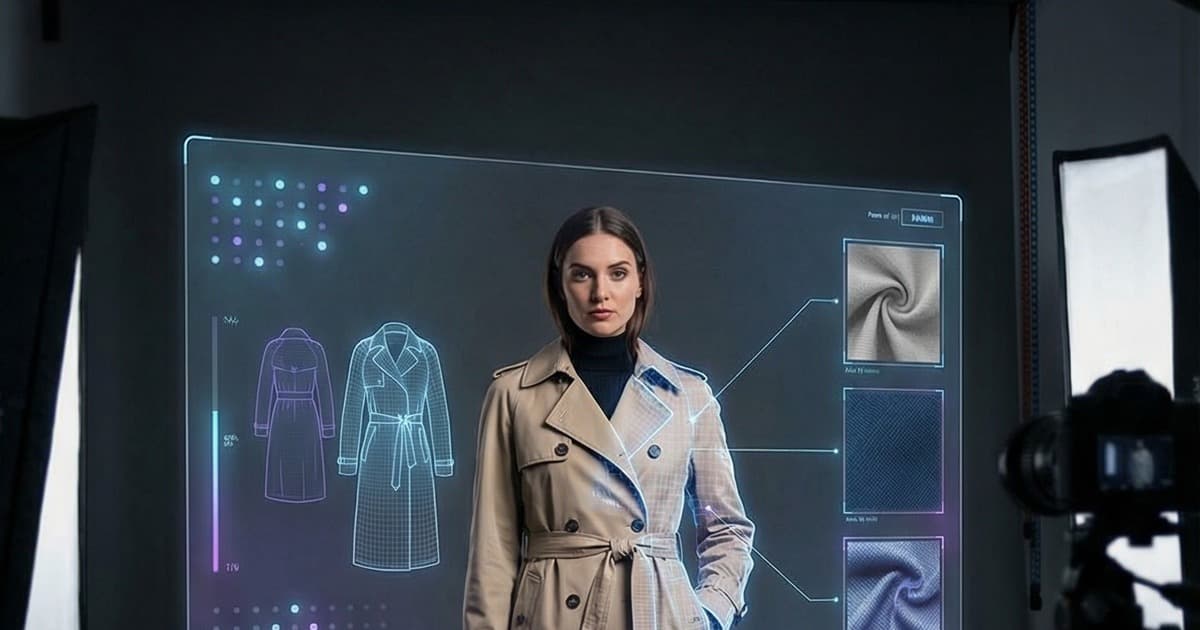
If you've ever dropped a product photo into a generic AI tool and watched it spit out a model wearing something that looks vaguely like your jacket - wrong drape, wrong texture, skin tone from a different planet - you already understand the problem.
Generic AI doesn't know your brand. It doesn't know how your fabrics fall. It doesn't know the light quality you shoot in, the body types you cater to, or the editorial mood your aesthetic lives in. It knows fashion in general, the way someone who learned about fashion from Wikipedia knows fashion.
That gap - between "AI that knows fashion" and "AI that knows your fashion" - is where everything breaks down at scale. And it's exactly the gap that brand-trained custom AI models are built to close.
What "Generic AI" Actually Means in a Fashion Context
When fashion brands start experimenting with AI-generated content, they almost always start with the same tools: Midjourney, Adobe Firefly, DALL-E, or one of the many consumer-facing image generators. These tools are powerful. They can produce gorgeous imagery. But they're trained on the internet - on everything - which means they've absorbed an enormous range of aesthetics, styles, body types, lighting conditions, and fabric behaviors.
That breadth is their strength for creative exploration. It's their fatal flaw for brand consistency.
Here's what goes wrong when a fashion brand uses a generic AI tool for product content:
Fit is wrong. Generic models have no idea how your size 8 blazer sits on the shoulder, how the hem breaks at the hip, or whether the collar is structured or soft. They make educated guesses. Those guesses are often wrong in ways that are immediately obvious to anyone who actually owns the garment.
Texture is invented. A 100% brushed cashmere sweater and a poly-blend lookalike are visually distinct to anyone who's handled fabric - but to a generic AI, they're both "sweater." The AI will render something that looks plausible on screen but doesn't represent the actual material quality you're selling. That matters because texture drives perceived value, and perceived value drives price anchoring.
Style codes drift. Every fashion brand has a visual language: the warmth temperature of their photography, how close the models stand to the camera, whether the background is lifestyle or studio white, what jewelry and accessories typically appear. Generic AI doesn't know any of this. It produces images that might be good, but they don't feel like you.
Models don't match your casting. Whether you sell to plus-size shoppers, mature women, athletic builds, or have committed to specific diversity standards in your imagery, a generic AI model will default to whatever body type dominated its training data. That's usually not your target customer.
The result: AI-generated content that requires so much post-production correction it's faster to just shoot the product conventionally. The efficiency gains evaporate.
The Custom AI Model Difference
A brand-trained AI model is trained - or fine-tuned - on your brand's own visual assets. Not the internet. Not every fashion brand that ever existed. Your catalog. Your studio. Your aesthetic.
This is sometimes called "fine-tuning," "LoRA training," or in more advanced implementations, full custom model training. The mechanics vary, but the principle is the same: you teach the AI what your brand looks and feels like, and the AI learns to produce content that stays inside those parameters.
Here's what changes when the model knows your brand:
1. Fabric and Material Accuracy
When you've trained on hundreds of product photos showing how your specific fabrics behave - how the silk charmeuse catches light, how the heavyweight denim holds structure, how the ribbed knit stretches - the AI builds a representation of those materials. Output images show fabric that actually looks like what you sell.
This isn't a minor cosmetic difference. For luxury and premium brands, material communication is everything. A customer buying a £400 cashmere piece is buying the texture, the weight, the drape. If your AI-generated imagery doesn't communicate that authentically, you're undermining the product before they even read the description.
2. Fit Consistency Across Your Line
Brand-trained models learn the silhouette signatures of your collections. The dropped shoulder on your outerwear line. The relaxed straight leg that defines your denim. The cropped cut that runs across your knitwear. This means AI-generated fit images stay consistent with how your clothes actually look - not just how clothes look in general.
For catalog generation at scale (more on that below), this consistency is critical. When a customer browses your full collection, they should see a coherent visual story. Generic AI fragments that story. Brand-trained AI maintains it.
3. On-Brand Model Casting and Styling
Advanced brand-trained systems can learn your preferred model aesthetics, styling conventions, and even your editorial poses. Want the model always in a three-quarter turn with hands relaxed? Want the hair pulled back to show off the neckline? The AI can learn these patterns and apply them consistently.
This goes beyond aesthetics into brand equity. Your casting choices communicate who your brand is for. If your AI-generated content shows different body types, ages, and style contexts than your brand normally does, you're sending mixed signals to customers.
How Brand-Trained AI Models Are Built
The training process varies depending on the depth of customization, but most modern approaches follow a similar path:
Step 1: Asset collection and curation The process starts with your existing catalog - typically hundreds to thousands of existing product shots, lifestyle images, and campaign visuals. The quality and diversity of this dataset shapes what the model can produce.
Step 2: Tagging and annotation Each image is labeled with information: product category, fabric type, color, styling details, model characteristics, lighting setup. This labeling teaches the AI what to associate with what.
Step 3: Fine-tuning or custom training Using techniques like LoRA (Low-Rank Adaptation) or full fine-tuning, the base model (which might be built on Flux, Stable Diffusion, or a proprietary architecture) is trained on your branded dataset. The model learns to weight your brand's visual characteristics.
Step 4: Evaluation and correction Generated outputs are reviewed against brand standards. Edge cases - unusual colorways, complex layered looks, accessories - are identified and the training is refined.
Step 5: Integration into production workflow The trained model is plugged into your content production pipeline, where it generates images and videos on demand, with your brand parameters baked in.
For video content specifically - which requires temporal consistency across frames, not just single-image accuracy - training complexity increases. This is why purpose-built AI video studio fashion platforms exist: the infrastructure to train and serve video models at brand-consistent quality is significant, and few brands have the engineering resources to build it in-house.
The Real-World Results: What Brand-Trained AI Actually Delivers
Let's get concrete about what this capability unlocks for fashion brands.
Full Catalog Coverage Without Full Catalog Shoots
The average fashion brand shoots a small fraction of its catalog in lifestyle or on-model conditions. The rest sits as flat-lay product photos or simple pack shots - functional, but not emotionally compelling.
With a brand-trained AI model, you can take every SKU in your catalog and generate on-model imagery that matches your brand aesthetic. A product line of 300 SKUs that would take weeks and significant budget to shoot conventionally can be fully covered in days. The visual quality and brand consistency are maintained across all 300 items.
This has direct conversion rate implications. On-model imagery consistently outperforms flat-lay for purchase intent. If your brand has been unable to afford on-model imagery for everything, a brand-trained AI essentially removes that constraint.
Consistent Video Content for Every Product
The demand for video content - across TikTok, Instagram Reels, product pages, paid social - has outpaced what most fashion brands can produce with conventional video shoots. A single brand-trained ai fashion video generator changes this equation entirely.
Feed in a product, a prompt describing the use case ("model walking into a café in autumn light"), and the system generates a short video clip that looks like it came from your studio. The model's movement, the fabric behavior, the aesthetic - all consistent with your brand. Generate dozens of variations for A/B testing. Generate seasonal content without scheduling a new shoot.
This isn't theoretical. AI-generated video ads for ecommerce are already delivering performance results for brands that have made the switch. The constraint has always been brand consistency, not technical capability. Custom models solve the consistency problem.
Rapid Response to Trends and Seasons
Fashion moves fast. Generic AI tools can technically respond to trends, but they'll style your brand's products in whatever the AI thinks is trending - which may clash with your aesthetic or your customer base.
A brand-trained model lets you respond quickly within your brand's visual language. Launching a holiday gift guide? Generate campaign imagery overnight. Seasonal transition content? Done in hours. New colorway landing page assets? On demand.
The competitive advantage here is real: brands that can execute visually at trend speed, without sacrificing brand consistency, have a structural edge in performance marketing.
Generic vs. Brand-Trained AI: The Side-by-Side
| Dimension | Generic AI | Brand-Trained AI |
|---|---|---|
| Fabric accuracy | Approximate | Precise to your materials |
| Fit representation | Generic silhouette | Your specific cut/construction |
| Visual brand voice | Inconsistent | Baked into model |
| Casting consistency | Default bias | Your demographic |
| Styling conventions | Generic fashion | Your editorial codes |
| Video capability | Basic | Brand-consistent motion |
| Time-to-publish | Fast but needs correction | Fast and accurate |
| Catalog scale | Limited by corrections | Unlimited coverage |
The pattern is clear: generic AI tools are fast but inaccurate. Brand-trained models are equally fast but accurate because they know your brand.
Why Most Brands Don't Have This Yet - and What's Changing
Until recently, custom AI model training required significant ML engineering resources, substantial compute budgets, and a dataset preparation process that was time-consuming even with technical help. This put brand-trained AI firmly in the "enterprise only" category - accessible to brands with internal AI teams or seven-figure technology budgets.
That's changing rapidly.
Platforms built specifically for fashion content production are now handling the training infrastructure, dataset management, and model serving, offering brand-trained AI as a service rather than a capital project. For fashion brands that want the benefits of custom AI models without building a machine learning team, this is the path.
The economics are shifting too. When you factor in the cost of conventional photoshoots, video production, and creative agency fees versus AI-generated content at scale, the ROI calculation is increasingly clear. Brands producing hundreds of content pieces per month for paid social, organic, and owned channels simply can't afford to shoot everything conventionally. AI-generated product content becomes not just efficient, but necessary.
The Fashion-Specific AI Challenge: Why This Category Is Different
Fashion AI isn't just general product AI. It has unique complexity that generic models consistently underestimate:
Drape and physics. Fabric moves. It falls. It gathers. It compresses. Getting this right in video requires models that understand material behavior specifically, not just what a garment looks like in a static reference photo.
Color accuracy. Fashion purchasing is extremely color-sensitive. A customer who orders "sage green" and receives something closer to "olive" returns the product. AI models must reproduce exact colorways with precision, especially in video where lighting variation can shift perceived color.
Size representation. Fit varies by size, and accurate size representation matters enormously for conversion and returns. A brand-trained model that has seen your size range will represent garments more accurately across sizes than a generic model filling in gaps with assumptions.
Seasonal coherence. Fashion shoots have a seasonal feel - the quality of light, the locations, the styling choices. Brand-trained models absorb this seasonality from your historical campaigns and maintain it in generated content.
These are the reasons that AI fashion photoshoots work for some brands and fail for others: the ones that work have invested in customization. The ones that fail tried to shortcut that investment with generic tools.
Building Toward the Brand-Trained Future
If you're a fashion brand thinking about where to invest in AI, here's a practical framework:
Start with your visual archive. The quality of your training data determines the quality of your brand model. If your existing catalog imagery is inconsistent - different lighting setups, varying quality across seasons, mixed styling conventions - clean it up before training on it. Garbage in, garbage out.
Define your visual standards explicitly. Before training, articulate what "brand-consistent" actually means for your label. Lighting temperature. Preferred model types. Styling rules. Background treatment. The more explicit you are, the more precisely you can evaluate model outputs.
Think about video from the start. It's tempting to start with image generation, which is simpler, and treat video as a later phase. But the brands getting the most value from brand-trained AI are those that have invested in video from day one. Video performance on paid social alone typically justifies the investment.
Measure against brand standards, not just production speed. The right question isn't "how fast can we generate content?" - it's "how much of what we generate meets our brand standards without correction?" Generic AI might be fast but require heavy correction. Brand-trained AI should dramatically reduce correction time.
Ready to See What Brand-Trained AI Looks Like for Your Catalog?
If you're a fashion brand that's tired of generic AI tools that don't know your aesthetic - or you've been spending more time correcting AI output than you're saving - it's time to see what purpose-built, brand-trained AI actually looks like in production.
Tellos AI Video Studio is built specifically for ecommerce fashion brands. It handles product video generation, on-model imagery, and catalog-scale content production - trained to your brand, not to the internet.
Book a demo with Tellos and see your products in brand-consistent AI video. No generic outputs. No off-brand aesthetics. Just your products, your visual identity, at the scale your content calendar actually demands.
Related reading: