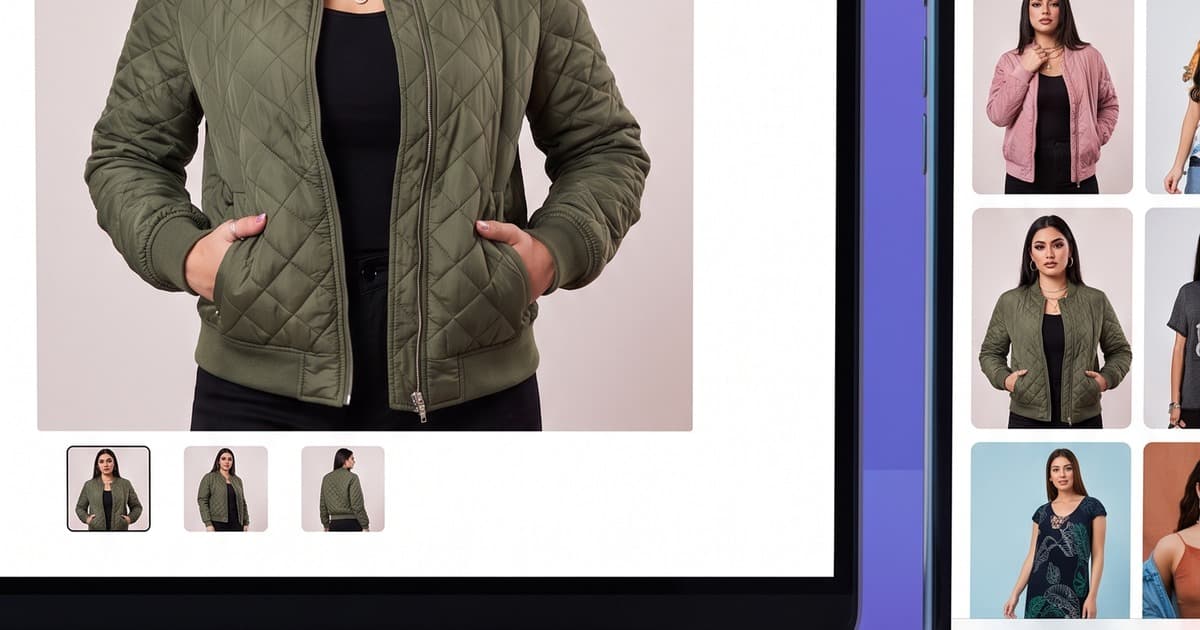
Virtual try-on has been the "holy grail" of fashion ecommerce for over a decade. The pitch is irresistible: let shoppers see themselves wearing your clothes before they buy. Returns drop. Confidence goes up. Everyone wins.
But in 2026, the reality is more nuanced. There are now two very different things being called "virtual try-on" — and they perform very differently in practice. One is genuinely changing how fashion brands sell online. The other is still mostly a marketing slide deck.
Let's break down exactly what's working, what isn't, and what fashion brands should actually be investing in.
The Two Types of Virtual Try-On
Before comparing anything, it helps to understand that "virtual try-on" now describes two fundamentally different technologies:
AR Try-On (Augmented Reality Fitting Rooms) The customer uses their phone camera or webcam to see themselves wearing the garment in real time. Snapchat pioneered this for accessories; brands like ASOS, Zara, and Warby Parker have experimented with it for clothing. The idea is that you hold your phone up, see yourself in the jacket, and buy with confidence.
AI-on-Model Imagery High-quality, photorealistic images of AI models wearing your actual products — generated from a flat-lay or product photo. No AR overlay. No camera required. Just professional, consistent on-model photography that shows the garment the way a lookbook would — except generated by AI in minutes, not a studio in days.
Both get called "virtual try-on" in industry coverage. They are not the same thing. And in 2026, their adoption trajectories look very different.
AR Try-On: The Promise vs the Reality
The idea behind AR try-on is compelling enough that major players have invested heavily in it. Snap's AR shopping lenses, Google Shopping's virtual try-on for apparel, Fit:Match's body-scanning tech — the category has attracted real capital.
So why is it still mostly absent from the average fashion Shopify store?
The Technical Barrier Is Still High
Building AR try-on into a fashion ecommerce experience isn't a plugin you add in an afternoon. It requires:
- 3D garment modeling for every SKU (not just a flat-lay — actual dimensional mesh data)
- Body tracking and physics simulation so the fabric moves and drapes realistically when the customer moves
- Device compatibility (it works well on flagship iPhones; it can be choppy or unavailable on lower-end Android devices)
- Integration with your commerce stack — and many Shopify themes aren't set up for it out of the box
For a brand with 50–200 SKUs updating seasonally, maintaining this infrastructure is a significant ongoing cost. You're not just generating it once.
The Accuracy Problem
Even when AR try-on works technically, it often doesn't work convincingly. Fabric simulation in AR still struggles with:
- Real drape and stretch — how a jersey knit falls differently than a structured blazer
- True colour rendering under different lighting environments
- Fit accuracy — seeing a garment "on you" via AR doesn't tell you whether it fits your specific measurements
The result? Most shoppers use it as a novelty, not a decision-making tool. Engagement metrics look good in press releases. Conversion lift is harder to prove.
Adoption Is Still Low
Despite the investment, a 2025 survey of Shopify fashion stores found fewer than 3% had implemented AR try-on at the product level. For independent brands, the number is effectively zero.
The brands that have deployed it at scale are almost exclusively in the luxury or accessory categories — sunglasses, watches, shoes — where the 3D geometry is simpler and the product doesn't have to contend with variable body shapes and fabric physics.
AI-on-Model Imagery: Why It's Winning
While AR has been struggling to cross the mainstream threshold, a different approach to the same underlying customer need has been quietly exploding.
AI-on-model imagery addresses the exact same question a shopper has when they pick up a garment — "how will this look on a body?" — without any of the AR technical overhead.
Instead of showing shoppers their own body in AR, it shows the garment on a realistic, professionally styled AI model. Think of it as the lookbook shot — except it's generated from your flat-lay photo in minutes, at scale, for every SKU in your catalogue.
What Shoppers Actually Want
The research here is clear: shoppers don't primarily want to see themselves in your clothes. They want to see:
- How the garment fits on a body — is it boxy or fitted? Where does the hem fall?
- How the fabric moves and drapes — does the dress flow, or does it look stiff?
- True colour in a real-world context — not a flat background, but how it looks styled
- Consistent comparison across styles — the same model in the same lighting so they can compare pieces
AR try-on answers question 1 (sort of). AI-on-model imagery answers all four.
This is why searches for AI-on-model photography and AI fashion imagery have grown faster than AR try-on searches over the past two years. The technology that solves the actual problem is winning.
Head-to-Head: AR Try-On vs AI-on-Model
| AR Try-On | AI-on-Model Imagery | |
|---|---|---|
| Setup cost | High (3D modeling per SKU) | Low (upload flat-lay or product photo) |
| Per-SKU cost | €50–200+ for 3D mesh | Cents per image |
| Technical complexity | High (SDK, 3D assets, device compat) | Low (no integration required) |
| Shopper device required | Camera-enabled smartphone | Any device |
| Turnaround | Weeks per collection | Hours for full catalogue |
| Visual quality | Variable (lighting, tracking errors) | Consistent, lookbook-quality |
| Works on Shopify | Complex plugin setup required | Standard image — works everywhere |
| Best for | Accessories, simple silhouettes | All garment categories |
| Returns impact | Limited data for apparel | Proven lift in return reduction |
The economics alone explain most of the adoption gap. For a 200-SKU fashion brand updating twice a year, AR try-on means producing and maintaining 400 3D models annually. AI-on-model imagery means uploading 400 flat-lays and receiving 400+ professional hero shots in a single working day.
The Size-Inclusive Advantage
One area where AI-on-model imagery dramatically outperforms AR: size representation.
In traditional photography, shooting every SKU on models across the full size range (XS–3XL) means booking multiple models, multiple shooting days, and a production budget that most brands can't justify. The result: most brands show one size on one model type and call it done.
With AI, generating on-model images across a full size range — different body types, heights, skin tones — is essentially free in terms of marginal cost. You upload one product photo; you generate images showing it on five different model profiles.
This matters for sales. Research into size-inclusive fashion photography consistently shows that customers buy more confidently — and return less often — when they see a garment on a body similar to their own. AR try-on theoretically enables this, but only if the customer's body is tracked accurately by the AR system, which is inconsistent in practice.
Conversion and Returns: What the Data Says
The core commercial question: does virtual try-on of either type actually reduce returns and lift conversion?
AR Try-On: The data is mixed and mostly from accessories. Warby Parker's virtual try-on for glasses has shown measurable engagement lift. For apparel, the results are much harder to attribute — most studies are self-reported by the vendors selling the technology, and control groups are rarely clean.
AI-on-Model Imagery: The data here is more consistent, because it's essentially a comparison between "no on-model images" and "professional on-model images" — a comparison the industry has data on going back years. On-model images outperform flat-lay only:
- +25–40% add-to-cart rate on PDPs with on-model hero images vs flat-lay only
- 15–25% reduction in return rate when shoppers can see fit, drape, and proportions
- Higher average order value when lookbook-quality images communicate product quality effectively
The advantage of AI is that these gains — previously only available to brands that could afford professional model photography — are now accessible to every brand at any scale.
What Happens When You Add Video
Here's where things get genuinely exciting in 2026: the on-model imagery advantage gets significantly bigger when you add short video clips.
A static on-model image shows fit and styling. A 3–5 second video clip shows how the fabric moves — the drape of a silk blouse when the model turns, the structure of a blazer when arms move, the flow of a maxi dress in motion.
This is where AR try-on was supposed to win (real-time movement), but in practice AI video is closing that gap rapidly. Using AI video generation models like Kling, Runway, and others, brands can now generate short on-model motion clips directly from product photos — no film shoot required.
Adding these video clips to PDPs lifts time on page and further reduces the "I'm not sure how it'll look" hesitation that drives returns. If you're already generating AI-on-model images, the workflow to add video clips for key hero SKUs is a natural next step.
You can read more about this in our piece on AI model videos on product pages.
Why AR Try-On Isn't Going Away (But Who It's For)
None of this is to say AR try-on is dead. It will continue to evolve and it does have genuine use cases:
Where AR try-on makes sense:
- Eyewear and accessories — sunglasses, hats, jewellery — where geometry is simpler and the try-on experience maps directly to how you wear the item
- Luxury fashion — where the engineering investment is a tiny fraction of product margins and the brand experience is a differentiator
- Footwear — AR try-on for shoes has matured faster than apparel because shoe geometry is more predictable
Where it doesn't:
- Mid-market and independent fashion brands with high-volume, multi-SKU catalogues
- Garments with complex fabric behaviour (knitwear, denim, structured tailoring)
- Brands on Shopify or similar platforms without dedicated engineering resources
For the vast majority of fashion ecommerce brands, the ROI calculation doesn't yet support the implementation cost.
The Practical Path Forward for Fashion Brands
If you're running a fashion brand in 2026 and you want to solve the same problem AR try-on promises to solve — giving shoppers the confidence to buy — here's what actually works:
Step 1: Replace flat-lay-only hero images with AI on-model shots
This is the highest-leverage change you can make to your PDPs. If shoppers currently see a flat-lay or ghost mannequin on your product pages, switching to on-model images (even AI-generated ones) will lift conversion. Full stop.
Step 2: Generate for your full SKU range, including all colour variants
The scale advantage of AI is that you don't have to choose which products get the "good" photography. Every SKU, every colourway, gets on-model imagery. Shooting all colour variants is one of the biggest hidden costs in traditional photography — AI eliminates it.
Step 3: Add model diversity for key categories
For your best-performing SKUs, generate images across multiple model body types. The data on this is clear — broader representation drives higher conversion across your customer base, not just for shoppers outside a narrow size range.
Step 4: Layer in video for hero products
For your 20–30 top-converting or featured products, add short on-model video clips to PDPs. This brings you as close to the AR try-on experience as most shoppers actually need — without any of the AR overhead.
Step 5: Repurpose across channels
Your AI-generated on-model images don't just live on PDPs. The same assets fuel your Instagram content, your email campaigns, your Meta ads, and your wholesale buyer presentations. One AI shoot session generates content for your entire marketing stack.
The Barrier AR Try-On Hasn't Solved
There's a deeper reason AI-on-model imagery is winning: it meets shoppers where they already are.
Shoppers don't need to install anything, grant camera access, or wave their phone at themselves in a mirror. They scroll through a product page. They see a great photo of the garment on a model that looks like someone they can relate to. They understand how it fits. They buy.
The AR paradigm requires behavioral change. It requires shoppers to learn a new interaction pattern in the middle of their shopping flow. Adoption data consistently shows that even when AR try-on is available, the majority of shoppers don't use it — they just look at the product images.
Which means the quality of those product images matters more than ever.
Tellos: AI-on-Model Photography at Scale
This is exactly the problem Tellos is built to solve. Upload your product images — flat-lays, ghost mannequin shots, or even just product photos on a hanger — and Tellos generates professional, lookbook-quality on-model photography for your entire catalogue.
No studio booking. No model casting. No waiting weeks for edits. Your catalogue goes from flat-lay only to full on-model in hours.
The result is a PDP visual stack that answers every question a shopper has about how your clothes look on a body — without AR, without a camera, without any friction in the buying journey.
Ready to see what AI-on-model images look like for your products?
Explore Tellos AI Photo Studio →