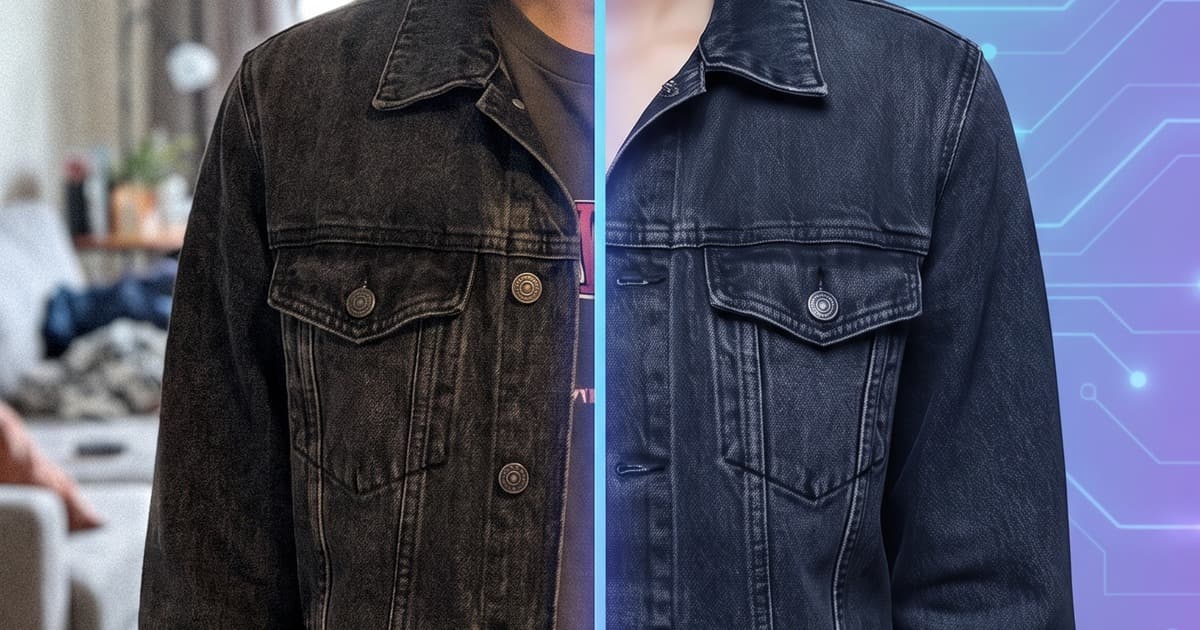
UGC builds trust. AI photography builds scale. The brands that figure out where each one belongs — and stop treating them as competitors — are winning in 2026.
If you're debating whether to invest in user-generated content or AI-generated product photography, you're asking the wrong question. The real question is: which type of content belongs on which channel, and why?
This post breaks it down channel by channel, with a practical framework for layering both into a content strategy that actually converts.
What We're Actually Comparing
Before getting into channels, let's define terms properly.
User-Generated Content (UGC) — content created by real customers, creators, or brand advocates showing products in use. It looks raw, authentic, and lived-in. It could be a customer's Instagram Story wearing your hoodie, a TikTok creator unboxing your dress, or a simple review photo from someone who just received their order.
AI Product Photography — professionally generated images created by AI systems that place your garment on a photorealistic virtual model, in controlled lighting, against chosen backgrounds. It's polished, consistent, and scalable. Think: the hero image on your PDP, the hero shot in your email, the grid image on your brand Instagram.
These are fundamentally different tools with fundamentally different strengths.
| UGC | AI Product Photography | |
|---|---|---|
| Feel | Raw, authentic, human | Polished, professional, controlled |
| Trust signal | Social proof from real people | Brand credibility and quality |
| Scalability | Limited by supply of creators/customers | Unlimited — generate for every SKU |
| Consistency | Variable | Guaranteed |
| Cost | Low-moderate per asset | Low at scale |
| Production control | Low | High |
| Best for | Discovery, top-of-funnel, social proof | Conversion, catalog, brand image |
Why This Question Has Become So Urgent
Two years ago, most fashion brands treated UGC as a nice-to-have — something you reposted when customers tagged you. AI-generated imagery was exotic and expensive. Neither was a strategic pillar.
That's changed.
UGC has exploded because platforms algorithmically reward it. TikTok and Instagram Reels actively boost content that looks real and person-made. Performance marketers discovered that UGC-style creatives outperform polished ads by 2–4x on Meta. A whole industry of "UGC creators" now exists — people paid to make content that looks organic.
AI product photography has matured dramatically. What once required expensive enterprise contracts or inconsistent image quality is now fast, affordable, and reliably professional. Brands can generate on-model images for an entire catalog in hours, maintain visual consistency across hundreds of SKUs, and produce content their in-house team simply couldn't create on any reasonable budget.
Both are now viable at scale. Which is why the question of where to use each has never been more important.
Channel-by-Channel Breakdown
TikTok and Short-Form Video: UGC Wins Here
TikTok's algorithm is finely tuned to detect and deprioritize content that looks too produced. The platform rewards authenticity — natural lighting, handheld camera movement, casual speech, real reactions.
AI-generated product photography — even excellent AI photography — doesn't translate naturally to TikTok's native format. A polished on-model image dropped into a TikTok slideshow performs measurably worse than a real person talking about the same garment on camera.
What works on TikTok:
- Customers showing unboxing and first reactions
- Creators giving honest "honest review" style content
- Try-ons in real environments (bedrooms, parks, cities)
- Behind-the-scenes of how the product looks and moves IRL
The exception: AI video of garments moving can work in specific TikTok formats — particularly for product demo ads. But the content framing still needs to feel authentic. (See Fashion Video Content at Scale for more on AI video formats.)
Verdict: On TikTok, UGC wins. Prioritize real creator content and customer video over AI imagery.
Product Detail Pages (PDPs): AI Photography Wins Here
This is where the comparison flips completely.
Your PDP is where buying decisions happen. Shoppers on a product page are evaluating fit, quality, and styling — and they need the most informative, professional image possible. A UGC photo of someone wearing your jacket on the street tells them something, but it doesn't tell them what they need to know: how will this look on me, in good light, with accurate color?
AI on-model photography is purpose-built for PDPs:
- Consistent lighting so color renders accurately
- Controlled backgrounds so the product is the focus
- Professional model positioning that shows fit and drape
- Multiple angles generated from a single source image
- Consistency across your entire catalog so the store looks cohesive
The data backs this up. Brands that add AI on-model images to previously flat-lay-only PDPs consistently report meaningful lifts in add-to-cart rate. Shoppers need to visualize fit — and AI model images are the most scalable way to provide that.
What UGC adds on PDPs: Customer review photos and video testimonials in the review section can complement professional hero images. A carousel of real customer photos below the fold builds social proof after you've established the product's quality. But the hero images and product gallery should always be professional.
Verdict: AI photography wins on PDPs. Use UGC in the reviews/social proof section to complement, not replace, professional imagery.
Instagram Feed and Brand Aesthetic: Depends on Brand Tier
Instagram is more nuanced because it serves multiple purposes: brand building, discovery, and sales. What works depends on where your brand sits in the market.
Luxury and premium fashion brands — your Instagram is a brand magazine. It needs editorial-quality imagery, consistent aesthetics, and visual coherence. AI-generated lookbook photography is ideal here. You can maintain a consistent editorial look across every post, every season, without the cost of continuous photo production. Related: Fashion Photography for Instagram.
Mid-market and trend-focused brands — Instagram is a mix of editorial and relatable. A blend of AI-generated catalog-quality posts and UGC-style content from creators performs well. The AI posts establish brand positioning; the creator content drives discovery and relatability.
DTC and community-driven brands — your audience wants to see real people. Heavy UGC and creator content signals that your brand has community. AI photography can play a supporting role (for product launches, new arrivals), but authenticity is your differentiator.
Verdict: Know your brand tier. Premium brands lean AI; community-driven brands lean UGC; most sit in a hybrid.
Meta Ads: You Need Both
This is where the most sophisticated brands are building genuine competitive advantage — and the answer is definitively: both, tested systematically.
Meta advertising performance lives or dies by creative. Most brands fail at creative testing because they can't generate enough assets. They run one or two ad creatives, hit creative fatigue after a few weeks, and wonder why ROAS drops.
AI photography solves the volume problem. You can generate 20 hero image variations of the same product — different models, different backgrounds, different poses — and test them all simultaneously. The Meta algorithm finds your winner fast, and you're ready with the next rotation before fatigue sets in.
UGC creatives solve the trust problem. For cold audiences and top-of-funnel, UGC-style ads consistently outperform polished imagery because they're harder to scroll past. They look like organic content, not ads.
The winning Meta creative strategy:
- Use AI-generated product images for retargeting campaigns (where the audience already knows you)
- Use UGC creator content for cold audience prospecting (TikTok-style authenticity breaks through)
- Use AI imagery for collection-launch announcements and product catalog ads
- Use UGC for testimonial-driven DR formats
The brands generating the best Meta ROAS are running both pools simultaneously and letting the algorithm allocate budget to what's working.
Related: Meta Ads for Fashion: AI Creative Testing
Verdict: Both are essential. AI solves the volume/variant testing problem; UGC solves the trust/cold-audience problem.
Email Marketing: AI Photography Wins
Email marketing is where your audience is warmest and most likely to buy. They're already subscribed; they chose to receive your messages. This is not a discovery channel — it's a conversion channel.
Here, professional visual quality matters. The hero image in your email sets the tone for the entire campaign. A polished AI-generated lookbook image of your new arrival communicates quality, drives desire, and links cleanly to the product page.
UGC in email can work in specific formats:
- Customer spotlight emails ("See how Sarah styles our new collection")
- Review-highlight emails with customer photos
- "How our customers wear it" editorial content
But for standard campaign emails, promotional emails, and new arrival announcements — AI photography produces significantly better visual quality and brand consistency than UGC can reliably deliver.
Verdict: AI photography for campaign emails; UGC works in specific customer-spotlight formats.
Pinterest: AI Photography Wins Clearly
Pinterest is fashion's highest-intent discovery platform. People are actively planning purchases, saving outfits, curating wardrobes. The platform's best-performing fashion content is editorial, styled, and aspirational — exactly what AI lookbook photography produces.
The raw, authentic feel of UGC tends to underperform Pinterest's native aesthetic. Users on Pinterest are building aspiration boards, not watching reviews.
AI-generated lookbook imagery maps directly to what Pinterest's algorithm rewards: vertical, editorial, visually cohesive, styled scenes. You can create hundreds of Pin-ready images from a single AI photo session, scheduled out across weeks.
Related: Fashion Photography for Pinterest
Verdict: AI photography dominates Pinterest.
The Hybrid Strategy: How to Layer Both
The smartest fashion brands don't choose — they allocate strategically. Here's a practical framework:
The Content Stack
Foundation layer (AI Photography):
- All PDP hero images and gallery images
- Catalog and lookbook production
- Email campaign hero visuals
- Pinterest content
- Instagram brand feed posts
- Variant photography (every colorway, every size)
Activation layer (UGC & Creator Content):
- TikTok and Reels content
- Meta cold-audience prospecting ads
- Instagram Stories and Reels
- Review imagery on PDPs
- Customer spotlight emails
Performance layer (Tested Systematically):
- Meta retargeting: AI imagery wins
- Meta prospecting: UGC wins
- Always test both and let data decide
The Production Workflow
- Product arrives → Generate full AI photo set immediately (hero, variants, lifestyle)
- Send product to 2-3 UGC creators → They produce TikTok and creator content within 1-2 weeks
- AI images go live immediately on PDP, email, Pinterest, brand Instagram
- Creator content feeds TikTok, Reels, Meta prospecting
- Both content types rotate into Meta ads, tested against each other
This workflow means you're never waiting. Your PDP is live with professional imagery on day one. Creator content flows in over the following weeks to fuel social and ads. No channel is starved for content.
The Trust Question
The most common objection to AI photography from brand teams: "But doesn't it feel less authentic? Won't customers notice?"
This is worth addressing directly.
Shoppers don't distrust AI-generated product images. What shoppers distrust is inaccurate product representation — images that misrepresent color, fit, or quality. A well-generated AI model image that accurately shows how a garment fits is far more trustworthy than a blurry UGC photo that leaves the fit unclear.
The authenticity currency is not about who took the photo — it's about whether the photo gives you the information you need to buy confidently.
Where authenticity matters most: Reviews, social proof, community content. This is where real customer photos and creator content build the trust layer on top of the product information your AI imagery provides.
Think of it as: AI imagery builds desire and delivers information. UGC builds community and delivers social proof. Both contribute to trust — just at different points in the funnel.
Where Brands Go Wrong
Mistake 1: Using UGC as PDP hero images. Customer photos are great in reviews. They are not great as product page heroes — inconsistent lighting, unclear fit, variable quality all hurt conversion.
Mistake 2: Thinking AI photography can replace TikTok-style content. It can't and shouldn't. The platforms are different. The audience expectations are different.
Mistake 3: Not testing both in Meta ads. Brands that only run one type of creative leave significant ROAS on the table.
Mistake 4: Waiting for UGC before launching. You don't have to wait. Launch with AI photography immediately. Let UGC layer in over time as customers and creators engage.
Mistake 5: Inconsistent AI imagery. If your AI product images vary in quality, lighting, or model aesthetics, you lose the primary advantage. Consistency across your catalog is the point. Platforms like Tellos handle this at scale.
2026 Context: The Landscape Has Shifted
A few years ago, the UGC-vs-professional photography debate was clear: big brands had professional photography, small brands made do with UGC. That's no longer the case.
AI photography has democratized professional-quality visual content. A brand with 200 SKUs can generate a full, polished, consistent catalog in an afternoon — something that would have required weeks of studio time in the past. This changes the calculus for every tier of fashion brand.
At the same time, UGC has evolved from an organic phenomenon into an intentional content category with its own creator economy, its own ad formats, and its own performance benchmarks. It's not a substitute for professional content; it's a distinct content type with distinct performance characteristics.
The brands winning in 2026 are those that understand both clearly — and build systems to produce both efficiently.
Using Tellos as the AI Layer in Your Content Strategy
Tellos is built to be the AI photography and video layer in this kind of hybrid strategy. You bring the products; Tellos handles the on-model imagery, variant generation, and video content at catalog scale.
What this means practically:
- Upload your flat-lays or product images → get PDP-ready AI model shots
- Generate across all color variants automatically
- Produce short video clips showing movement, for Meta and PDPs
- Maintain consistent model, lighting, and background across your entire catalog
While your UGC creators are producing TikTok content and creator reviews over the following days and weeks, your professional visual library is live and working from day one.
Start generating catalog-quality AI product images with Tellos →
The question isn't UGC or AI photography. It's knowing exactly where each one belongs — and having the infrastructure to produce both without choosing between them.