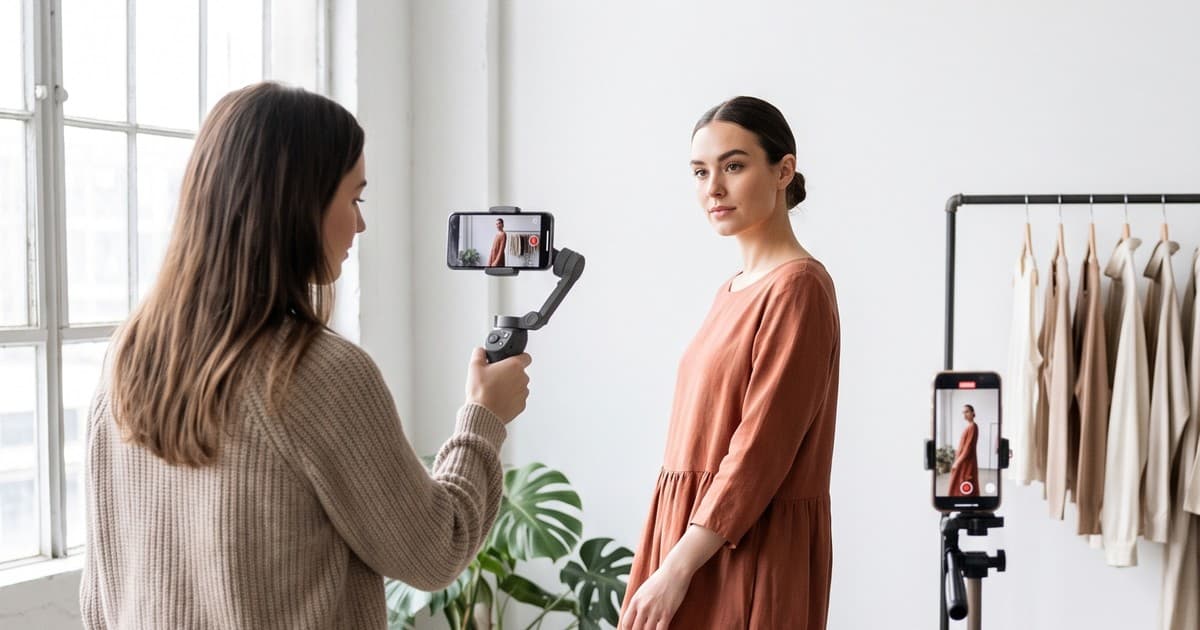
Instagram stopped letting shoppers check out inside the app in 2025. TikTok Shop went the other way and doubled down on in-app checkout, with industry estimates putting its 2026 global GMV above $100 billion. Those two decisions changed what "social commerce" means for a fashion brand, and they changed what kind of video you need on each platform.
If you run ecommerce or growth for an apparel brand, you have probably asked the same question most operators ask: should we put our video budget into TikTok Shop, Instagram, or both? The honest answer is "both, but not with the same content and not for the same job." This post breaks down how each platform actually sells, which video formats perform where, and how AI fashion video lets a small team feed both channels without doubling production costs.
The Core Difference: Where the Sale Happens
Before comparing formats and algorithms, get clear on the one structural difference that drives everything else.
TikTok Shop: the sale happens inside the app
On TikTok Shop, a shopper watches a video, taps the product card, and buys without leaving TikTok. Payment, order tracking, and returns all run through the platform. That means:
- The video is the product page. For many buyers, your 20-second clip is the only thing they see before paying.
- Creators drive most of the volume. Industry reports estimate that affiliate creators account for roughly 60-70% of US TikTok Shop GMV, and a similar share in Europe.
- Speed and volume matter more than polish. The feed rewards fresh content, and products that stop getting new videos stop getting traffic.
Instagram Shop: discovery in the app, checkout on your site
Meta moved Facebook and Instagram Shops to website checkout during 2025. Product tags, the Shop tab, collections, and shoppable Reels still work, but when a shopper taps "buy," they land on your own store. That means:
- Instagram is a discovery and intent channel. The Reel creates desire. Your product detail page (PDP) closes the sale.
- Brand consistency matters more. The shopper sees your feed, your profile, and then your site. Any mismatch in look or quality leaks trust.
- You own the checkout. Email capture, upsells, loyalty, and post-purchase flows all happen on your turf.
| TikTok Shop | Instagram Shop | |
|---|---|---|
| Where checkout happens | Inside TikTok | On your website |
| Main traffic driver | Affiliate creators + For You feed | Reels, Explore, ads, your profile |
| Role of the video | Acts as the product page | Creates intent, hands off to PDP |
| Content lifespan | Days | Weeks to months (feed + profile) |
| Look that wins | Native, fast, "real person" | Editorial, cohesive, on-brand |
| Who owns the customer data | Mostly TikTok | Mostly you |
This single difference, in-app checkout vs website handoff, is why the same video often performs very differently on the two platforms.
What Performs on TikTok Shop
TikTok Shop is a volume game. The algorithm tests every new video with a small audience, and only the ones that hold attention get pushed further. For fashion, that creates a few clear patterns.
1. Fit and movement in the first two seconds
TikTok viewers decide almost instantly. Videos that open with the garment on a body, in motion outperform videos that open on a hanger, a logo, or a flat-lay. Show the drape, the stretch, the way a skirt moves when someone turns.
2. One product, one clear reason to buy
The best-performing Shop videos focus on a single SKU and a single hook:
- "The only wide-leg jean that doesn't drag on the floor at 5'2"."
- "This dress in three sizes on three body types."
- "Linen shirt that doesn't wrinkle after a full workday."
Multi-product lookbooks tend to do better on Instagram. TikTok Shop wants one product card, one tap.
3. Size and body-type coverage
Fashion has high return rates on TikTok Shop, and shoppers know it. Videos that show the same item on multiple sizes and body types answer the "will it fit me?" question before it becomes a return. This is where AI fashion video is especially useful. Generating the same garment on several model types is cheap and fast, while booking several models for a real shoot is neither.
4. Many variations, not one perfect video
Because each video gets a fresh test, the winning approach is to publish many variations of the same product: different models, backgrounds, hooks, and pacing. A brand that posts 30 videos for a hero SKU gives the algorithm 30 chances to find a winner. A brand that posts one polished video gives it one.
5. Fuel for affiliates
Most TikTok Shop fashion sales come from creators, not brand accounts. Creators need raw material: clean on-model clips, detail shots, and different colorways they can remix, voice over, or react to. Brands that give affiliates a ready library of assets get more posts, faster. We covered how to build that volume in TikTok Shop Video Content: How Fashion Brands Create Enough Videos to Sell.
What Performs on Instagram Shop
Instagram rewards a different set of qualities. The shopper often sees your content several times, visits your profile, and then leaves for your site. The job of your video is to build enough desire and trust that the shopper makes that jump.
1. Editorial quality and a cohesive look
On Instagram, your feed is your storefront window. Reels that look like they belong to the same campaign, with consistent lighting, models, and art direction, make your brand feel established. Random, mismatched clips make it feel like a dropshipper. If you want more on this, see Consistent Fashion Photography at Scale: How AI Keeps Your Catalog Cohesive.
2. Outfits and styling stories
Instagram shoppers respond to looks, not just items. A Reel that styles a blazer three ways, or builds a full weekend outfit, gives you multiple product tags in one video and raises average order value on your site.
3. Carousels and Reels working together
On Instagram, video and stills support each other. A strong pattern:
- A 10-15 second Reel shows the look in motion and drives reach.
- A carousel of on-model stills shows the details and gets saved.
- Stories with product stickers catch followers who are close to buying.
All three point to the same PDP, and all three need to look like they came from the same shoot.
4. The PDP handoff has to match
Since checkout moved to your website, the Reel is only half the job. If a shopper taps a tag on a beautiful editorial Reel and lands on a PDP with a single flat-lay photo, you lose them. The fix is to put the same model video on the PDP. We cover why in AI Model Videos on Product Pages: Why Fashion Brands Are Adding Motion to Every PDP.
5. Paid Reels and Stories
Instagram remains a strong paid channel for fashion. Meta's ad system can find buyers well when it has enough creative variations to test. Here, the need looks a lot like TikTok: many versions of the same product, in 9:16, with different hooks. For format tips, read AI Video Ads for Fashion: Create Scroll-Stopping Reels and Stories Without a Production Team.
Head-to-Head: Which Platform Wins for Which Goal?
There is no single winner. The right channel depends on what you are trying to do this quarter.
| Goal | Better fit | Why |
|---|---|---|
| Fast sales on a hero SKU | TikTok Shop | In-app checkout removes friction |
| Launch a new collection | Editorial storytelling, full looks | |
| Build email and SMS list | Checkout and capture on your site | |
| Clear seasonal inventory | TikTok Shop | Volume + creator affiliates |
| Raise average order value | Multi-product tags, styled looks | |
| Reach new, younger buyers | TikTok Shop | For You feed, low follower needs |
| Protect premium positioning | Cohesive, curated feed | |
| Test many product hooks cheaply | Both | Algorithms reward variation |
When TikTok Shop should lead
- Your price point is under roughly $80 and impulse buying is realistic.
- You have a few hero SKUs that are easy to show in one clip.
- You can offer affiliate commissions that creators find worth their time (fashion commissions commonly sit in the 10-25% range).
- You can handle fulfillment and returns through TikTok's rules.
When Instagram should lead
- Your brand depends on premium or editorial positioning.
- Your products sell as outfits or collections, not single items.
- You care about owning the customer relationship and lifetime value.
- Your Shopify store already converts well and just needs more qualified traffic.
When to run both
Most growing fashion brands end up on both platforms. The mistake is posting the same video to both and expecting the same result. A polished editorial Reel can feel like an ad on TikTok and get skipped. A shaky, fast, creator-style clip can look cheap in your Instagram grid. The winning approach is one source, two edits.
One Source, Two Edits: A Practical Workflow
Here is how a lean team can feed both platforms from a single production step.
Step 1: Start from the product, not the platform
Begin with what you already have: flat-lays, ghost mannequin shots, or basic packshots of each SKU. With an AI fashion video platform, those become the input for on-model photos and videos. No studio, no model booking, no reshoot for each colorway. If this workflow is new to you, see From Flat-Lay to Full Lookbook: How AI Transforms Product Photos into Editorial Content.
Step 2: Generate a base set per SKU
For each product, create a base library:
- 3-5 on-model videos in 9:16 with different models or body types
- 4-6 on-model stills for carousels and the PDP
- 1-2 detail clips showing fabric, stitching, or closures
- Colorway versions of your best video
Step 3: Cut the TikTok Shop edit
From the base set, build TikTok-first versions:
- Hook in the first second: motion, fit, or a size comparison
- Short: 8-20 seconds
- Native feel: simple backgrounds, text on screen for the one key benefit
- Many variants: swap models, hooks, and background per version
- Affiliate pack: share clean clips without text so creators can add their own voice
Step 4: Cut the Instagram edit
From the same base set, build Instagram-first versions:
- Consistent art direction: same model set and background style across the collection
- Styled looks: combine products into outfits and tag each one
- Pair with stills: publish a carousel alongside each Reel
- Match the PDP: put the same video and stills on the product page shoppers land on
Step 5: Measure each platform on its own terms
Do not compare TikTok and Instagram with the same metric. Use:
| Platform | Primary metric | Secondary metrics |
|---|---|---|
| TikTok Shop | GMV per video, product card click rate | 2-second hold rate, affiliate posts per SKU |
| Tag taps to site sessions, site conversion rate | Saves, profile visits, email signups | |
| Paid (both) | Cost per purchase, ROAS | Thumb-stop rate, creative fatigue speed |
Then feed the winners back into production. If a certain model type or background wins on TikTok, test it on Instagram paid. If a styled look gets saves on Instagram, turn the hero item into a single-SKU TikTok Shop clip.
Where AI Fashion Video Fits
The biggest constraint on both platforms is the same: content volume. TikTok Shop wants dozens of videos per hero product. Instagram wants a cohesive, editorial look across every drop. Paid social on both wants constant fresh creative to beat ad fatigue. Traditional photoshoots cannot keep up with that pace at a reasonable cost, and phone-shot content rarely meets the Instagram quality bar.
AI fashion video changes the math:
- Speed: go from product photo to on-model video in minutes, not weeks.
- Variation: generate the same garment on different models, sizes, and backgrounds without extra shoot days.
- Consistency: keep the same model set and look across a whole collection for Instagram.
- Coverage: create videos for long-tail SKUs that would never justify a real shoot.
- Cost per asset: spread production across hundreds of outputs instead of a handful.
It is worth being clear about how the technology stack works. General video models such as Sora, Kling, and Runway are impressive underlying technology. On their own, they are not built for keeping a specific garment accurate across dozens of outputs, matching your brand's model set, or exporting ready-to-post assets for each channel. Tellos is the production layer on top: it takes your product images, keeps the garment true to the real item, and produces on-model photos and videos formatted for PDPs, TikTok Shop, and Instagram. For more on running this at volume, read Fashion Video Content at Scale: How AI Lets Brands Produce Hundreds of Videos Per Month.
A note on accuracy and returns
On TikTok Shop especially, a video that makes a garment look better than it is will sell once and come back as a return. Whatever tool you use, check that color, length, fit, and fabric texture match the real product. Accurate AI visuals are not just a compliance issue. They are how you keep the return rate on social commerce under control.
Common Mistakes to Avoid
- Cross-posting the same edit everywhere. Each platform has its own native look. Make two edits from one source.
- Treating Instagram like a checkout. It is not one anymore. Invest in the PDP that the tag lands on.
- Posting one polished video per SKU on TikTok. The algorithm needs volume and variation to find winners.
- Ignoring affiliates. On TikTok Shop, creators move most of the product. Give them assets they can use.
- Showing one body type only. Fit questions become returns. Show the product on several sizes.
- Measuring both platforms with one metric. TikTok is about GMV per video. Instagram is about site sessions and conversion.
Quick Decision Checklist
Use this before you plan next month's content:
- Which products are hero SKUs with a single clear hook? Put these on TikTok Shop first.
- Which products sell as looks or collections? Lead with Instagram Reels and carousels.
- Does every PDP have on-model video that matches your Instagram content?
- How many video variations per hero SKU can you publish this month? Aim for double digits.
- Do your affiliates have a clean asset library they can remix?
- Are you tracking each platform on its own primary metric?
If the answer to question 4 is "two or three," content volume is your bottleneck, not the platform choice.
The Bottom Line
TikTok Shop and Instagram Shop are no longer two versions of the same thing. TikTok Shop is a checkout powered by creators and volume. Instagram is a discovery engine that hands shoppers to your own site. Fashion brands that win in 2026 stop asking "which one?" and start asking "what does each one need from us?" The answer, in both cases, is more on-model video than a traditional production schedule can deliver, cut two different ways.
Ready to feed TikTok Shop and Instagram from a single product photo? Try the Tellos AI Video Studio and turn your catalog into on-model videos for every channel in minutes.