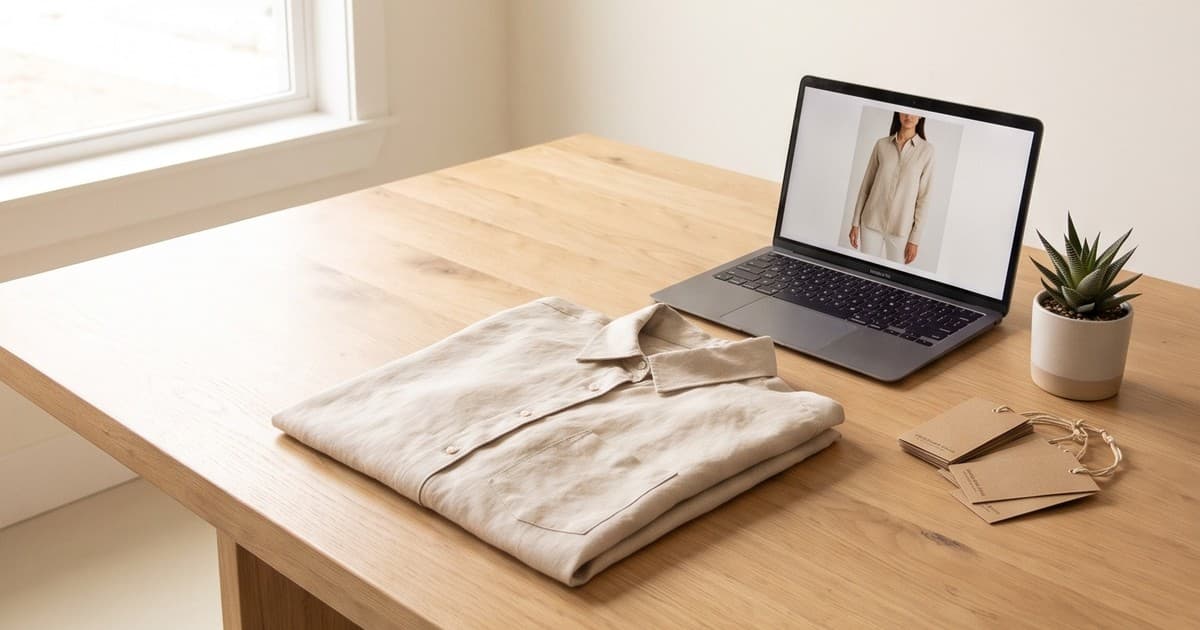
A single mid-size apparel collection can require three to five physical samples per style before a single product photo goes live: a fit sample, a pre-production sample, a photo sample for the studio, sometimes a second photo sample for a lifestyle shoot, and one more for the showroom or influencer seeding. Multiply that by 60 styles and a few colorways, and you are shipping, steaming, styling, and eventually discarding hundreds of garments that nobody ever buys.
That is the part of sustainable fashion marketing most brands never put on the impact report. The fabric is organic, the dye is low-impact, the packaging is recycled - and then the content engine quietly burns through samples, flights, courier trips, and studio days every season.
AI fashion content changes the math. When you can generate on-model photos and video from one garment or one flat-lay, the number of physical samples your marketing needs drops sharply. This post breaks down where sample waste actually comes from, what AI removes, what it does not, and how to talk about it honestly without greenwashing.
Where Sample Waste Actually Comes From
Most sustainability conversations in fashion focus on production volume and end-of-life textiles. Those are the big numbers. The US EPA estimated 17 million tons of textiles were generated in municipal waste in 2018, with about 11.3 million tons landfilled and a recycling rate under 15%. Samples are a small slice of that, but they are the slice your marketing team directly controls.
Here is where they pile up.
Photo samples that never get sold
Photo samples are often made before final production specs are locked. They can have slightly different trims, a pre-approved shade, or a size run that does not match inventory. After the shoot, many of them cannot be sold as first-quality stock. They get:
- Sent to a sample sale (best case)
- Donated with brand labels cut out
- Stored "just in case" and written off a year later
- Thrown out, which still happens more often than anyone admits
Duplicate samples for parallel shoots
If your ecommerce team, your paid social team, and your wholesale team all run separate shoots, each one often requests its own set of samples. Parallel shoots mean parallel samples, plus the courier trips between studio, office, and agency.
Colorway and size variants shot "for completeness"
A PDP with six colorways usually means six physical garments on set. Extended size ranges mean more again. If you want to show a dress on a size 6 and a size 18 model, you need both sizes made in time for the shoot, which is a real constraint we covered in our guide to AI fashion photography for plus-size and extended sizing brands.
Reshoots
A reshoot is a sustainability cost too. If a color reads wrong on camera, or a new channel needs a different aspect ratio, the samples come back out, the team travels again, and the studio lights go back on.
The Hidden Footprint of a Traditional Photoshoot
Samples are only one part of it. A typical on-location or studio shoot also carries:
| Shoot input | Typical footprint driver |
|---|---|
| Physical samples | Fabric, manufacturing, express shipping from factory |
| Crew travel | Flights or car trips for photographer, stylist, models, HMU |
| Location shoots | Vans, generators, permits, sometimes international travel |
| Studio time | Lighting rigs, climate control, steaming stations |
| Couriers | Samples moving between factory, office, studio, agency |
| Reshoots | All of the above, again |
None of these numbers show up on a garment's product-level carbon label. They sit in the marketing budget as "production costs." But if your brand makes public sustainability claims, the content supply chain is part of the story, and customers and journalists are getting better at asking about it.
There is also a regulatory angle. In the EU, the Ecodesign for Sustainable Products Regulation (ESPR) introduces a ban on destroying unsold apparel and footwear for large companies, with smaller companies following later. Photo samples that cannot be sold are exactly the kind of inventory that becomes awkward under rules like this. Fewer samples in the first place is the cleanest answer.
How AI Fashion Content Cuts Sample Waste
AI does not make your garments more sustainable. It makes the marketing around them far less wasteful. Here is how, step by step.
1. One garment, unlimited shots
With an AI production platform like Tellos, you start from a single product image: a flat-lay, a ghost mannequin shot, or even a factory photo of the finished piece. From that, you can generate:
- On-model PDP photos across multiple poses
- Short on-model product videos for PDPs and social
- Lifestyle scenes (beach, street, studio, interior) without a location shoot
- Different model looks for different markets
The garment only needs to exist once, and often it only needs to exist long enough to be photographed flat. You are not shipping it to a studio, styling it on three models, and sending it back.
2. Colorways without extra samples
If you have one physical sample and approved color references for the other five colorways, AI content workflows can produce consistent visuals across the full set. Instead of making six photo samples, you make one, plus the color data you already have from your supplier.
Operator tip: Always verify color accuracy against a physical swatch before publishing AI-generated colorway images. Wrong color is the fastest way to turn a sustainability win into a returns problem.
3. No parallel shoots
Because the source is a single image, the same asset can feed every team:
- Ecommerce gets clean PDP photos and on-model video
- Paid social gets vertical cuts for Reels, TikTok, and Stories
- Wholesale gets line-sheet visuals
- Email and CRM get seasonal lifestyle scenes
One garment, one upload, every channel. That removes the duplicate sample sets and the courier loop between teams. If you are building out video for social specifically, our post on AI video ads for fashion walks through the channel side.
4. Reshoots become regenerations
When a campaign needs a new background, a new aspect ratio, or a holiday refresh, you regenerate from the original source. No samples come out of storage, no crew travels, no studio time gets booked. The only thing that moves is data.
5. Pre-production marketing
This is the most underrated benefit. With AI content, brands can build marketing visuals from late-stage samples or even digital prototypes, then test demand before committing to full production volume. Testing demand before you cut fabric is one of the most direct ways to reduce overproduction, which is the biggest sustainability lever in the whole industry.
A Practical Before-and-After
Here is a simplified view of one 40-style seasonal drop at a mid-size DTC brand.
| Step | Traditional workflow | AI content workflow |
|---|---|---|
| Photo samples needed | 40 styles x 2-3 colorways on set | 40 styles, 1 sample each (or flat-lay only) |
| Shoots | Studio PDP shoot + lifestyle shoot + social shoot | One product capture session |
| Crew and travel | Photographer, stylist, 2-4 models, HMU, location van | Product photographer or in-house team |
| Colorway coverage | Physical sample per colorway | Generated from one sample plus color references |
| Reshoot for a new channel | Rebook studio, pull samples | Regenerate in minutes |
| Post-shoot samples | Many unsellable, stored or discarded | Fewer made, fewer to manage |
The exact numbers vary a lot by brand. But the direction is consistent: fewer garments made for content, fewer trips, fewer studio days. For a detailed cost comparison of the same shift, see our breakdown of fashion photo studio setup vs AI.
What AI Does Not Solve (Be Honest About This)
Sustainable fashion audiences are sharp. If you overclaim, they will notice. Here is what AI content does not fix:
- It does not change your garment's footprint. Fabric, dyeing, and manufacturing impacts stay exactly the same.
- It does not eliminate samples entirely. You still need fit samples and quality checks. Nobody should approve production from a render alone.
- It uses compute. AI generation runs on data centers that use energy. For most brands, that footprint is small compared to flights, location vans, and physical samples, but it is not zero, and you should not say it is.
- It does not replace fit accuracy. If your AI visuals show a garment fitting differently from reality, you trade sample waste for return waste, which is worse.
The honest framing is simple: AI content reduces the waste your marketing creates. It is one lever, not a sustainability strategy on its own.
How to Talk About It Without Greenwashing
Regulators are paying attention to green claims. The EU has moved to tighten rules on vague environmental claims, and the UK's CMA and the US FTC Green Guides both push brands toward specific, provable statements. That applies to your content workflow claims too.
Claims that hold up
- "We reduced photo samples for our spring collection from roughly 120 to 40 by using AI-generated on-model imagery."
- "Our spring campaign was produced without a location shoot or crew travel."
- "Colorway images are generated from one physical sample to reduce sample production."
Claims to avoid
- "Our AI photos are carbon neutral."
- "Zero-waste marketing."
- "AI makes our products sustainable."
Specific, measured, and scoped claims build trust. Vague ones invite scrutiny. Keep a simple log each season: samples made, samples used for content, shoots run, travel booked. That gives you real numbers to share.
Be transparent about AI imagery
Some shoppers want to know when they are looking at AI-generated visuals. A short line on your About page or sustainability page explaining how you produce content, and why, turns a potential trust issue into a brand story. Many sustainable brands already publish their supply chain. Publishing the content chain is a natural next step.
Building a Lower-Waste Content Workflow
Here is a practical rollout plan for a brand moving from traditional shoots to AI-first content.
Step 1: Audit your current sample flow
For one season, track:
- How many samples are made specifically for marketing
- How many shoots you run, and how many samples each one uses
- What happens to samples after each shoot
- How many reshoots happen and why
This gives you your baseline. Without it, you cannot make honest claims later.
Step 2: Standardize product capture
AI output quality depends on input quality. Set up one clean capture station:
- Consistent, diffused lighting
- Neutral background
- Flat-lay or ghost mannequin shots with the full garment in frame
- Close-ups of fabric texture, trims, and details
Our guide to turning flat-lays into on-model photos covers the capture process in more detail.
Step 3: Replace the easiest shoots first
Start where AI is strongest and risk is lowest:
- PDP on-model photos for core styles
- Colorway variants of styles you already shot
- Social video for new arrivals
Keep a hero campaign shoot if it matters to your brand identity. Many brands run one small, intentional shoot per season for campaign imagery and use AI for everything else.
Step 4: Check accuracy against the garment
Before anything goes live, compare the AI output to the physical sample:
- Color matches a physical swatch
- Silhouette and length look right
- Prints and logos are correct
- Fabric drape and movement look realistic
This step protects your return rate, which is its own sustainability metric. Every return means another shipment, more packaging, and sometimes a garment that cannot be resold.
Step 5: Measure and publish
After one season, compare to your baseline:
- Marketing samples made
- Shoots run
- Crew travel booked
- Content volume produced
- Time from sample to live PDP
If the numbers are good, put them in your impact report. If they are mixed, adjust and try again next season.
Why This Matters for SEO and Brand Positioning
There is a marketing benefit here too. Shoppers search for terms like "sustainable fashion brand," "low-waste clothing," and "ethical fashion ecommerce." Brands that can show real operational changes, not just material choices, have more credible content to rank for those terms.
A page explaining how you produce content with fewer samples and less travel is:
- Genuinely useful to your audience
- Specific enough to earn links from sustainability writers
- Hard for competitors to copy without doing the work
It also pairs well with other operational content. If you run a kids or baby line, for example, fewer shoots also means fewer child-model logistics, which we covered in our post on AI fashion video for kids and baby clothing brands.
Where Tellos Fits
Tellos is an AI fashion video and photo studio built for ecommerce brands. It is a production workflow, not a raw model. Under the hood, platforms like Tellos can draw on leading generative video technology, including models in the same family as Sora, Kling, and Runway, and wrap it in the part fashion brands actually need:
- Garment-accurate output from flat-lays and product photos
- On-model photos and video for PDPs, ads, and social
- Consistent models and scenes across a full collection
- Bulk generation so one upload session can cover a whole drop
For sustainability-focused brands, that means one physical sample can feed your entire content calendar. For operators, it means fewer shoots to plan, fewer samples to chase, and faster time to live product pages.
Key Takeaways
- Sample waste is the part of sustainable fashion marketing your team directly controls. Photo samples, duplicate shoot sets, colorway samples, and reshoots all add up.
- AI fashion content cuts physical samples and shoot travel by generating on-model photos and video from a single garment or flat-lay.
- It does not replace fit samples or change your garment's footprint. Be honest about the scope.
- Measure before and after, then make specific claims. Vague green claims are a regulatory and reputation risk.
- Protect accuracy. A lower-waste content workflow only works if the visuals match the real garment, otherwise returns erase the gains.
Start Cutting Sample Waste This Season
If your brand talks about sustainability, your content workflow should back it up. Tellos turns one product image into on-model photos and video for every channel, so your next drop needs fewer samples, fewer shoots, and zero location vans.
Try the Tellos AI Video Studio and see how much of your next shoot you can skip.