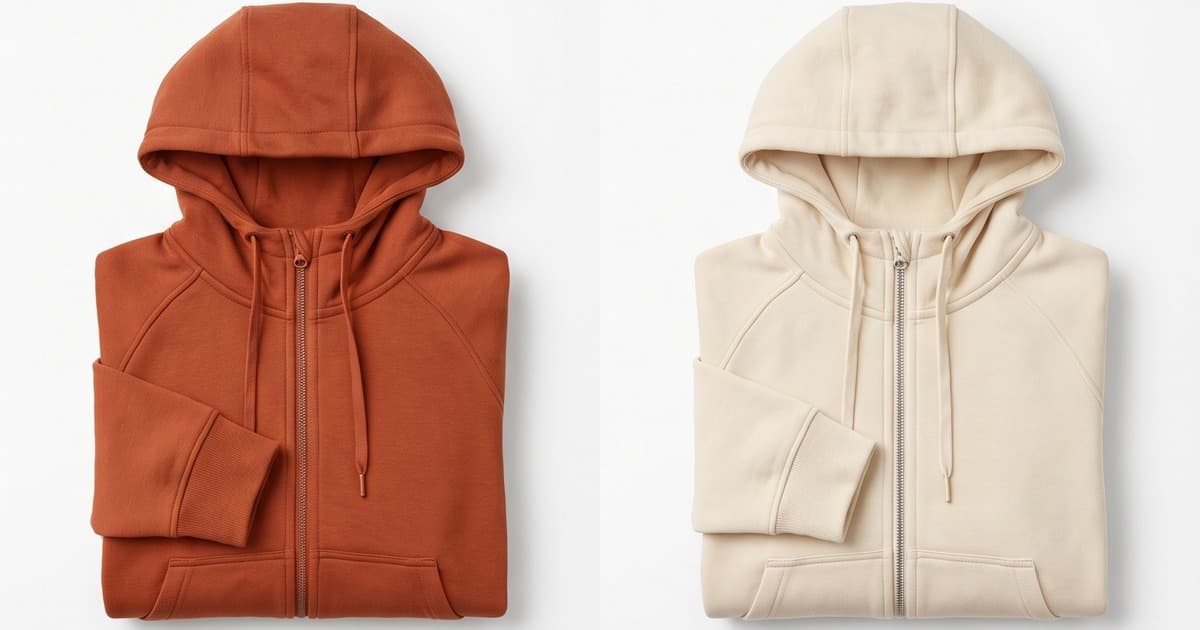
You're not just photographing a jacket. You're photographing it in cobalt blue, forest green, rust orange, cream, jet black, dusty pink, burgundy, and steel grey.
That's eight hero shots for a single style. Eight sets of model styling. Eight rounds of post-production. And if you have ten styles in your collection, you're looking at 80 on-model hero images — for one drop.
This is one of the most underestimated costs in fashion production. Brands talk about their shoot budget in terms of styles, but the real multiplication factor is colorways. And it's where traditional photography economics completely fall apart at scale.
AI changes the math. With AI-generated variant photography, you upload one flat-lay per color, and you get consistent on-model shots for every colorway in the same session — same model, same lighting, same background, same pose. The color changes. Everything else stays identical.
Here's how it works, why it matters, and why the math alone makes it a no-brainer for any fashion brand dealing with multi-variant catalogs.
The Hidden Cost of Colorway Photography
Ask most brands what a catalog shoot costs, and they'll give you a day-rate figure: studio rental, photographer, models, hair and makeup. What they often forget to factor in is the multiplier effect of variants.
Consider a mid-size brand with a 30-style collection. If the average style comes in 4 colorways, that's 120 SKUs to photograph. A traditional shoot day typically handles 8–12 complete setups (model changes, styling adjustments, lighting tweaks for different garment types). At that rate, a 120-SKU variant catalog requires 10–15 full shoot days.
The time cost is significant. But the consistency problem is worse.
Even with the same photographer, the same studio, and the same model, a shoot spread across multiple days will produce subtle variations: slightly different lighting angles, minor posture differences, varied expression energy. By day three, your cobalt blue jacket looks like it was photographed by a different brand than your forest green one.
For customers comparing colorways on a product page, that inconsistency creates friction. They can't trust that the fit and styling they're seeing in black is the same as what they'd get in rust. It undermines the decision.
Consistent fashion photography at scale is one of the most overlooked conversion levers in fashion ecommerce — and it's exactly where AI has the clearest advantage.
The Photoshop Workaround Nobody Talks About
Here's what a lot of brands actually do: they photograph the garment in one colorway, then use Photoshop (or a retoucher) to digitally recolor it for the other variants.
It sounds efficient. In practice, it rarely holds up.
Fabric color and fabric behavior are linked. A cobalt blue jacket photographs with different shadow depth, different sheen, different texture emphasis than the same jacket in cream. Recoloring in post doesn't capture how light interacts with the actual material. The result looks flat, slightly off — and customers notice.
Returns data backs this up. When product images don't accurately represent color and material behavior, customers are more likely to be disappointed on arrival and more likely to return. The short-term production saving becomes a long-term logistics cost.
AI doesn't recolor your garments — it generates new images from the actual garment in each color. You photograph a flat-lay (or simple hanger shot) of every variant, upload them, and AI generates photorealistic on-model images for each one. Real fabric, real texture, real color behavior. Just without the 10 additional shoot days.
How AI Variant Photography Works
The process is straightforward, but the output quality is what makes it viable for real production catalogs.
Step 1: Photograph flat-lays for each colorway
This is the input. You need a clean, well-lit flat-lay of every color variant — the jacket laid flat on a white or neutral surface, showing the front clearly. No model required at this stage. A single person with a table, a white background, and decent lighting can photograph an entire collection's worth of flat-lays in a few hours.
Step 2: Upload to Tellos AI Photo Studio
Upload your flat-lays along with your brief: which AI model you want (you can choose from a diverse library), the pose or vibe you're going for, and the background style. These settings apply consistently across every variant in the batch.
Step 3: AI generates on-model images for every colorway
Tellos generates a realistic on-model shot for each flat-lay you uploaded — with the same model, the same lighting setup, the same pose, and the same background. The only variable is the color and material of the garment itself, derived from your actual flat-lay input.
Step 4: Review and export
You review the outputs in the platform and export the ones ready to go. If any variant needs a retry (unusual texture, complex print), you can regenerate without affecting the rest of the batch.
The entire process — from flat-lay upload to export-ready hero images — typically takes under an hour for a standard variant batch.
The Math: Why This Changes Everything for SKU-Heavy Brands
Let's put concrete numbers on it.
Traditional shoot: 10 styles × 6 colorways = 60 hero shots
- Average traditional shoot: 10–12 complete on-model setups per day
- 60 hero shots ≈ 5–6 shoot days
- Costs (studio, photographer, model, HMU, styling, post): €3,000–€6,000/day
- Total: €15,000–€36,000 for 60 images
AI variant photography: 10 styles × 6 colorways = 60 hero shots
- Flat-lay photography: 1–2 hours, minimal equipment, in-house
- Upload and generate: 20–40 minutes
- Review and export: 30 minutes
- Total time: under a day. Cost: a fraction of traditional production.
The gap widens with scale. At 200 SKUs, traditional production becomes logistically impossible to do consistently. Across multiple seasons, the compounding savings are dramatic.
And this isn't about cutting corners. The output quality — when AI is generating from a real product flat-lay with accurate color and material data — is production-grade. The same quality you'd expect from a well-run studio day, applied systematically across your entire SKU library.
Consistency Across Variants: The Conversion Advantage
For customers browsing your product pages, variant consistency matters more than most brands realize.
When someone clicks between the cobalt, the forest green, and the rust colorways of the same jacket, they're making a comparison. They're trying to understand whether the fit looks the same, whether the styling translates, whether the vibe of the garment carries across colors. If the images feel slightly different — different model energy, different background brightness, slightly different pose — the brain registers inconsistency. That inconsistency creates doubt.
With AI variant photography:
- Same model, every color — customers see the fit consistently represented
- Same lighting and shadows — material behavior is directly comparable
- Same background — product becomes the only variable
- Same pose — fit lines are identically framed for comparison
This matters particularly for brands targeting multiple segments with variant colorways. A black version of a jacket might be positioned as a workwear option; the rust version might read more weekend. If the image styling tells that story consistently, the product page does more work.
AI product photography for Amazon follows the same consistency logic — Amazon's algorithm and customer behavior both reward clean, consistent, multi-image product pages, and variant photography is central to that.
Real Production Scenarios Where AI Variant Photography Wins
Scenario 1: The seasonal drop with 8+ colorways per hero piece
You're launching a signature piece — a coat, a dress, a structured blazer — in 8 colorways. This is your statement SKU for the season. Every colorway needs professional on-model photography for the PDP, for campaign assets, for the lookbook.
Traditional approach: Multiple shoot days, or a marathon single day where quality degrades by hour six. Consistency is a constant challenge.
AI approach: One consistent batch job. Every colorway has an identical production standard. The cobalt blue coat looks as polished as the cream version looks as polished as the burgundy version. Your hero piece is represented at full quality across every variant.
Scenario 2: The restock with new colorways
You're restocking a bestselling style and adding three new colorways based on customer demand. You need on-model photography for the new variants — but you're not doing a full shoot for three SKUs.
Traditional approach: Either delay the restock until you can justify a full shoot day, or release new colorways with inferior flat-lay images and hope conversion doesn't drop.
AI approach: Upload three new flat-lays. Generate three new on-model images using the same model and settings you used for the original colorways. Launch with full visual parity. No delay, no compromise.
Scenario 3: The marketplace catalog expansion
You're expanding to a new marketplace — Amazon, Zalando, ASOS — that requires on-model images for every SKU. Your existing catalog has 80 styles in 4–6 colorways each, meaning 320–480 required images. You don't have most of them.
Traditional approach: This isn't feasible within a normal production timeline or budget.
AI approach: Systematic flat-lay photography of every variant, batch generation, marketplace-compliant outputs. Doable within days, not months.
Size and Diversity Across Colorways
One additional advantage of AI variant photography: you can generate size-inclusive representations at no extra production cost.
Traditional photography can show your burgundy jacket on a size 8 model — but showing it on a size 16 model as well requires an additional booking, fitting, and in many cases an additional shoot day. Most brands default to a single size representation even when their sizing range goes to 3XL.
With AI, you can generate the same colorway on multiple model body types in the same batch. Customers who wear larger sizes see themselves represented across your full color range — not just the one colorway you happened to have a diverse cast for.
Fashion catalog automation at the enterprise level increasingly includes size diversity as a standard visual requirement, not an optional upgrade. AI makes that standard achievable without multiplying production costs.
Integrating AI Variant Photography Into Your Workflow
The cleanest integration looks like this:
At sampling stage: When samples arrive, photograph flat-lays for every colorway immediately. This becomes your AI input library. You don't need a studio — a clean floor space, a white sheet, and good window light are sufficient for flat-lay inputs.
At launch prep: Upload flat-lays to Tellos, set your model and styling parameters, and run the batch. You'll have on-model images for every variant before launch, without blocking a shoot day.
At restock: Maintain your flat-lay archive. When new colorways arrive or bestsellers restock in new options, add to the archive and run a small batch. Variant photography is no longer a logistical event — it's a quick production task.
At catalog update: Periodically refresh your variant imagery — updated model, new background aesthetic, seasonal recolor of your styling — without returning to a shoot. Because AI variant photography starts from your product flat-lays (which don't change), refreshes are fast and cheap.
This integration removes variant photography as a production bottleneck. Instead of planning around when you can justify a shoot day for new colorways, you photograph variants as they arrive and generate images on demand.
What to Look For in AI Variant Photography Quality
Not all AI-generated images are equal for variant photography. A few quality markers to evaluate:
Color accuracy: Does the AI output actually reflect the true color of your garment, or does it shift toward generic approximations? Test with a known tricky color (a warm rust, a muted sage, a cool grey) against the physical garment.
Material behavior: Does the AI capture the sheen of a satin, the structure of a wool blend, the drape of a silk? Or does everything look like the same soft jersey? High-quality AI photo generation is trained on real fashion imagery and handles material differentiation well.
Cross-variant consistency: Are the outputs actually consistent across variants, or does the model position, lighting angle, or background tone shift subtly between images? True batch consistency requires the AI to apply identical parameters across every generation in the set.
Revision control: When a specific variant doesn't come out right, can you regenerate just that one without disrupting the rest of the batch? Good workflow tooling allows targeted reruns without starting over.
Tellos AI Photo Studio is built specifically for fashion ecommerce production requirements — including the variant use case — with consistency controls and material rendering optimized for catalog-quality outputs.
The Flat-Lay You Already Have Is More Valuable Than You Think
Here's a reframe that matters: every flat-lay image you already have in your asset library is a potential on-model hero shot.
If you've been selling on Amazon, Etsy, your own Shopify store, or any marketplace — you already have flat-lays. Every product photo you've ever taken to show the garment clearly is an input for AI variant photography.
This means your existing flat-lay archive can be converted into a professional on-model catalog without a single additional shoot day. Brands with years of flat-lay product photography can generate on-model images for their entire historical catalog — not just new launches.
The AI shooting day concept extends to your existing assets as much as it applies to new production. Your archive has more value now than it did before AI variant photography existed.
The Competitive Reality in 2026
The brands that figure out AI variant photography first will have a meaningful operational advantage over those still scheduling shoot days for every new colorway.
The brands winning on fashion ecommerce in 2026 are the ones that move fastest, present most consistently, and represent their full catalog — not just the hero pieces that justified a full shoot. AI variant photography is what makes that scale achievable.
Your competitor with 50 SKUs in 5 colorways has 250 product variants to photograph. If they're doing it traditionally, they're either underfunded on visuals (relying on flat-lays or Photoshop recolors) or overspending on production. The brand that solves this with AI has lower cost, faster time-to-market, and better on-site consistency — all at once.
Ready to Photograph Every Colorway Without Booking Another Shoot?
If you have a collection with multiple color variants — and you're either delaying launches, cutting corners on variant images, or spending disproportionately on multi-day shoots — AI variant photography directly solves your problem.
Tellos AI Photo Studio generates on-model images for every colorway from your existing flat-lays. Same model, same lighting, same background across your entire SKU library. Production-grade quality at a fraction of the cost and time.
See what Tellos AI Photo Studio can do for your collection →
Stop scheduling shoot days for colorways. Upload your flat-lays and get your full catalog done today.