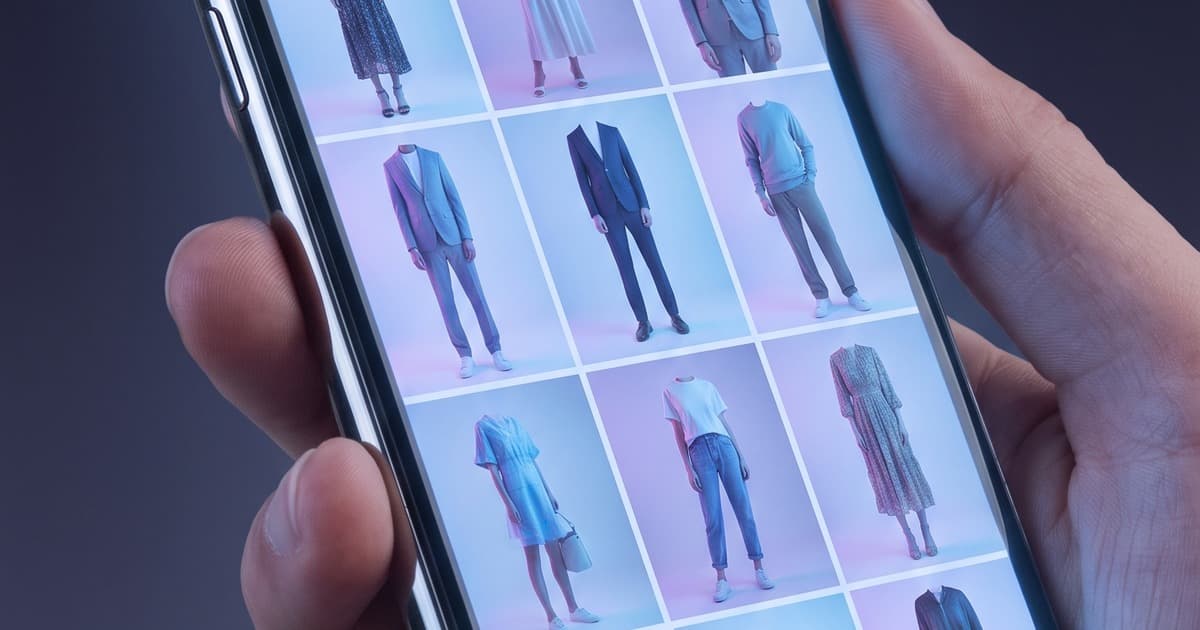
Meta performance marketing for fashion lives and dies by creative. Not your targeting. Not your bidding strategy. Creative.
You can have a perfectly segmented audience, an aggressive ROAS target, and a generous budget — and still watch it all stall if your creative runs out of steam. Most fashion brands figure this out the hard way: they launch with two or three polished ad images, ride the initial performance spike, and then spend the next three weeks watching CPMs climb and ROAS erode as the algorithm exhausts its ability to squeeze results from the same visuals.
The solution isn't more budget. It's more creative — and specifically, more variety of creative, generated fast enough to stay ahead of fatigue.
AI-generated fashion photography and video has changed the math on this completely.
Why Creative Volume Is the Lever Most Fashion Brands Ignore
Every Meta advertiser knows about creative fatigue in theory. In practice, most brands under-invest in creative variety because production has historically been the bottleneck.
A traditional fashion product shoot yields maybe 8–12 hero images per SKU if you push hard. You get one model, one background, a handful of angles. If you're advertising that product across multiple audiences, placements, and campaign objectives, those 12 images start competing with each other within days.
Meta's algorithm is constantly learning which creative performs best for which audience segment. The more variants you give it to test, the more granular that learning becomes. A brand running 20 image variants on a single product isn't just getting more data — they're finding signal the brand with 3 variants will never see. Which model resonates with your 25–34 demographic vs your 45–54 buyers? Which background converts higher for cold traffic? Which pose stops the scroll on a mobile feed?
Without volume, you can't answer these questions. You're guessing.
The Traditional Creative Math Doesn't Work for Meta
Let's be honest about the economics. A professional fashion shoot that produces 3–4 usable hero images per SKU (with model, lighting, styling, post-production) costs roughly €600–€1,200 per image when you factor in the full day rate spread across the output.
To generate 20 ad variants for a single product at that cost? That's €12,000–€24,000. For one SKU. Before you've spent a cent on media.
So brands don't do it. They run the same 3 images until Meta tells them the creative is fatigued, then scramble to re-shoot, which takes 3–4 weeks, by which time the campaign has lost momentum.
This is why most fashion brands' Meta performance looks like a sawtooth: spike at launch, decay over weeks, scramble, spike again, repeat. The bottleneck is always creative.
AI-generated content breaks this cycle.
What "20 Variants" Actually Means in Practice
When we talk about testing 20 ad variants, we don't mean 20 completely different concepts. We mean systematically varying the elements that actually drive performance differences:
Model variation — Different AI model ethnicities, body types, ages. The same dress on 5 different models gives you real data on which resonates with each audience segment. This matters particularly for size-inclusive brands who want to show fit across body types, which we covered in depth in our size-inclusive fashion photography guide.
Background / setting variation — Minimal white studio vs lifestyle outdoor vs editorial textured wall. Different contexts perform differently depending on campaign objective: white backgrounds tend to outperform on conversion-focused campaigns; lifestyle backgrounds work better for awareness.
Pose and orientation — Full-length standing, cropped three-quarter, movement, seated. Each communicates different things about the garment. Movement shots (particularly in video) consistently drive longer dwell time on fashion ads.
Color variant hero shots — If a product comes in 8 colorways, that's 8 more variants before you've changed anything else. We've seen brands underestimate how significantly performance varies across colorway ads — your black colorway and your rust colorway may attract completely different buyers.
Format-specific crops — The same image doesn't work equally well as a 1:1 feed post, a 9:16 Story, and a 1.91:1 catalog ad. Generating format-optimized variants matters more than most brands realise.
With AI photo generation, you start from one product flat-lay and generate all of this. The cost difference compared to traditional production is an order of magnitude.
How the Meta Algorithm Actually Rewards Fresh Creative
Meta's ad algorithm has become increasingly sophisticated about creative performance attribution. A few dynamics that matter for fashion advertisers:
Frequency and fatigue signals. Meta tracks how many times a unique user has seen a given creative. When frequency rises above roughly 2.5–3 impressions per week per user, engagement drops and CPMs rise. The algorithm interprets this as the ad becoming less relevant and penalises it in the auction. Fresh creative resets this counter.
Creative learning and optimisation. When you upload new creative into an active ad set, Meta enters a brief learning phase — but it brings forward its existing audience intelligence. New creative in a warm campaign tends to ramp faster than a cold launch. This means regular creative refreshes don't cost you momentum; they build on it.
Creative diversity signals. Campaigns running 10+ creative variants allow Meta's algorithm to do audience-creative matching — serving different visuals to different segments within your target audience automatically. This is a capability that simply doesn't exist when you're running 2–3 assets. With enough volume, Meta identifies micro-audiences within your broader targeting that respond to specific creative styles. You never would have known to target them — the algorithm figures it out from the data.
Placement diversification. Different placements favour different creative formats. Reels reward motion and authenticity. Stories reward immediacy and bold text. Feed favours clean, high-quality product images. Running creative specifically designed for each placement — rather than forcing one asset to stretch across all of them — meaningfully improves performance.
The Creative Fatigue Timeline (and How AI Solves It)
Here's a realistic creative lifecycle for a fashion performance campaign:
| Phase | Timeline | What's Happening |
|---|---|---|
| Launch | Days 1–5 | Algorithm learning, frequency low, CPMs efficient |
| Peak | Days 6–14 | Best ROAS window; creative fresh to most of your audience |
| Saturation | Days 15–25 | Frequency building; repeat impressions increasing; CTR starting to drop |
| Fatigue | Day 25+ | CPMs rising, CTR declining, ROAS deteriorating |
For a brand running a 3-creative campaign, there's no escaping the saturation phase. You're running the same three images into an audience that has already seen them multiple times.
For a brand running 20 creative variants, the algorithm continuously cycles through under-exposed assets. Different variants are in different phases of their lifecycle simultaneously. Some are ramping up while others are winding down. The net effect: the fatigue curve flattens significantly, and performance stays more consistent for longer.
The practical upshot: with AI-generated creative, you can ship a 20-variant campaign in the time it would traditionally take to brief a shoot. You refresh with another 20 variants 3–4 weeks later. Fatigue never becomes a crisis — it's a scheduled maintenance task.
Format-by-Format Breakdown: Where AI Creative Has the Biggest Impact
Static Feed (1:1 and 1.91:1)
Static images remain the most cost-efficient format for fashion direct response. AI photo generation is a perfect match here — consistent lighting, professional model shots, clean backgrounds. The ability to generate 8+ hero images per product (different models, backgrounds, angles) feeds the algorithm's testing appetite without any additional production cost.
Best use of AI static creative: Color variant testing, model diversity, background A/B testing, seasonal lifestyle contexts.
Instagram Reels and TikTok-style Video
Short-form video is now Meta's highest-reach format, but it's historically been the hardest to produce at scale for fashion brands. AI video generation changes this. A 3–6 second clip showing natural model movement — garment draping, walking, subtle gesture — can be generated from a single on-model image using AI video tools.
This is the area where AI video at scale has the most immediate impact for fashion Meta advertisers. Instead of producing one Reel per campaign, you can generate 6–8 short video variants with different model motion styles (walking, turning, looking back) and test which drives better engagement.
For a deeper dive into video ad performance specifically, our AI video ads guide covers the full creative and performance picture.
Stories
Stories are an underrated performance format for fashion. Full-screen, immersive, and well-suited to editorial-style imagery. AI-generated lookbook photos crop neatly to 9:16. Adding a simple text overlay for CTA is enough. The key advantage of AI here: you can generate Stories-native creative (vertical, full-frame) as a distinct output rather than just cropping landscape images.
Carousel
Carousel ads work well for fashion when you're showing multiple products, a collection, or multiple angles/colorways of one item. AI's consistency advantage is significant here — the same model, lighting, and background across 5 carousel cards creates a polished, editorial feel that performs well for mid-funnel audiences who are comparing options.
Running a Proper Creative Test with AI Variants
The goal isn't just to have lots of creative. It's to run structured tests that give you learnable data. Here's a repeatable framework:
1. Isolate variables. Don't change 3 things at once. Test one variable at a time: model vs model, background vs background, static vs video. Each test should have a clear hypothesis.
2. Give each variant enough spend to reach statistical significance. A good rule of thumb: €50–€100 per variant before drawing conclusions, depending on your average order value and audience size.
3. Use Meta's built-in A/B test feature or Dynamic Creative. Dynamic Creative (DCO) lets you upload up to 10 images, 10 headlines, and 5 descriptions and lets Meta mix and match. It's fast to set up with AI creative because you're not limited by production. The algorithm does the testing.
4. Rotate winning variants into new campaigns. When you identify a winning model type or background context, generate more variants in that direction. AI makes this iteration cycle fast — the feedback loop from test result to new creative to launch can be under 24 hours.
5. Plan your refresh calendar. Based on your audience size and budget, estimate when fatigue will set in (usually 3–4 weeks for fashion brands spending €100–€500/day). Schedule your next AI creative batch before that point — not after.
The Cost Comparison: Traditional vs AI for Meta Creative
Let's put real numbers on this.
Traditional production for a Meta creative batch (one product, one campaign):
- Photographer day rate: €800–€1,500
- Model: €400–€900
- Studio or location: €300–€600
- Styling and art direction: €300–€500
- Post-production (editing, retouching): €400–€800
- Total for ~10 images: €2,200–€4,300
- Timeline: 2–4 weeks from brief to live assets
AI-generated creative batch (one product, one campaign):
- Generate 20+ on-model image variants: included in platform subscription
- Generate 6–8 short video clips for Reels: included
- Total incremental cost: near zero per batch
- Timeline: 1–2 hours from product photo to campaign-ready assets
This isn't about cutting corners on brand presentation. AI-generated fashion content, when done well, is indistinguishable from traditional production in the contexts where Meta ads are consumed (mobile feeds, 1–2 second impressions, small screens). The quality bar that matters for Meta creative performance is far lower than the quality bar for a print campaign or a homepage hero image.
For fashion brands who are also thinking about catalog automation, the same AI outputs that feed your Meta creative can also feed your product pages and email campaigns — dramatically increasing the ROI of each production session.
What the Fastest-Growing Fashion Brands Are Doing Differently
The pattern among fashion performance marketing leaders is consistent: they treat creative production as a continuous process, not a campaign event.
Rather than briefing a new shoot every quarter, they have an always-on AI creative pipeline. New products get on-model shots and video variants generated the same week they hit inventory. Winning ad concepts get iterated with new models and seasonal backgrounds. Creative is refreshed on a rolling 3–4 week cycle.
The result: their Meta accounts always have fresh creative in rotation. The algorithm never runs dry. ROAS stays more predictable. And because AI generation is cheap, they can afford to test ideas that a traditional production budget would never justify — experimental backgrounds, niche model types, unusual color gradings — and let data tell them what works.
This approach is part of a broader visual content strategy that treats AI generation as infrastructure, not a one-time shortcut.
Common Mistakes Fashion Brands Make with AI Creative on Meta
Generating variants but not actually testing them. Twenty variants in a campaign set to serve the winning creative immediately means 18 variants never get a fair chance. Use structured testing — separate ad sets or A/B tests — so every variant gets impressions.
Over-optimising for polish at the expense of volume. The temptation is to use AI to generate a few very polished images. The performance advantage is in volume and variety, not perfection. Good-enough at 20 variants beats perfect at 3.
Forgetting video. Static images are easier to generate and test, but Reels placements are where Meta is pushing inventory — and where CPMs are most efficient right now. Brands not generating AI video variants are leaving a significant performance lever untouched.
Not planning refreshes. Generating a great first batch and then going quiet for 6 weeks defeats the purpose. Build the refresh cycle into your marketing calendar from the start. Pair each major collection drop with an AI creative batch, and plan interim refreshes mid-cycle.
Getting Started
If you haven't done it before, here's the simplest version of an AI-powered Meta creative workflow:
- Start with your top 3 performing products — the ones already generating revenue on Meta
- Generate 10–20 on-model variants for each (different models, 2–3 backgrounds, static + 2–3 video clips)
- Set up a Dynamic Creative ad set and upload all variants — let Meta test automatically
- After 2–3 weeks, identify which model types and backgrounds performed best
- Generate your next batch in that direction, plus new variants to test your next hypothesis
- Repeat every 3–4 weeks — before fatigue sets in, not after
The whole workflow, once you have your flat-lay product images, takes a few hours. And the impact on ROAS consistency is significant enough that most brands who try it never go back to the traditional shoot-and-wait model.
Make Your Meta Budget Work Harder
Meta advertising for fashion is an expensive channel when creative is the bottleneck. Every week you spend running fatigued creative is media budget that generates less return than it should. The brands that win on Meta aren't necessarily the ones with the biggest budgets — they're the ones with the freshest, most varied creative rotation.
AI-generated fashion content removes the production constraint that has held most brands back. You no longer have to choose between testing more variants and staying within budget. You can have 20 variants for the cost of one shoot — and refresh the entire set in an afternoon.
Ready to build an always-on creative pipeline for your Meta campaigns? Tellos AI Video Studio lets fashion brands generate on-model photos and short videos from flat-lay images — at the volume Meta performance marketing actually requires. Start generating your first creative batch at jointellos.com.