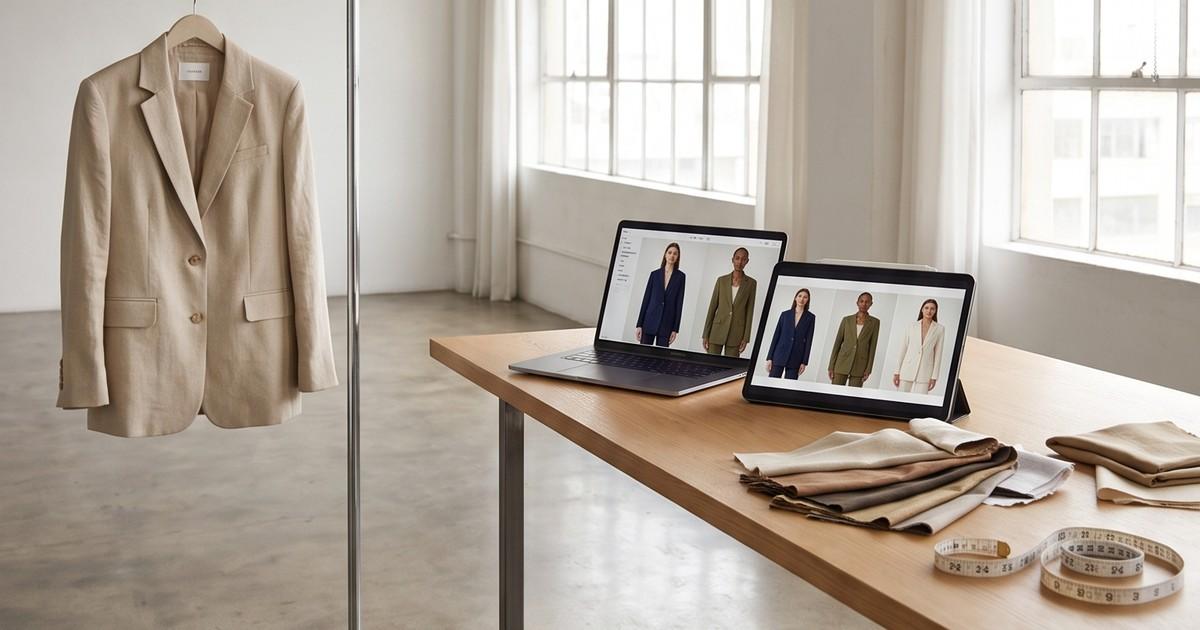
Quick answer: Fashion brands use AI to cut physical samples in four places. 3D and generative design tools replace early proto rounds, 3D fit simulation replaces some fit samples, digital line sheets and renders replace salesman samples for wholesale, and AI product photography and video replace the duplicate photo samples marketing used to need. Published case studies report sample reductions of roughly 40% to 75%, and in some simple product groups up to 100%. Fit-critical approvals and production pre-production samples still need a real garment.
A single style can easily go through a proto, two or three fit samples, a size set, a salesman sample per market and a photo sample per shoot. Multiply that by a 200-style season and colorways, and the sample room becomes one of the biggest hidden costs in the business.
The good news: almost every one of those samples exists to answer a question. "Does the silhouette work?" "Does it fit?" "Will buyers order it?" "What does it look like on a person?" AI and 3D tools can now answer a lot of those questions without anyone cutting fabric.
This guide walks through where samples come from, which ones AI can realistically remove, what the published numbers say, and how to roll it out without hurting fit quality.
Where Physical Samples Come From in a Fashion Calendar
Before you can cut samples, you need to know which ones you are making and why. Most brands have five sample types, each owned by a different team.
| Sample type | Owner | Question it answers | Typical count per style |
|---|---|---|---|
| Proto / development sample | Design | Does the idea work in 3D? | 1-3 rounds |
| Fit sample | Technical design | Does it fit the base size? | 2-4 rounds |
| Size set / PP sample | Production | Is grading and construction right before bulk? | 1 set |
| Salesman / wholesale sample | Sales | Will buyers order it? | 1 per rep or market |
| Photo / marketing sample | Ecommerce and marketing | What does it look like on a person? | 1 per shoot, often per colorway |
The counts vary by brand, but the pattern does not: each team orders samples to answer its own question, often for the same style, at the same time. That duplication is exactly where AI does the most damage to the sample budget.
How Fashion Brands Use AI to Cut Physical Samples: The Four Levers
1. Design and development: generative AI and 3D replace early protos
The earliest sample rounds are the easiest to remove. They exist mostly to check proportion, silhouette, color and print placement, all of which can be judged on screen.
- Generative design tools let designers explore many variations of a sketch, fabric and palette before anything is made. McKinsey's analysis of generative AI in fashion notes that designers are already using tools from companies such as Cala, Designovel and Fashable to "try myriad design variations without having to produce expensive samples."
- 3D garment software (Browzwear, CLO, Style3D and similar) builds the style from real pattern and fabric data, so teams can review drape, balance and print placement digitally.
The published results are strong. In Browzwear's customer story, KOOKAI says it reduced sampling by 50% after introducing 3D, and that it now simulates everything in 3D before sampling, which lets the team cancel designs that are not working before cutting fabric. Denim maker Crystal Denim reports a reduction of over 75% of physical samples after moving to a 3D workflow.
What this means for you: the "does it even look right?" round is the first one to go digital. If your designers still sample just to see a print placement, that is the lowest-risk place to start.
2. Fit: 3D simulation cuts fit rounds, but does not end them
Fit is where you should be most careful. A simulated garment on a digital avatar is only as good as the fabric data and the avatar behind it.
That said, brands with mature 3D teams are removing a lot of fit iterations:
- bonprix reports that sample reduction "varies from 50 to 100%, depending on the product group," that fit iterations are now conducted digitally, and that development time per style dropped by about 30 days (roughly three months to two).
- PEPCO reports a 40% reduction in physical samples in its kidswear department, the first category to adopt 3D, plus a production cycle that is 1-2 months shorter.
Notice the pattern in both: simple product groups go fully digital first. Basic tees, knit tops and simple woven shapes are easier to trust in simulation than tailoring, stretch swimwear or structured outerwear.
Rule of thumb: keep at least one physical fit approval for anything fit-critical, and use 3D to make sure that sample is right the first time instead of the third.
3. Wholesale and sales: digital line sheets replace salesman samples
Salesman samples are expensive, travel a lot and often end up unsellable. They exist so buyers can see the product, which is a visual problem AI and 3D are very good at.
Swiss performance brand Odlo reports that by replacing physical salesman samples with 3D renders, its sales team now needs only one physical garment, relying on renders for all other presentations. Odlo also reports 70% less invested in sample creation and around 18,000 final images per year created in 3D.
You do not need a full 3D pipeline to get part of this benefit. If your wholesale team presents line sheets on Faire, NuOrder or in a PDF, realistic on-model imagery from one sample can stand in for the full colorway rack. We cover the wholesale side in detail in Faire wholesale line sheets with AI photos and AI wholesale catalogs that impress buyers.
4. Content: AI photography and video replace photo samples
This is the lever most ecommerce teams control directly, and it is where Tellos works.
The traditional content workflow needs a physical sample of every style, often in every colorway, on set for every shoot: PDP, lifestyle, social, wholesale. If the studio shoot and the lifestyle shoot happen in different cities, you need two sample sets or a courier loop between them.
With AI product photography and video, the workflow flips:
- Capture one sample once. A flat-lay, ghost mannequin shot or simple on-hanger photo.
- Generate on-model photos across poses, models and backgrounds from that single image. See flat-lay to on-model with the AI Photo Studio and mannequin to model AI product photography.
- Generate on-model video for PDPs, Reels and TikTok from the same inputs.
- Cover colorways from one physical sample plus accurate color references, instead of shipping every color to set.
PEPCO's story shows the overlap between levers: its marketing team welcomed 3D because they "saw a great need to reduce time and the amount of physical samples that were needed for each photoshoot," and started using virtual garments in digital catalogs.
For the sustainability and marketing side of this lever, including how to talk about it without greenwashing, read our companion post on how AI content cuts sample waste.
What the Published Numbers Say
Here are the sourced figures in one place. One caveat up front: most of these come from vendor-published customer stories, so treat them as what is possible for committed adopters, not as a guaranteed baseline.
| Brand / program | Reported result | Source |
|---|---|---|
| KOOKAI | 50% fewer samples | Browzwear customer story |
| Crystal Denim | Over 75% reduction of physical samples | Browzwear customer story |
| bonprix | 50-100% fewer samples depending on product group; ~30 days faster development | Browzwear customer story |
| PEPCO | 40% fewer samples in kidswear; production cycle 1-2 months shorter | Browzwear customer story |
| Odlo | 70% less invested in samples; one physical garment for the sales team | Browzwear customer story |
| Australian Fashion Council FashTech Lab | 50% lower sampling costs; sampling time cut from 12 to 4 weeks (first pilot, 30 digital samples) | Ragtrader, 2024 |
The Australian Fashion Council pilot is useful because it is not a single vendor's case study. In its second pilot, covering 18 styles and assuming at least three fit samples per style, the program estimated it saved 635,000 litres of water and produced three times less carbon by not producing those physical samples.
The honest read: a 40-50% sample reduction is a realistic target for a brand that commits to digital workflows across one or two categories. The 75-100% numbers come from simple product groups or brands that have spent years building 3D teams.
What AI Cannot Replace (Yet)
Getting this wrong costs more than the samples you saved. Be clear with your team about the limits.
- An AI image is not a garment. As one manufacturer puts it, a generated image has no pattern, no seam construction, no fabric weight and no trim specification. It answers "what does it look like?" but not "can the factory make it?"
- Fit-critical approvals still need fabric. Swimwear, shapewear, tailoring and anything with technical stretch should keep at least one physical fit round. Our swimwear fit and fabric movement guide covers why.
- Pre-production samples stay. Your factory and QA team need a PP sample before bulk. No AI tool removes that.
- Generic image models change garments. General-purpose generators can quietly alter prints, logos, hems and colors. If the image is going on a PDP, accuracy matters more than aesthetics. See our AI clothing photo accuracy guide and our test of whether ChatGPT image generation is good enough for apparel.
- Fabric data is the bottleneck for 3D. Simulation is only as accurate as the fabric properties you feed it. Brands that skip fabric digitization get pretty renders that drape wrong.
Which Samples to Cut First: A Prioritization Table
Not every sample has the same risk. Start where the downside is small and the volume is large.
| Sample | Risk of going digital | Volume per season | Start here? |
|---|---|---|---|
| Photo / marketing samples (extra colorways, second shoot sets) | Low | High | Yes, first |
| Salesman samples (extra sets per rep or market) | Low to medium | Medium to high | Yes |
| Early proto rounds (silhouette, print placement) | Low to medium | High | Yes, with 3D |
| Fit rounds for simple basics | Medium | Medium | After fabric data is in place |
| Fit rounds for technical or fit-critical styles | High | Medium | Reduce, do not remove |
| PP / size set samples | Very high | Low | No |
The top row is the fastest win for most ecommerce brands because it needs no pattern data, no 3D team and no change to the factory workflow. One sample, one capture, AI for everything downstream.
A 90-Day Rollout Plan
Days 1-30: Measure and pick a category
- Count your samples. Pull last season's sample orders by type: proto, fit, salesman, photo. Most brands have never seen this number in one place.
- Pick one category with simple construction and high colorway counts. Basics, knitwear and simple dresses are common starting points.
- Set a baseline for cost, lead time and sample count per style in that category.
Days 31-60: Run the content lever
- Shoot one sample per style in the pilot category as a flat-lay or ghost mannequin.
- Generate PDP images and on-model video for every colorway from those inputs.
- Run a side-by-side review with merchandising: does the AI content match the physical garment on color, print and fit? Fix the inputs, not just the outputs.
- Track performance on the PDPs that use AI content. Our guide on measuring ROI on AI-generated content covers which metrics to watch.
Days 61-90: Extend to wholesale and design
- Replace extra salesman sets with digital line sheets built from the same AI imagery.
- Pilot 3D proto review for the next season's pilot category, if you have pattern and fabric data.
- Report the result as a specific, measured number: "We cut photo samples in knitwear from X to Y this season." Specific claims hold up. Vague sustainability claims do not.
Compliance Note: Disclosing AI Models in Ads
If you replace photo samples and human models with AI-generated people in advertising, check the disclosure rules in your markets.
- New York now requires advertisers to conspicuously disclose when an ad includes a "synthetic performer" they know about. The law (General Business Law section 396-b) took effect on June 9, 2026.
- The EU AI Act's Article 50 transparency obligations, including disclosure of deepfakes, began to apply on 2 August 2026.
How these rules apply to product imagery on your own PDPs versus paid ads is a question for your legal team. The practical step for operators: tag AI-generated assets in your DAM so you always know which images and videos include synthetic people.
How Tellos Fits Into a Sample-Reduction Program
Tellos is not a 3D pattern tool and does not replace your fit process. It covers the content lever: turning one product image into on-model photos and video for every channel.
- Upload once: flat-lay, ghost mannequin, packshot or existing model shot.
- Generate on-model photos with consistent models and backgrounds across the catalog.
- Generate on-model video for PDPs, ads and social, using the latest AI video models as the underlying technology.
- Keep the garment accurate: color, print and silhouette are treated as fixed, and the model and scene are what change.
That is usually the fastest place to remove samples, because the photo sample is the one most brands duplicate the most. For a full cost comparison, see fashion photography cost in 2026: traditional vs AI, and for full-catalog workflows see AI catalog production without a shoot.
FAQ
How are fashion brands using AI to cut physical samples?
They use generative design and 3D tools to replace early proto rounds, 3D fit simulation to reduce fit samples, digital renders and line sheets to replace salesman samples, and AI product photography and video to replace photo samples for ecommerce and social. Most brands start with content and wholesale, where the risk is lowest.
How much can AI reduce physical samples?
Published case studies report reductions of about 40% (PEPCO kidswear), 50% (KOOKAI), over 75% (Crystal Denim) and 50-100% depending on product group (bonprix). These are mostly vendor-published results from committed adopters, so a 40-50% reduction in one or two categories is a more realistic first target.
Can AI replace fit samples completely?
Not for most brands. 3D fit simulation can remove several fit rounds, and simple product groups can sometimes go fully digital, but fit-critical styles and pre-production samples still need a physical garment.
Do I need a 3D team to start reducing samples?
No. The content lever needs no pattern data or 3D software. You capture one physical sample per style and use AI to generate on-model photos and video for every colorway and channel. 3D tools add value later in design and fit.
Is it greenwashing to say AI cut our sample waste?
Only if the claim is vague or unmeasured. Count your samples before and after, report the specific change, and be clear that AI reduces marketing and development waste rather than the footprint of the garment itself.
Key Takeaways
- Samples exist to answer questions. AI and 3D now answer many of those questions on screen.
- Four levers: design protos, fit rounds, salesman samples and photo samples.
- Published reductions run roughly 40-75%, higher in simple categories, mostly from vendor case studies.
- Start with photo and salesman samples, where risk is lowest and duplication is highest.
- Keep physical fit approvals for fit-critical styles and always keep the PP sample.
- Measure before and after and report specific numbers.
Cut Your Next Season's Photo Samples
Your photo samples are probably the easiest samples to cut this season. Tellos turns one product image into on-model photos and video for PDPs, ads and wholesale, so one sample per style covers every channel.
Try the Tellos AI Video Studio and see how many samples your next drop really needs.