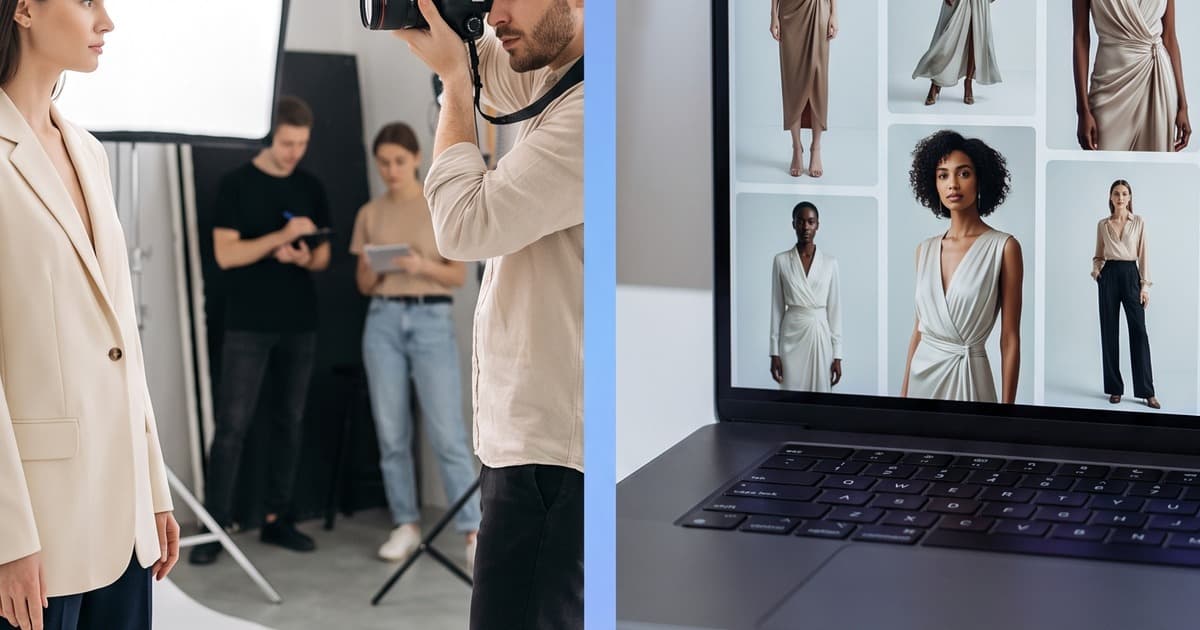
For years, outsourcing product photography was the smart move for fashion brands that didn't want the overhead of an in-house studio. Hand the brief to an agency, get polished images back in two weeks, everyone's happy.
That calculus has shifted. AI-generated fashion photography has crossed the quality threshold where it's a serious production option — not a workaround, not a budget compromise. The question for 2026 isn't "should we outsource or go in-house?" It's a three-way decision: outsource, AI, or a hybrid of both.
This post breaks down the economics, the timelines, the creative tradeoffs, and the specific use cases where each approach wins.
What "Outsourcing" Actually Looks Like in 2026
When fashion brands outsource photography, they're typically working with one of three types of providers:
- Full-service agencies — handle everything: casting, studio, styling, photography, post-production. High quality, high cost, minimum order sizes and lead times.
- Freelance photographers + separate retouchers — more flexible, often cheaper per image, but you're coordinating more moving parts.
- Product photography studios — specialized operations that run high-volume catalog shoots on a semi-assembly-line basis. Competitive per-image pricing for plain-background shots, but limited creative range.
Each has its role. But the common thread is: physical production takes time and coordination. And every additional SKU, variant, or revision adds cost.
The Economics: Real Numbers for 2026
Let's put some actual figures on the table.
Traditional Outsourced Photography Costs
| Service Type | Cost Per Image | Minimum Order | Turnaround |
|---|---|---|---|
| Full-service agency (editorial) | €80–€250+ | 20–50 images | 2–4 weeks |
| Freelance photographer + retoucher | €30–€80 | Negotiable | 1–3 weeks |
| High-volume catalog studio | €8–€25 | 50–100 images | 5–10 days |
| Variant re-shoots (per color) | €15–€40 | Per image | Additional days |
So a mid-size fashion brand launching a 50-SKU collection with 3 color variants each — that's 150 hero images minimum. At a studio rate of €15/image you're at €2,250 before lifestyle shots, secondary angles, or any video. At agency rates, that number climbs to €12,000–€37,500.
And that's before you factor in the coordination time: briefing rounds, model casting approvals, styling reviews, back-and-forth on retouching.
AI Photography Costs (Tellos)
AI-generated on-model photography runs at a fraction of the per-image cost. There's no model day rate, no studio booking, no post-production queue. A 50-SKU collection with 3 color variants — 150 hero images — can be generated in a matter of hours, not weeks.
The cost advantage compounds as scale increases. For 500 images, the gap between outsourcing and AI isn't linear — it's a different category of economics entirely.
Where Outsourcing Still Wins
Let's be honest: AI doesn't replace every type of fashion photography, and pretending otherwise isn't useful.
1. Hero Campaign Shoots
Your seasonal campaign imagery — the billboard, the homepage takeover, the lookbook cover — is where your brand makes its statement. These images carry the weight of your brand identity and often involve creative direction that requires real human energy in the room: the way a model tilts her head, an unexpected moment, the chemistry between subjects.
AI is improving rapidly, but directing a nuanced editorial moment is still a human-led process. A great campaign shoot with an experienced photographer produces images with an intangible quality that AI is not consistently replicating yet.
2. Brand Films and Moving Hero Content
If you're producing a 60-second brand film for your brand launch or seasonal campaign, that's a production requiring actors, locations, cinematography, and narrative direction. AI video is powerful for product-level content (see our guide on AI model videos for product pages) but not a replacement for a directed brand film.
3. Celebrity, Influencer, or Athlete Collaborations
Any shoot involving a real, named person — a brand ambassador, a collab partner, a celebrity face — is inherently human. That's a relationship, not a render.
4. Highly Specific Creative Briefs Requiring Real Environments
Some brands need a specific real location: a particular coastal town, an actual motorcycle workshop, a genuine farm setting. AI can simulate environments, but when the specificity of a real place is the point, you book a location.
Where AI Wins — Decisively
This is where the calculus has shifted most dramatically in 2026.
1. Catalog and PDP Hero Images at Scale
For the bulk of your product catalogue — the images that live on product pages, in search results, in email campaigns — AI is now the clear winner. Consistent backgrounds, consistent lighting, consistent model presentation across every SKU. No variation in skin tone rendering between two shoot days three weeks apart. No retoucher who slightly over-smoothed one batch.
We covered the scale advantage in depth in Consistent Fashion Photography at Scale — it's one of the most underrated benefits of AI-generated catalog imagery.
2. Color and Size Variant Photography
This is the killer use case for AI. Traditional photography has a dirty secret: most brands only photograph one or two colorways and hope shoppers extrapolate. Photographing 6 variants properly would multiply shoot costs by 6x.
With AI, generating all 8 color variants of a jacket in the same model, same pose, same background takes minutes. We dedicated a full post to this: Photographing All Your Color Variants with AI.
3. Ad Creative Testing at Scale
If you run Meta, TikTok, or Google Shopping ads, you know creative testing is the performance lever. But outsourced photography isn't designed for iteration — you brief once, shoot once, pay once. Requesting 20 variations to A/B test is financially absurd with an agency.
AI makes creative testing economically viable. Generate the same garment on 5 different models, 4 different backgrounds, 3 different poses — that's 60 variations to test. No agency can compete with that workflow. See Meta Ads for Fashion: How AI Creative Lets You Test 20 Ad Variants.
4. Size-Inclusive Representation
Booking diverse model sizes through a casting agency is expensive and logistically complex — agencies have limited plus-size representation, day rates are high, fittings are required. AI lets you generate your catalogue on XS through 3XL bodies without the production overhead.
This is both an ethical imperative and a commercial one: customers buy more when they see the garment on a body similar to theirs. Full breakdown in Size-Inclusive Fashion Photography with AI.
5. Pre-Order and Pre-Production Content
Samples arrive late. Launches don't wait. AI lets you generate product visuals from tech packs or flat-lays before physical samples exist — enabling pre-order pages, wholesale buyer previews, and investor decks without delaying your launch date.
6. Turnaround When You Need It Fast
Outsourcing has lead times. Even a fast studio needs 5–10 business days. AI delivers finished images in hours. When a trend breaks or you need to launch a flash sale, AI is the only option that matches the pace of modern fashion retail.
Revision Cycles and Creative Control
One underappreciated advantage of AI: the revision cycle is nearly instant, and it doesn't cost extra.
With an outsourced shoot, requesting a revision — different model, different background, slightly different styling — often means a re-book. Even just requesting additional angles or reshoots of specific items can trigger new invoicing. The typical outsourcing relationship has limited flexibility once the shoot day is over.
AI generation allows you to iterate freely. Try three background options. See the garment on a different model type. Test a different pose. The marginal cost of iteration is essentially zero.
Minimum Order Sizes and Brand Stage
Your optimal approach depends heavily on where your brand is.
Early-stage / DTC startup (under 50 SKUs):
- A full outsourced catalog shoot is likely prohibitive
- AI-first approach makes launch viable without photography budget
- See our guide: How to Launch a Fashion Brand with AI Content
Growing brand (50–500 SKUs):
- The hybrid model makes most sense: outsource 1–2 campaign shoots per year, use AI for all catalog, variant, and ad creative production
- This is where the cost savings are most dramatic
Established brand / enterprise (500+ SKUs):
- AI at catalog scale is non-negotiable — no traditional studio can turn around 500+ images per season at a competitive cost
- Outsource agency retains role for brand campaign work, collab shoots, hero campaign imagery
The Hybrid Model: How to Structure It
The brands getting this right in 2026 aren't choosing one or the other — they're using both deliberately.
What goes to the agency/freelancer:
- 1–2 seasonal campaign hero shoots (the images that define your brand moment)
- Brand films and long-form video content
- Any shoots involving real brand partners, celebrities, or influencers
- Highly specific location-dependent editorial work
What goes through AI:
- All catalog PDP images
- Every color and size variant
- Restock imagery (new season SKUs added to existing catalog)
- Ad creative variations for performance testing
- Social content batches (daily Instagram, Pinterest, TikTok)
- Wholesale and buyer presentation materials
This split typically means 1–2 outsourced shoot days per year plus ongoing AI production — versus the old model of 4–8 shoot days annually.
Structuring the Briefing Workflow for Each
Briefing for Outsourced Shoots
Be specific and lock it down before the day:
- Shot list with each SKU, required angles, and styling notes
- Mood board aligned with seasonal creative direction
- Model casting brief with reference images
- Background and prop direction
- Post-production brief (retouching level, colour grading reference)
- Delivery format (resolution, file type, naming convention)
Getting this brief tight reduces costly re-shoots and revision rounds.
Briefing for AI Production
The AI briefing is lighter but still benefits from structure:
- Product flat-lay requirements: clean background, good lighting, all details visible
- Model type preferences per collection (age range, skin tone, size range)
- Background style direction (lifestyle, white, editorial, seasonal)
- Output format specs (file type, resolution, aspect ratio)
- Naming and tagging conventions for your DAM or Shopify upload
Because AI production is fast and iterations are low-cost, the brief doesn't need to be as exhaustive — you can see a test output and refine.
The Real Question: What's Your Volume?
The decision framework is ultimately simple:
- Low volume, high brand impact → outsource
- High volume, consistent quality required → AI
- Need both → hybrid
A full-service agency isn't going to give you a competitive per-image rate on 200 SKUs. And AI isn't going to direct your brand campaign the way an experienced creative director will.
The brands that win in 2026 are those that stop treating this as an either/or decision and start allocating each type of content to the production method it's actually suited for.
Start with the High-Volume Problem
If you're spending significant budget on catalog photography each season — and that budget is the constraint preventing you from shooting all your variants, all your sizes, all your colorways — AI catalog production is the fastest path to solving that problem.
Tellos AI Photo Studio generates on-model fashion imagery at catalog scale, with consistent lighting, backgrounds, and model presentation across your entire SKU range. Upload your flat-lays and get back production-ready images in hours, not weeks.
The agency budget you free up stays where it has the most impact: campaign shoots that make your brand memorable.