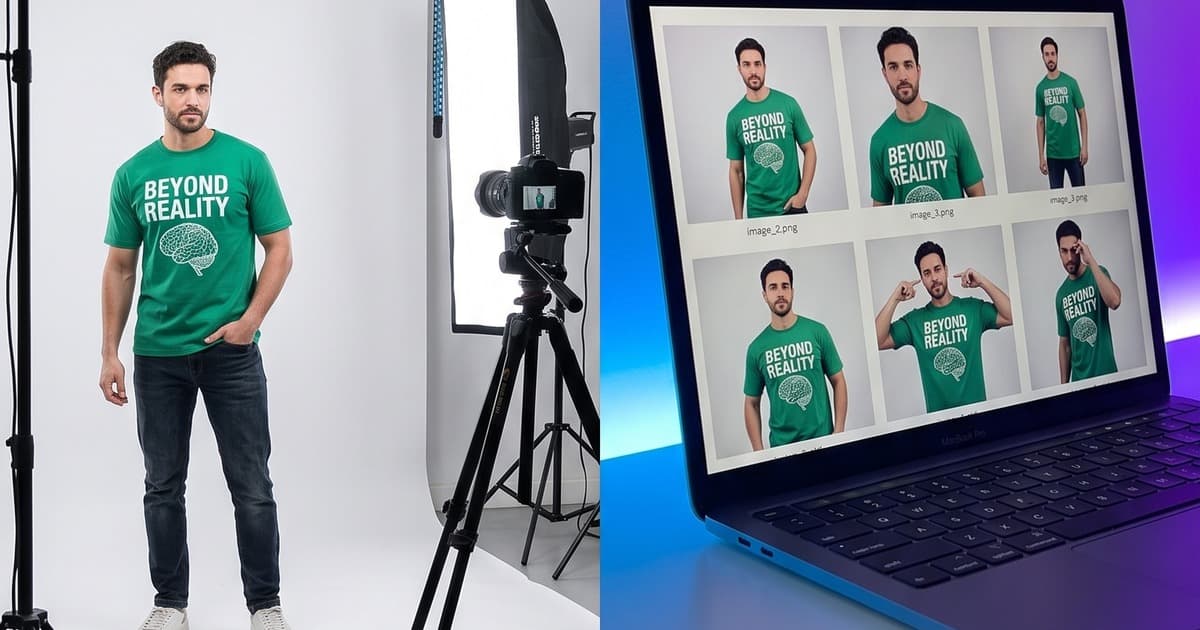
Building an in-house photo studio used to be a rite of passage for growing fashion brands. You hit a certain volume of SKUs, the external shoot costs started stacking up, and someone in finance said: "Why don't we just bring it in-house?"
It's a reasonable question. And for a long time, it was the right answer.
But that calculus has shifted. AI-generated fashion photography has matured to the point where brands of every size are asking a different question: Why build at all?
This post breaks down exactly what a fashion photo studio setup involves — costs, team, workflow — and compares it honestly against AI-powered production. Whether you're a startup evaluating your first real photo setup or an established brand reconsidering your infrastructure, this is the guide you need.
What Does a Fashion Photo Studio Setup Actually Cost?
Let's start with the traditional path, because most brands underestimate it significantly.
The Space
A functional fashion photography studio needs room to work. You're not shooting in a spare office. Realistic minimum requirements:
- 500–1,000 sq ft for a single-camera setup with basic seamless paper and lighting rigs
- 1,500–3,000 sq ft for a professional setup with multiple backdrops, a dressing/styling area, and a client lounge
In a major city, that's €3,000–€12,000/month in rent. Even in secondary markets, expect €1,500–€5,000/month. Over a year, you're looking at €18,000–€144,000 in rent alone before you've taken a single photo.
The Equipment
Bare minimum for a professional fashion setup:
| Item | Cost |
|---|---|
| Camera body (e.g. Sony A7R V or Canon R5) | €3,500–€5,000 |
| Lenses (1–2 quality primes) | €2,000–€4,000 |
| Studio strobes (2–4 lights + modifiers) | €3,000–€8,000 |
| Seamless paper, stands, booms | €800–€1,500 |
| Tethered shooting setup (laptop + software) | €2,000–€3,500 |
| Basic backdrop system | €500–€2,000 |
| Total equipment | €12,000–€24,000 |
This is the entry-level end. Brands that want continuous lighting, video capability, cyclorama walls, or multi-background setups are looking at €40,000–€100,000+.
The Team
Equipment doesn't shoot itself. An in-house studio requires:
- Staff photographer: €40,000–€75,000/year salary
- Photo editor / retoucher: €35,000–€60,000/year
- Studio coordinator / sample manager: €28,000–€45,000/year
- Stylist (often freelance per shoot): €300–€800/day
For a functional 3-person in-house team, you're at €100,000–€180,000/year in salaries before benefits, equipment upgrades, or additional freelancers.
Ongoing Costs
Studios have continuous overhead:
- Maintenance and equipment replacement: 10–15% of kit value per year
- Consumables (seamless paper, clips, tapes, gels): €2,000–€5,000/year
- Software (Capture One, Lightroom, retouching suites): €1,500–€3,000/year
- Utilities for the space: €3,000–€8,000/year
The Real 3-Year Number
For a mid-size brand running a proper in-house studio:
| Category | Year 1 | Years 2–3 (each) |
|---|---|---|
| Space (rent) | €48,000 | €48,000 |
| Equipment (initial) | €20,000 | €3,000 (maintenance) |
| Team salaries | €140,000 | €145,000 |
| Ongoing costs | €8,000 | €8,000 |
| Annual total | €216,000 | €204,000 |
Over 3 years: ~€624,000. And this assumes no team turnover, no equipment failures, and full studio utilization year-round.
What You Get for That Investment
To be fair, an in-house studio has real advantages:
- Speed: Shoot and edit same-day when urgent
- Control: No booking windows, shoot whenever needed
- Consistency: Same setup, same equipment, same team
- Flexibility: Reshoot immediately if something's wrong
- Owned assets: Your team, your workflow, your process
For brands shooting 2,000+ SKUs per year across multiple collections, an in-house studio can make financial sense. The math works when utilization is high and the team is efficient.
But here's what most brands discover after building: utilization is rarely as high as projected, and the overhead is nearly fixed regardless.
The Hidden Costs Nobody Talks About
The Sample Management Problem
To photograph a garment, you need the physical sample in the studio. For fast-fashion or trend-driven brands, this creates a constant logistics challenge: coordinating sample arrivals, returns, storage, and condition checking.
A studio sitting idle waiting for samples is expensive overhead with zero output.
The Seasonal Utilization Cliff
Fashion brands have intense seasonal peaks (SS and AW collections) followed by quieter periods. Your studio and team cost the same in February regardless of whether you're shooting 500 pieces or 50.
Industry average utilization for in-house fashion studios: 55–65% of working days. You're paying for a studio full-time and using it part-time.
Model Booking Complexity
Even with your own studio, you still need to book external models for on-figure shooting. That means agency fees, fitting sessions, day rates (€500–€2,500/day for mid-tier fashion models), and all the logistics of coordinating humans.
Models cancel. They have conflicting bookings. They don't fit the sample. This friction doesn't disappear because you own a nice studio.
The Consistency-at-Scale Challenge
Even the best in-house teams struggle to maintain perfect visual consistency across 500+ SKUs shot over several weeks. Lighting ratios drift. Different photographers have different instincts. Color profiles shift between editing sessions.
The result: a catalog that looks subtly inconsistent, requiring expensive retouching passes to harmonize.
The AI Alternative: What's Actually Possible Now
This is where the conversation has changed dramatically in the last 18–24 months.
Modern AI fashion photography platforms — like Tellos — can generate on-model, on-location, editorial-quality fashion images from a simple product photo. The workflow is radically different:
Traditional studio workflow:
- Receive samples → 2. Book models → 3. Coordinate shoot day → 4. Shoot → 5. Cull → 6. Edit → 7. Deliver
AI workflow:
- Photograph flat-lays (or use existing product photos) → 2. Upload to AI platform → 3. Select model type, setting, style → 4. Generate → 5. Review and export
For a 100-piece capsule collection, the traditional path takes 2–3 shoot days + 1–2 weeks of editing. The AI path takes a few hours.
What AI Does Exceptionally Well
- Unlimited scale: 10 SKUs or 10,000 — the per-unit economics barely change
- Perfect consistency: Same model, lighting, color profile, and backdrop across every image
- No sample required (in many cases): Generate from flat-lays or even tech packs for pre-order content
- Instant reshoots: Wrong background? Change it in minutes, not weeks
- Diversity at zero cost: Select diverse models representing your customer base without additional casting fees
- 24/7 availability: No booking windows, no sample coordination, no team scheduling
The Cost Comparison
Let's compare a brand shooting 1,000 SKUs per year:
| Approach | Year 1 Cost | Per-Image Cost |
|---|---|---|
| In-house studio (mid setup) | €216,000 | €216/SKU |
| Freelance photographer (day rate model) | €60,000–€90,000 | €60–€90/SKU |
| AI photo platform (e.g. Tellos) | €8,000–€24,000 | €8–€24/SKU |
The AI economics are not incremental. They're a different order of magnitude.
The Hybrid Approach: Where Most Brands Land
Here's the honest recommendation for most fashion brands: you don't have to choose completely.
The sweet spot for 2026 is a minimal physical setup + AI for on-model work.
Minimal Physical Setup (The Flat-Lay Station)
You need one thing: clean, consistent flat-lay photos of your products. This is the AI's input.
A professional flat-lay setup costs:
| Item | Cost |
|---|---|
| Light box or sweep table | €300–€800 |
| 2 LED panels or speedlights | €400–€1,000 |
| Camera (or even a modern smartphone) | €0–€1,500 |
| Editing software | €200–€600/year |
| Total | €1,000–€3,900 |
A trained in-house coordinator (or even a trained assistant) can photograph 50–100 SKUs per day on a flat-lay station. That's your physical infrastructure requirement.
From those flat-lays, AI handles everything else: on-model placement, background selection, editorial styling, video generation.
Who Needs What
Startups (< 200 SKUs/year):
- Flat-lay station (DIY or small investment) + AI platform
- Total infrastructure cost: < €5,000 setup, < €15,000/year ongoing
- No studio, no dedicated team
Mid-size brands (200–2,000 SKUs/year):
- Dedicated flat-lay coordinator + AI platform
- Possibly one studio day per season for hero/campaign shots with real models
- Total: < €30,000–€50,000/year vs €150,000–€220,000 for in-house full studio
Enterprise brands (2,000+ SKUs/year):
- Full AI pipeline integrated into product workflow
- In-house studio retained for brand campaign and editorial work only (not catalog)
- Significant cost reduction on the bulk catalog workload
What AI Still Doesn't Replace
Let's be honest about the limitations, because they matter for planning.
Brand Campaign and Hero Imagery
For your twice-a-year brand campaign — the images that define your season — you likely still want a real shoot. Real creative direction, real models, real locations. AI is not the right tool for aspirational brand storytelling at that level.
Plan for 1–2 real production days per year for campaign imagery. Use AI for everything else.
Complex Technical Details
For garments where very specific details matter (intricate embroidery, specialty fabric behavior, 3D texture) you may want real photography to capture those nuances authentically. AI is getting very good at fabric simulation, but highly detailed artisan work still benefits from direct photography.
Video (With Caveats)
AI video generation for fashion has improved enormously — see our guide on AI model videos on product pages — and is increasingly viable for PDP videos, social content, and even ads. But for hero campaign videos with complex creative direction, traditional production still leads.
The Decision Framework
Before committing to a studio build, answer these questions honestly:
1. What's your annual SKU volume?
- Under 500: AI + flat-lay station is almost certainly the right answer
- 500–2,000: Hybrid approach, no full in-house studio needed
- 2,000+: Evaluate ROI carefully; AI may still beat the math
2. How seasonal is your production?
- High seasonality = low studio utilization = poor ROI on fixed overhead
3. Do you need on-model or flat-lay?
- If flat-lay is acceptable for your category, a studio is largely unnecessary
- If on-model is essential, AI removes the need for a studio entirely
4. What's your runway for this investment?
- Studios are 3–5 year commitments (leases, equipment depreciation, team tenure)
- AI platforms are month-to-month with no capital requirement
5. Is visual consistency a known problem for you?
- If you're already struggling with inconsistency across shoots, AI solves it structurally
- In-house studios improve consistency but don't eliminate it
How Brands Are Making the Transition
Here's what the transition typically looks like for brands moving to AI-first:
Month 1–2: Flat-lay foundation Set up or improve your flat-lay photography process. Establish a consistent protocol (same angles, same background, same lighting setup) so AI inputs are clean and uniform.
Month 2–3: AI platform onboarding Run your catalog through an AI platform. Most teams are surprised by output quality within the first session. Generate a test batch of 20–50 SKUs and evaluate against traditional outputs.
Month 3–6: Scale and iterate Build AI generation into your core product workflow. Coordinate with your e-commerce team on image specs, naming conventions, and delivery format.
Month 6+: Reduce traditional dependencies As confidence in AI output grows, reduce external shoot days. Reallocate budget to higher-impact areas (campaign shoots, video content, marketing).
Telling Your Team
The conversation around AI and photography teams is sensitive but worth having directly.
AI-powered platforms don't eliminate the need for creative direction — they shift it. Your team's value moves from technical execution (setting up lights, tethering cameras, managing retouching queues) to creative oversight (selecting model aesthetics, defining brand visual guidelines, quality control, campaign strategy).
Brands that manage this transition well end up with smaller, higher-value creative teams doing more interesting work. The repetitive production grind is what gets automated — not the creative thinking.
The Bottom Line
If you're evaluating whether to build a fashion photo studio in 2026, the answer for most brands is: don't.
Not because studios aren't valuable — they are. But because the economics have shifted fundamentally. The capital, the overhead, the operational complexity, and the scalability constraints of a physical studio are increasingly hard to justify when AI platforms deliver comparable (and in many ways superior) output at 5–10% of the cost.
The right question isn't "How do I build a better studio?" It's "What's the minimum physical infrastructure I need to feed a high-quality AI production pipeline?"
For most brands, that answer is surprisingly simple: a clean flat-lay setup and a platform that can turn those images into a full on-model catalog.
Start Producing Without the Studio
Tellos gives fashion brands professional on-model photography, lookbooks, and video content without a studio, a shoot day, or a model booking.
Upload your flat-lays. Choose your models, backgrounds, and style. Get your full catalog back in hours.