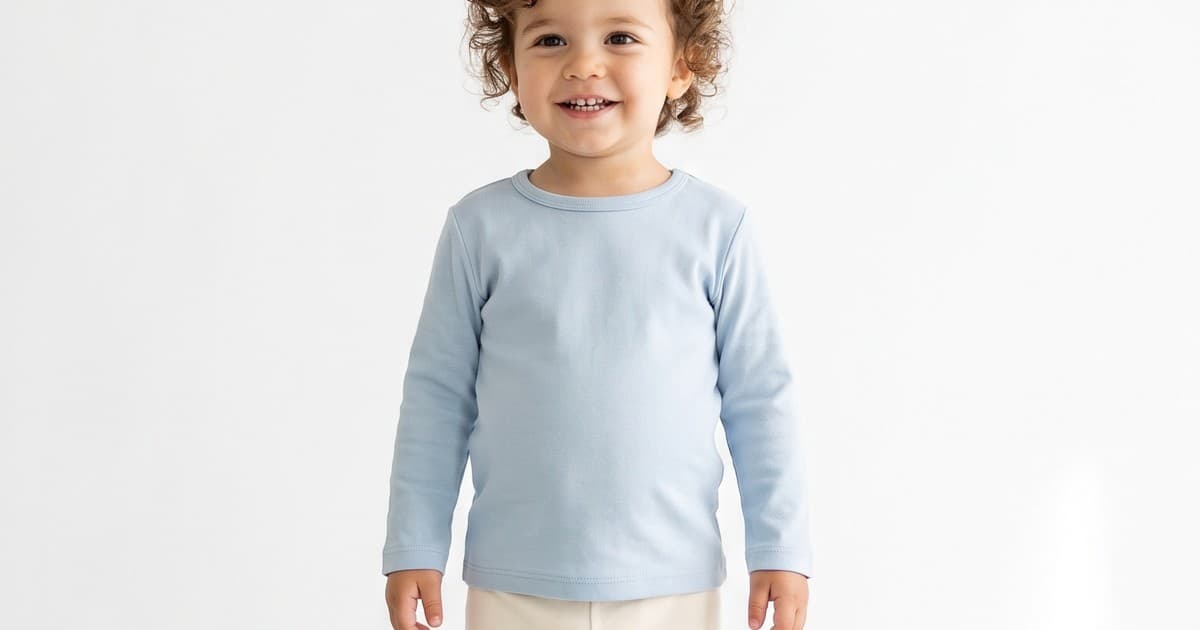
If you sell baby or kids' clothing online, you already know the photoshoot brief that never survives contact with reality: book three toddlers for a Saturday, hope none of them melt down before the third outfit change, and pray the size 2T model doesn't outgrow the sample between fitting and shoot day. Kidswear is one of the hardest categories in ecommerce to photograph well, and it's not close.
AI fashion video and photography removes almost every one of those constraints. No child models, no parental consent paperwork, no work-permit filings, no wrangling a toddler who decided the studio floor is more interesting than the camera. This post breaks down exactly why kidswear photography is so operationally expensive, what AI changes, and how to actually run the workflow without producing content that looks fake or creeps out parents.
Why Kidswear Photography Is Harder Than Any Other Apparel Category
Adult fashion photography is a solved problem: book a model, book a studio, shoot for a day, get 200 usable images. Kidswear breaks nearly every assumption in that process.
Child labor law compliance isn't optional
In the US, using children in commercial photography triggers real regulatory exposure. New York, for example, requires photographers and brands to hold an Employer Certificate of Eligibility before using child performers or models, a certification that costs money, takes time to obtain, and has to be renewed every three years. Federal FLSA rules add hour restrictions, work-permit requirements, and school-day limitations on top of state-level rules that vary widely.
None of this is exotic paperwork a small or mid-size kidswear brand can casually absorb. It's a compliance function, and getting it wrong isn't a fine you write off, it's a labor violation.
Scheduling around a toddler's actual attention span
A professional adult model can hold a pose, take direction, and shoot 40 looks in a day. A 3-year-old can do maybe 45 focused minutes before a shoot grinds to a halt. Add nap schedules, feeding windows for infants, and the fact that a "good" shot depends entirely on a child's mood in that exact second, and your shot list turns into a negotiation with a person who cannot be negotiated with.
Fit changes fast, and samples don't wait
Baby and toddler bodies change size within weeks. A sample fitted for a 6-month-old shoot booked three weeks out might not fit by shoot day. Brands often end up re-booking models mid-cycle, which means re-booking studios, stylists, and paperwork all over again.
Parental consent and image rights add friction to every asset
Every image needs signed consent from a parent or guardian, usage rights need to be scoped (is this just for the PDP, or also paid social, or a billboard?), and renewals or expirations on those rights can quietly take assets out of rotation years later. It's an extra rights-management layer that adult fashion content doesn't carry.
The economics are brutal for a young, expanding assortment
Kidswear brands often carry more sizes per SKU (newborn through 24 months, or XS through XL for kids), which multiplies the number of on-model shots needed to show fit at each size. Shooting all of that with real children, across real size ranges, for every seasonal drop, is a budget most kidswear brands simply don't have.
What AI Changes for Kidswear Content
AI-generated child models sidestep the entire compliance and logistics stack. There's no employment relationship to certify, no consent form to chase, no toddler nap schedule to plan around, and no sample that has to fit a specific child on a specific day. You control the apparent age, sizing, ethnicity, and styling directly in the generation process.
That unlocks a few things traditional shoots structurally can't do at the same cost:
- Show every size, every time. Generate on-model images across the full size range (newborn, 6-12 months, 2T, 4T, and up) without booking a different child for each one.
- Iterate on styling in hours, not weeks. Swap outfit combinations, colorways, and backgrounds without re-booking a studio.
- Scale seasonal drops without scaling headcount. A brand launching 40 SKUs for a fall collection doesn't need 40 SKUs' worth of child-model bookings.
- Reduce legal exposure. No child labor certification, no minor consent tracking, no renewal management on model image rights.
| Traditional kidswear shoot | AI-generated kidswear content | |
|---|---|---|
| Compliance | Employer certificates, work permits, consent forms | None required |
| Scheduling | Bound by child's mood, naps, school hours | On-demand, any time |
| Size coverage | Limited by which children you can book | Full size range in one pass |
| Cost to reshoot | Full re-booking (model, studio, stylist) | Regenerate the prompt |
| Turnaround | Days to weeks | Minutes to hours |
| Sample fit risk | High (kids outgrow samples fast) | Not applicable |
The Part Brands Get Wrong: AI Babies Look Off, and Shoppers Notice
Here's the honest caveat, because this category has a specific failure mode that other apparel categories mostly don't: badly generated AI children read as uncanny in a way that actively damages trust. Parents shopping for their kids are unusually sensitive to anything that feels synthetic or off about a child's face, and social feedback on the topic has been blunt. There's a real and visible backlash in shopper communities against brands that ship obviously artificial-looking baby imagery, precisely because it feels wrong in a category built on parental trust.
This doesn't mean avoid AI for kidswear. It means the quality bar for a child's face, proportions, and skin texture has to be higher than for adult apparel content, because viewers are looking harder. A slightly-off adult model in a product photo gets scrolled past. A slightly-off baby face gets screenshotted and mocked.
Practical guardrails that actually matter here:
- Prioritize product-forward framing over tight face close-ups. The garment is what you're selling; you don't need a magazine-cover portrait to show a onesie fits well.
- Run every generated child image through a real human visual check, not just an automated pass/fail score, before it goes anywhere near a PDP. Numeric quality scores in this space are advisory, they don't catch what a human eye catches in half a second.
- Keep proportions and expressions natural and calm. Exaggerated smiles or unnatural poses are where the uncanny-valley effect gets worst.
- Be transparent in social captions when appropriate. Brands that get called out tend to be ones that seem to be hiding that content is AI-generated, not ones using it as a stated production tool.
Treat this the same way you'd treat any new production method: pressure-test the output against your actual customer's expectations before scaling it across your catalog.
Where This Fits in a Kidswear Content Workflow
A practical rollout for a kidswear or baby brand looks less like "replace the whole photoshoot" and more like a hybrid model in the first season, then expanding as quality and confidence build.
Step 1: Start with flat-lay or ghost-mannequin product photography you already have
Most kidswear brands already shoot flat-lays or use ghost mannequin photography for their PDPs. That's the input. AI fashion video platforms like Tellos turn those existing product photos into on-model imagery and video, which means you don't need a from-scratch photoshoot to get started.
Step 2: Generate across your real size range
Instead of picking one "hero" size to photograph and hoping shoppers extrapolate fit for the rest, generate on-model content across your actual size breaks. This is one of the biggest conversion levers in kidswear specifically, because size confidence is the single largest driver of both purchase decisions and returns in apparel broadly, and kidswear parents are shopping for a body they can't personally measure against a size chart on a screen.
Step 3: Push it into short-form video, not just static images
TikTok and Instagram Reels reward frequent, native-feeling product content, and kidswear parents are heavy short-form video consumers. AI-generated fashion video lets a kidswear brand produce a week's worth of on-model Reels and TikToks from the same product photos used for the PDP, without booking a shoot for every piece of content.
Step 4: QA every asset against your specific audience's tolerance
Run a small batch, get real feedback (internal team, a customer panel, or just careful eyes on the actual output) before committing to full-catalog rollout. This category punishes shipping quickly more than most, because the trust cost of getting a baby's face wrong is higher than the trust cost of a slightly stiff-looking adult pose.
Return Rate: The Business Case Beyond "It's Cheaper"
Cost savings on photoshoots is the obvious pitch, but it undersells the bigger number. Baby and kids' apparel already runs a comparatively lower return rate than general apparel (roughly 8-12%, versus 24-40% for apparel broadly), largely because gifting and lower price points make returns less worth the hassle for a lot of buyers. But sizing is still cited as one of the top drivers of the returns that do happen, and it compounds badly in a category where a shopper is guessing at a size for a body they can't try the item on in real time.
Showing accurate on-model fit across your full size range, something that's expensive to do with real child models but comparatively cheap with AI-generated content, directly attacks the sizing-uncertainty driver behind kidswear returns. Fewer size-driven returns means better margin retention on a category that already runs on tighter unit economics than adult apparel.
Common Questions Kidswear Brands Ask Before Trying This
Does this replace our current child models entirely? Not immediately, and you don't have to frame it that way. Many brands run a hybrid approach: hero campaign imagery still uses real children for brand storytelling, while the bulk of PDP and size-range coverage shifts to AI-generated content where the ROI is clearest.
Will customers think we're being deceptive? Only if you try to hide it and get caught, which happens. Brands that treat AI-generated content as a stated production tool, not a secret, don't see the same backlash that's hit brands trying to pass synthetic imagery off as a real shoot without disclosure.
What about video, not just stills? The same underlying models used for AI video, Sora, Kling, Runway, and similar systems, generate the raw motion. A platform like Tellos sits on top of that as the production layer: it's the workflow that turns your product photos into on-model video and manages the output at catalog scale, rather than requiring you to prompt-engineer a general-purpose video model SKU by SKU.
Is this only for babies, or does it work for older kids too? It works across the full kids' range, but the uncanny-valley risk is highest for infant faces specifically. Content for older kids (think 6-12 year olds) tends to tolerate AI generation more easily, similar to adult apparel.
The Bottom Line
Kidswear photography carries a compliance burden, a scheduling problem, and a fit-coverage problem that adult apparel simply doesn't have. AI fashion video removes the child labor certification, the consent paperwork, and the toddler-attention-span constraint that make traditional kidswear shoots so expensive and slow to run. The tradeoff is a real one: this category has zero tolerance for content that looks even slightly off on a child's face, so the QA bar has to be higher, not lower, than for the rest of your catalog.
Get that balance right, and kidswear becomes one of the categories where AI-generated content delivers the clearest ROI in fashion ecommerce: full size-range coverage, faster seasonal turnaround, and a meaningful dent in the sizing-driven returns that eat margin in this category.
Ready to see it on your own product photos? Try the Tellos AI Video Studio and turn your existing flat-lays into on-model kidswear content across your full size range.