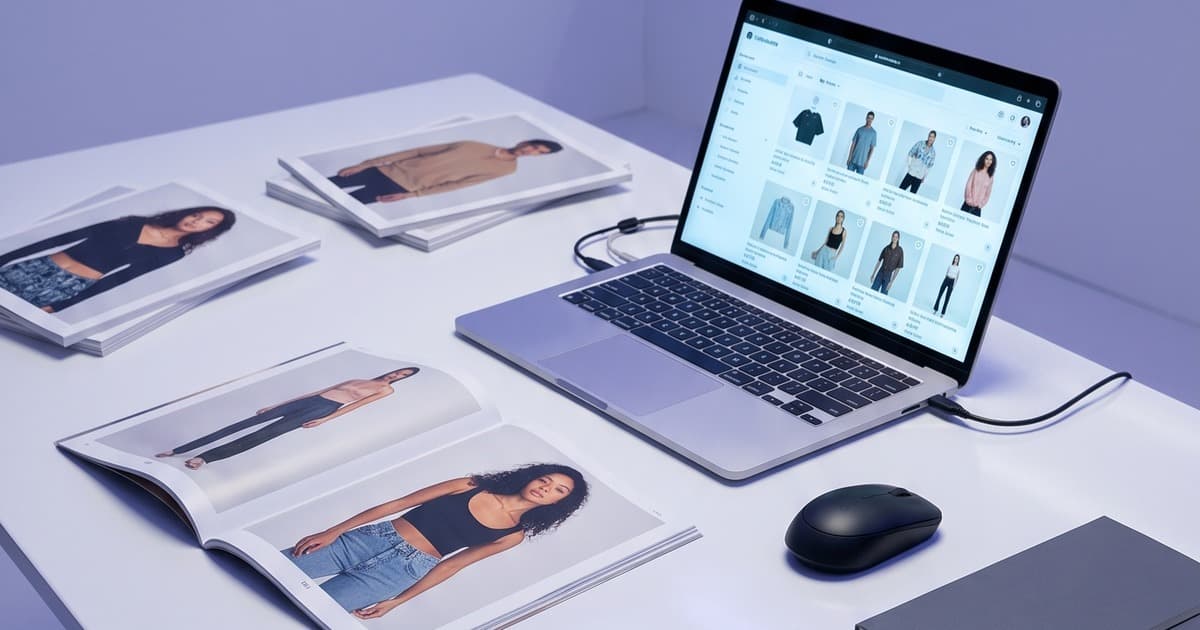
Wholesale is a game of trust. A buyer at a boutique, a regional chain, or a department store is making a purchasing decision worth thousands of dollars. Before they write that PO, they need to see exactly what they're buying — professionally photographed, clearly presented, consistent across every SKU.
That's the problem. For small and mid-sized fashion brands, producing a wholesale-grade catalog is genuinely hard. The photography budget alone can run to five figures. Then there's layout, printing, and distribution — all of which need to happen before you've even confirmed your factory order.
AI is changing that equation entirely. Brands are now generating wholesale-ready catalogs — complete with on-model photography, consistent backgrounds, and size-inclusive options — in a fraction of the time and cost of a traditional production. And the results are impressing the buyers.
Why Wholesale Catalogs Are Different from Consumer-Facing Content
Before we get into the AI side of things, it's worth being specific about what wholesale buyers actually need to see.
A wholesale catalog isn't Instagram content. It's a decision-making tool. Buyers are scanning dozens of brands in a short window — at a trade show, in a showroom, or reviewing digital submissions after a pitch meeting. They need:
- Clear, professional on-model photography — not ghost mannequin, not flat-lay. They need to see drape, fit, and movement.
- Consistency across the entire line — same model, same lighting, same background across all SKUs. Inconsistency reads as a lack of professionalism.
- Correct color representation — buyers need to trust that the catalog color matches the actual garment.
- Multiple angles — front, back, detail shots where relevant.
- Size inclusivity — increasingly, buyers want to see how garments look across body types, not just on a size 0 sample fit.
- Clean layout — style codes, wholesale prices, available colors and sizes, delivery dates.
A consumer-facing lookbook can be artistic and editorial. A wholesale catalog needs to be functional first. The photography has to serve the data.
The Traditional Wholesale Catalog Problem
Here's the math that doesn't work for small brands.
A professional catalog shoot for a 50-piece collection typically involves:
- Studio rental: €500–€1,500/day
- Photographer: €800–€2,000/day
- Model(s): €600–€1,500/day per model
- Hair and makeup: €400–€800/day
- Styling: €300–€600/day
- Retouching: €15–€40 per image
- Catalog layout design: €1,500–€4,000
- Printing (if physical): €500–€2,500 for 100 copies
For a 50-piece collection with 3 shots per piece, you're looking at €8,000–€18,000 minimum. That's before you account for reshoots if something doesn't work out, or the two to four weeks of post-production time.
For a brand doing €500K–€2M in wholesale annually, that's a meaningful chunk of budget. And it has to happen every single season.
Larger brands absorb this. They have in-house creative teams and negotiated rates. But for independent and emerging brands — exactly the brands where wholesale expansion could be transformative — the math is brutal.
So what actually happens in practice? Many small brands submit catalogs with inconsistent photography, mixed quality, or worse: flat-lays and phone photos. Some buyers will overlook it if the product is strong enough. Many won't. First impressions in wholesale are hard to recover from.
How AI Generates Wholesale-Ready Catalog Content
AI-generated fashion photography has crossed a quality threshold that makes it viable for wholesale use. The technology has matured to the point where the images don't just look "good for AI" — they look like professional catalog photography, because that's effectively what they are.
Here's how the workflow actually works.
Step 1: Upload your garments
You start with what you already have: product flat-lays, ghost mannequin shots, or even factory sample photos. The AI needs to understand the garment — its texture, cut, color, and construction. High-quality flat-lays give the best results, but the bar for input quality is lower than you'd expect.
Step 2: Select your AI model lineup
This is where the wholesale opportunity really opens up. Rather than being limited to whoever you could book and afford on a specific day, you're choosing from an extensive library of AI models. You can:
- Select models that match your target customer's body type and aesthetic
- Choose multiple models across different sizes for size-inclusive catalogs
- Maintain the same model(s) across your entire collection for consistency
- Use the same model lineup across multiple seasons to build brand recognition in your catalog
Step 3: Configure the look
Professional white or light grey background (standard for wholesale), specific lighting setup, desired poses and angles. You can specify the exact catalog aesthetic — clinical and product-focused, or slightly lifestyle-leaning if that suits the brand.
Step 4: Generate at scale
A 50-piece collection with front and back shots for each SKU generates 100 catalog images. With AI, that's a few hours of compute time, not a full shooting day. You can generate all of them in one batch, with guaranteed consistency across every single image.
Step 5: Quality review and refinement
You review the outputs, flag anything that needs adjustment, and regenerate specific shots. Because there's no shoot day to reschedule, iteration is cheap.
Step 6: Catalog layout
Once you have the photography, catalog layout is either handled by your designer, an AI layout tool, or a template system. The photography is the hardest part — and that's now solved.
What AI Catalog Photography Actually Looks Like in Practice
Let's be specific about the output quality, because this is where skepticism is warranted.
Fabric representation: Modern AI fashion photography handles most fabric types well — cotton, denim, structured wovens, lightweight knits. Complex textures like intricate lace, very sheer fabrics, or highly metallic materials can require more careful prompting, but the quality has improved significantly. For most wholesale collections, the output is indistinguishable from studio photography.
Fit accuracy: When the AI has good input imagery (clean flat-lays or ghost mannequin shots), it accurately represents how garments fit and drape. Buyers can read the silhouette and understand the garment construction.
Color accuracy: This is one area where careful attention is required. AI-generated images are generally color-accurate, but you should review every SKU against actual garment swatches before finalizing. For wholesale specifically, color accuracy is non-negotiable.
Consistency: This is where AI genuinely beats traditional photography. When you shoot over multiple days with the same model, lighting conditions shift, the model changes hair or makeup slightly, or shadows fall differently. AI generates every image from the same parameters, giving you perfect consistency across a 200-SKU catalog.
Size-Inclusive Wholesale Catalogs: A Competitive Advantage
This deserves its own section because it's becoming a meaningful factor in wholesale decisions.
More buyers — especially those selling to conscious consumers — are asking to see extended-size representation in brand catalogs. They want to know how the garments look across body types before committing to range buying.
Traditional photography makes this expensive. Booking multiple models across different sizes for a single collection shoot significantly increases the budget. Many smaller brands simply can't do it.
With AI, size-inclusive representation is effectively free. You generate the same garments on multiple AI model body types within the same batch. A 50-piece collection becomes 100 images: 50 in a standard sample size, 50 in extended sizes. The incremental cost is minimal.
For brands targeting buyers who care about inclusivity — which is increasingly a wide net — this is a genuine competitive advantage. You can show up to a wholesale appointment with a catalog that larger brands with traditional budgets often don't have.
Line Sheets and Order Form Integration
The catalog is the visual layer. But wholesale also requires the functional layer: line sheets and order forms.
A line sheet is a stripped-down, data-heavy document — style codes, colorways, wholesale prices, minimums, delivery dates. It's what buyers actually use to write orders. The catalog photography feeds directly into this.
With AI-generated catalog photography, the line sheet integration is clean:
- Every SKU has consistent, professional photography from the same shoot session
- Images are properly named and organized (style code as filename is standard)
- Multiple colorways per style can be represented individually
- The photography can be used in both the lookbook-style catalog and the functional line sheet
Some brands use digital catalog platforms (NuOrder, Joor, Brandboom) that combine both — the visual catalog and the order entry in one interface. AI-generated photography works perfectly with all of these, since you're just uploading image files.
Digital Catalog Distribution: The Shift That's Already Happened
Ten years ago, wholesale was physical catalogs, printed and mailed. That shift to digital has largely happened, which actually works in favor of AI-generated content.
Digital catalogs change the economics and logistics entirely:
- No printing costs — a 200-page digital catalog costs nothing to distribute
- Updates are free — add new SKUs, update prices, swap out photography between seasons without reprinting
- Track engagement — digital catalog platforms tell you which pages buyers spend time on
- Immediate distribution — send a link rather than waiting for delivery
- Trade show ready — share on iPad during appointments, email follow-up instantly
For AI-generated catalogs specifically, digital distribution means you can move fast. Generate the catalog, upload to your digital platform, and start booking wholesale appointments — all in the same week you receive factory samples.
This speed advantage is significant. Seasonal lookbook production with AI means you're not waiting on a three-week post-production window before you can present to buyers.
Trade Show Catalogs: Timing Is Everything
Trade shows have a brutal deadline structure. You need to show up with professional materials — full stop. There's no "we're still working on the catalog."
For brands attending shows like Première Vision, Magic, Coterie, or regional trade events, the catalog deadline is fixed. It's the date of the show. Everything else bends around it.
Traditional catalog production has a minimum timeline. Book the shoot four to six weeks out, shoot, retouch, layout, print, ship. That's two to three months if everything goes perfectly. If your samples arrive late from the factory (and they do), you're scrambling.
AI-generated catalogs compress this timeline dramatically. Once you have samples — even rough samples — you can generate professional catalog photography within days. Layout and digital distribution add another few days. The hard minimum for a polished AI wholesale catalog, from samples in hand to catalog ready, is roughly one to two weeks.
For brands whose samples are always arriving right before show deadlines, that's the difference between showing up with something impressive and showing up with apologies.
What Buyers Actually Think
The honest answer is: most buyers can't tell the difference.
This isn't a knock on AI photography — it's a reflection of how good the technology has become. The quality bar for wholesale catalog photography is "professional and consistent," not "technically complex." Buyers are evaluating garments, not photography craft.
A few things are true simultaneously:
- Buyers care about professionalism, not how the photography was produced
- Some buyers, if they knew the photography was AI-generated, might have questions or concerns
- The increasing prevalence of AI in production workflows is shifting industry norms rapidly
The practical advice: present your catalog confidently. If a buyer asks about your photography process, you can be straightforward about using AI tools — it's increasingly normal and often reads as operationally sophisticated rather than cutting corners.
What buyers will definitely notice: inconsistency, poor quality, unprofessional presentation. AI addresses all three of those problems.
The ROI Case for AI Wholesale Catalogs
Let's close the math loop from earlier.
Traditional catalog shoot for a 50-piece collection: €8,000–€18,000 + 3–4 weeks production time.
AI catalog generation for a 50-piece collection with a platform like Tellos: a fraction of that, measured in days.
If you're doing two wholesale seasons per year, that's potentially €16,000–€36,000 in annual catalog production savings. More importantly, it's the elimination of the scheduling nightmare, the dependency on model and studio availability, and the risk of production delays cascading into missed wholesale windows.
For brands doing their first serious wholesale push, the AI approach removes a meaningful financial barrier to entry. You can show up to your first trade show with catalog materials that compete with brands ten times your size.
For established brands, the efficiency gains compound every season — and the ability to do size-inclusive representation without additional cost opens doors with buyers who are actively prioritizing that.
Connecting Catalog Content to Your Broader Strategy
A well-produced wholesale catalog isn't just a wholesale tool. The same photography feeds your entire content ecosystem.
The consistent, professional on-model shots from your wholesale catalog become:
- Product page photos for your DTC store
- Instagram and social content
- Email campaign visuals
- Website banner imagery
- Digital ads
This is why building a fashion brand content calendar around AI catalog sessions makes so much sense. One generation session produces photography that works across every channel. The wholesale catalog is the flagship output, but everything else benefits too.
The consistency advantages that make AI photography strong for wholesale — same model, same lighting, same color treatment — are the same advantages that make your brand look polished and professional everywhere.
Getting Started: What You Need
If you're a fashion brand looking to produce your first AI wholesale catalog, here's the practical starting point:
What you need to have:
- Clean flat-lay or ghost mannequin shots of every SKU (phone camera is fine, good lighting matters)
- Your brand aesthetic defined (background color, model type, styling direction)
- Style codes, wholesale prices, and collection information for line sheet integration
What you don't need:
- A studio
- A photographer
- Models
- Hair and makeup
- A two-month lead time
What the process looks like:
- Prepare and upload your garment images
- Configure your catalog aesthetic (model selection, background, lighting style)
- Generate photography across all SKUs
- Review and refine
- Export for your digital catalog platform or layout designer
For brands new to the process, the first catalog takes slightly longer as you dial in the aesthetic. By the second season, it's a well-oiled workflow.
Ready to Build Your Wholesale Catalog?
If you're heading into a wholesale season — or you've been putting off building a proper catalog because the traditional production costs felt prohibitive — now is a good time to look at what AI can do for your brand.
Tellos gives fashion brands the tools to generate professional, wholesale-ready catalog photography at scale. Consistent models, clean backgrounds, size-inclusive options, all without booking a single studio day.
Explore Tellos AI Video Studio →
Stop letting catalog production be the reason buyers don't take you seriously. Show up to your next wholesale appointment with materials that close deals.