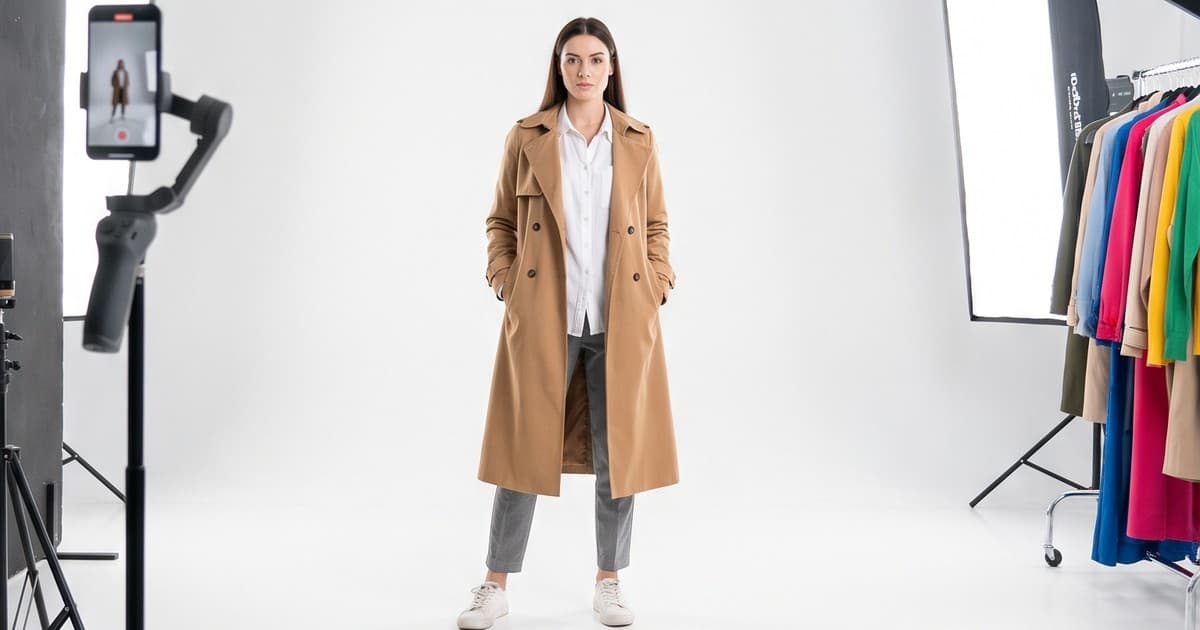
A fashion brand posting four Reels and four TikToks a week needs more than 400 short videos a year before it runs a single paid ad. Add Meta ad variations, product page clips, and Pinterest Idea Pins, and that number easily doubles. Most brands discover this the hard way: they book one beautiful shoot, get 12 polished videos back, and run out of content in three weeks.
So when someone searches for "a studio that can produce a series of social media videos for my fashion brand," the real question isn't just who can make good videos. It's who can make enough good videos, fast enough, at a cost that still makes sense in month six.
There are three realistic options in 2026:
- A video production studio (you rent the crew, space, and gear)
- A creative or social agency (you outsource strategy, production, and often posting)
- An AI video platform (you turn existing product photos into on-model video yourself)
This guide breaks down how each one works, what it really costs, where it shines, and where it breaks. By the end you should know which model fits your brand right now, and which mix fits it a year from now.
What "a Series of Social Videos" Actually Requires
Before comparing vendors, get clear on the job. A social video series for a fashion brand is not one hero film. It's a repeatable system that has to deliver:
- Volume: 15-40 short clips per month for organic, plus 10-30 ad variations if you run paid social
- Format coverage: 9:16 vertical for TikTok, Reels, and Shorts; 4:5 for feed; sometimes 1:1 for marketplaces
- Product accuracy: the garment's color, print, fit, and drape have to match what the customer receives
- Speed: new drops, restocks, and trends move in days, not quarters
- Consistency: the same visual identity across every clip so the feed reads as one brand
- Iteration: the ability to test hooks, scenes, and models, then double down on winners
Any production option you choose has to be judged against all six. A studio can win on craft and lose on volume. An agency can win on strategy and lose on speed. AI can win on volume and speed but needs a human with taste to direct it.
Option 1: Hiring a Video Production Studio
How it works
You book a production studio (or a freelance crew plus a rented space) for a shoot day. You supply the garments. They supply the director, camera operator, lighting, set, and often hair, makeup, and models through a casting agency. After the shoot, an editor cuts the footage into deliverables.
What it costs
Costs vary a lot by city and crew, but a typical one-day social shoot for a fashion brand looks something like this:
| Line item | Typical range |
|---|---|
| Studio rental (full day) | $800 - $3,000 |
| Director / DP + camera package | $1,500 - $5,000 |
| Models (2-3, day rate + usage) | $1,500 - $6,000 |
| Hair, makeup, stylist | $1,000 - $3,000 |
| Editing (10-20 short clips) | $1,500 - $5,000 |
| Total per shoot day | $6,000 - $22,000 |
That shoot typically yields 10-25 finished social clips. Divide it out and you're often paying $400-$1,500 per video. That's before shipping samples, reshoots for missing SKUs, or paying again for extended model usage rights.
Where studios shine
- Hero content. Campaign films, brand launches, and anything that needs real choreography or a specific location.
- Craft and control. You're on set. You can see the drape, adjust the light, and ask for one more take.
- Complex physical interaction. Models getting into cars, splashing in pools, dancing in groups.
Where studios break
- Volume. You can't book a shoot every week for every new SKU without a serious budget.
- Speed. Planning, casting, shooting, and editing usually takes 2-6 weeks end to end.
- Iteration. If a hook works, you can't easily make 10 more versions next Tuesday. The crew is gone.
- Sample logistics. Every product has to physically exist and be on set. Late samples mean missing content.
Verdict: Studios are excellent for a few campaign moments per year. They are a poor fit as the engine for a weekly social series.
Option 2: Hiring a Creative or Social Media Agency
How it works
An agency takes on some or all of the content function: strategy, creative direction, production (often subcontracted to studios or creators), editing, and sometimes community management and posting. You usually sign a monthly retainer with a defined number of deliverables.
What it costs
| Agency model | Typical monthly retainer | Typical output |
|---|---|---|
| Boutique social agency | $3,000 - $8,000 | 12-20 videos + captions |
| Full-service fashion agency | $10,000 - $30,000+ | 20-40 videos + strategy + paid creative |
| Creator / UGC agency | $2,000 - $10,000 | 10-30 creator-style videos |
Per video, agencies often land in a similar $250-$1,000 range. The difference is what's bundled: you're also paying for strategy, project management, and someone who knows what's working on TikTok this month.
Where agencies shine
- Strategy and trend literacy. Good social agencies know formats, hooks, and platform algorithms better than most in-house teams.
- Bandwidth. If you have no marketing team, an agency gives you one overnight.
- Creator networks. UGC-focused agencies can bring real people with real audiences.
For a deeper look at when creator content beats polished content, see our breakdown of UGC vs AI product photography for fashion brands.
Where agencies break
- Turnaround. Briefs, approvals, revisions, and the agency's own production schedule add up. Two to three weeks from brief to post is common.
- Fixed output. Your retainer buys a set number of videos. Need 30 extra ad variations for Black Friday? That's a change order.
- Brand knowledge loss. Account teams turn over. Every new person needs to relearn your fit notes, color standards, and tone.
- Still bound by physical production. Most agencies still shoot real garments on real people, so they inherit the same sample and scheduling limits as a studio.
Verdict: Agencies are a strong choice when you need strategy and a team, not just footage. They get expensive fast if your main problem is volume.
Option 3: Using an AI Fashion Video Platform
How it works
Instead of shooting video, you start with images you already have: flat-lays, mannequin shots, ghost mannequin photos, or existing model photos. An AI video platform generates on-model video of the garment, with a chosen model, scene, and motion style. You review, pick the best takes, and publish.
With Tellos AI Video Studio, the workflow is:
- Upload your look (any flat-lay, mannequin, or product photo)
- Pick your model by look, body type, and style, or use a custom brand-trained model
- Choose the vibe such as NYC street style, clean studio, UGC-look, or Paris runway
- Download and publish to TikTok, Reels, Shopify, Meta Ads, or YouTube Shorts
Under the hood, platforms like Tellos can draw on leading generative video models such as Sora, Kling, and Runway. Those models are the engine. The platform layer is what makes them usable for fashion: garment fidelity, consistent models, ecommerce-ready formats, and a workflow your team can run every day without writing prompts.
What it costs
AI video pricing is usually subscription or credit-based. For most fashion brands, the effective cost lands in the range of a few dollars to the low tens of dollars per finished clip, depending on volume and plan. There is no studio, crew, model day rate, or sample shipping.
Where AI shines
- Volume. Producing 100+ videos a month is realistic. We cover this in detail in fashion video content at scale.
- Speed. Videos are ready in minutes, so you can react to a trend the same day.
- Every SKU gets video. Not just the hero products. Long-tail items and colorways get motion too, which matters for product page conversion.
- Iteration. Same garment, five models, three scenes, two hooks. Test it all and keep what wins.
- No samples required. If you have a good product photo, you can make video before inventory even lands.
Where AI needs care
- Garment accuracy needs review. Complex prints, fine jewelry, sheer fabrics, and hardware need a human check before posting. A specialized fashion platform handles this far better than a general-purpose video model, but QA is still part of the workflow.
- Complex physical action is harder. Group choreography or detailed interaction with props is still better shot live.
- Creative direction still matters. AI removes the production bottleneck, not the need for taste. Someone on your team still decides what the brand looks like.
Verdict: AI is the strongest fit when the job is a steady series of social videos across many products. It's the only option of the three where volume and speed don't push the cost up linearly.
Side-by-Side Comparison
| Factor | Video Studio | Agency | AI Video Platform |
|---|---|---|---|
| Typical cost per video | $400 - $1,500 | $250 - $1,000 | Low single to low double digits |
| Turnaround | 2 - 6 weeks | 2 - 3 weeks | Minutes to hours |
| Realistic monthly volume | 10 - 25 per shoot | 12 - 40 per retainer | 100+ |
| Needs physical samples | Yes | Usually | No |
| Easy to iterate on winners | No | Slow | Yes |
| Strategy included | No | Yes | No (you or your team) |
| Best for | Campaigns, hero films | Brands without a marketing team | Ongoing series, ads, PDP video |
| Covers long-tail SKUs | Rarely | Rarely | Yes |
Which Option Fits Your Brand?
There is no single right answer. It depends on your stage, your team, and what you need the videos to do.
You're an early-stage brand with under 50 SKUs
You need content that looks professional and you need lots of it, but you don't have a $10,000 monthly content budget.
- Lead with AI for your weekly social series and product page videos
- Skip the agency until you have enough revenue that strategy is the bottleneck
- Book one studio day per year for a brand film or launch campaign, if at all
If you're launching from scratch, our guide on launching a fashion brand with AI content walks through the full setup.
You're a growing DTC brand with an in-house marketer or two
You have someone who understands your brand and your channels, but they're drowning in production requests.
- Make AI your production engine so your marketer spends time on ideas, not logistics
- Use studios for 2-4 campaign moments per year where you want something cinematic
- Use a UGC creator network selectively for testimonial-style content
You're an established brand with a large catalog
You likely already have studio relationships and possibly an agency. The gap is usually coverage: hero products get great video, and the other 80% of the catalog gets nothing.
- Keep the agency for strategy and campaigns
- Add AI to cover every SKU and colorway with on-model video
- Use AI for ad testing at volume and feed winners back into bigger productions
You have no marketing team at all
An agency is the fastest way to get strategy and execution together. But ask any agency you talk to how they produce volume. Many now use AI platforms behind the scenes, and you may be able to get the same output for less by running the AI layer yourself and paying the agency only for strategy.
How to Brief Any Partner for a Social Video Series
Whatever you pick, a clear brief saves weeks. Include:
- Volume and cadence: "20 vertical videos per month, 5 per week"
- Channels and formats: TikTok, Reels, Shorts, Meta Ads, Shopify PDP
- Product list: SKUs, colorways, and which ones are priorities
- Fit and fabric notes: how the garment should drape, stretch, or move
- Visual identity: reference brands, color palette, model casting direction, scene types
- Hooks and formats you want to test: outfit transitions, GRWM, "3 ways to style," new drop reveals
- Approval process: who signs off, and how fast
- Success metrics: watch time, saves, click-through, ROAS on ads
For platform-specific guidance on what performs where, see TikTok Shop vs Instagram Shop for AI fashion video and TikTok product videos with AI.
A Hybrid Model That Works for Most Fashion Brands
In practice, most fashion brands that post consistently in 2026 run a hybrid:
- 70-90% of social and ad video from AI. This covers new drops, every SKU, colorway variations, ad hook tests, and trend reactions.
- 10-30% from real-world production. This covers campaign films, founder content, behind-the-scenes, and creator partnerships.
- Strategy owned in-house or by a lean agency. This covers deciding what to make, what to test, and what to scale.
This mix gives you the authenticity of real footage where it counts and the volume of AI everywhere else. It also changes the economics. Instead of spending $15,000 to get 15 videos, you might spend a fraction of that and get 150, then put your studio budget toward the two or three moments a year that really deserve it.
If you're weighing the photography side of this decision too, our comparison of fashion photography outsourcing vs AI covers the same tradeoffs for still images.
Questions to Ask Before You Sign Anything
For a studio:
- How many finished, edited clips do we get per shoot day?
- What are the model usage rights, and for how long?
- What does a reshoot cost if a SKU is missing or a color is off?
For an agency:
- How do you actually produce the videos: in-house crew, freelancers, creators, or AI?
- What's the turnaround from brief to approved video?
- What happens if we need 3x the volume for a launch or a sale?
For an AI platform:
- How well does it handle my specific garments: prints, sheer fabrics, knits, hardware?
- Can I use consistent models across my whole catalog?
- Does it export the formats I need for TikTok, Reels, and my Shopify product pages?
- Who owns the output, and can I use it in paid ads?
The answers will tell you quickly whether a partner can support a real series or just a one-off.
The Bottom Line
If you need a few stunning campaign films a year, book a studio. If you need someone to own strategy and you have the budget, hire an agency. If you need a steady series of social media videos that covers your whole catalog, keeps up with trends, and doesn't cost more every time you grow, build your engine on AI and use the other two where they add the most value.
The brands winning on social right now are not the ones with the biggest shoot budgets. They're the ones that post consistently, test constantly, and put video on every product.
Ready to build your social video series without booking a single shoot? Try Tellos AI Video Studio and turn your existing product photos into on-model fashion videos for TikTok, Reels, and Shopify in minutes.