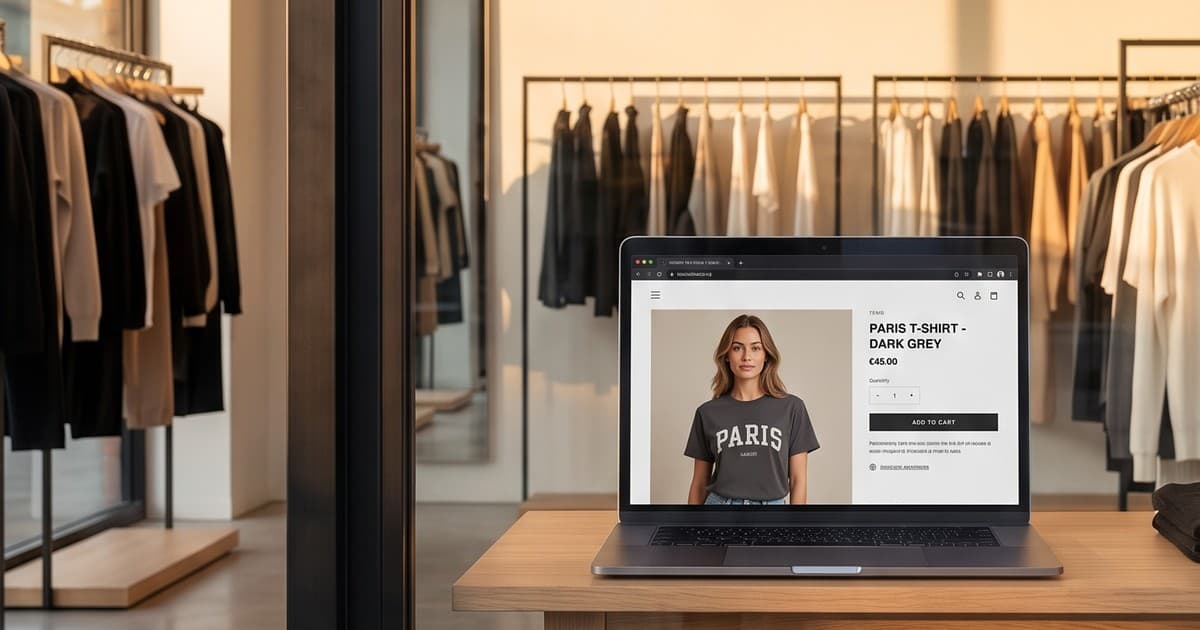
Your Shopify fashion store's product page is working against you in ways your analytics dashboard won't show you directly. The median fashion and apparel store converts at just 0.9% to 1.2%, well below the general ecommerce average of 2.5-3.0%. Meanwhile, the top 20% of fashion Shopify stores convert 40-65% above category average. Same platform, same theme options, same app ecosystem - wildly different outcomes.
The gap isn't traffic quality or ad spend. It's what happens in the eight seconds after a shopper lands on your product detail page (PDP). Fashion buyers can't touch the fabric, can't try on the fit, and can't verify that the color on their screen matches what shows up in the box. Every unanswered question about size, material, and trust is a reason to hit the back button.
This is a practical, section-by-section breakdown of where Shopify fashion stores lose conversions on the PDP, and exactly what to fix first.
Why Fashion Converts Differently Than Every Other Shopify Category
Before touching a single element on your product page, it's worth understanding why fashion is structurally harder to convert than home goods, beauty, or supplements.
Sizing uncertainty drives roughly 52% of fashion cart abandonment. Unlike a candle or a protein powder, a garment either fits or it doesn't, and shoppers have been burned before. That memory of ordering a "medium" that fit like a small follows every fashion shopper to every new store.
Style-fit anxiety is a second, separate barrier. Even when a shopper is confident about size, they're still asking "will this actually look good on me?" - a question sizing charts don't answer.
Trend velocity cuts both ways. Limited drops create urgency, but they also create decision pressure that can push hesitant shoppers to abandon rather than commit.
None of this means fashion stores are doomed to lower conversion. It means the PDP has to do more work than PDPs in other categories - it has to replace the fitting room, not just describe the product.
The Fit Certainty Problem (And Why It's Your Highest-Leverage Fix)
If you fix only one thing on your Shopify fashion PDP, fix this. Sizing confusion is the single most expensive and most commonly neglected conversion barrier in fashion ecommerce, and it's usually the cheapest to fix.
Put model specs where shoppers can't miss them
A single line - "Model is 5'9", 130 lbs, wearing a size S" - does more conversion work than an entire measurement grid. Shoppers don't compare themselves to a table of numbers; they compare themselves to a person. If your product images don't already include this, it's a same-day fix with measurable upside.
Make the size guide one tap away, not a separate page
Every extra click between "I'm not sure what size to get" and an answer is a shopper who leaves instead of clicking through. The size guide should sit directly next to the size selector on the PDP, not buried in a shipping/returns page or a nav dropdown.
Static charts underperform - interactivity is what moves the needle
A 2024 meta-analysis of 38 fashion retailers found that static size charts improve conversion by only 3-5%, while interactive guides that recommend a specific size based on shopper input deliver a 14% conversion lift and reduce return rates by 23%. If your Shopify store still links out to a flat measurement table, that's the gap between "informational" and "actually converting."
Add fit notes wherever the product deviates from standard
"Runs small," "true to size," "relaxed through the hip" - these three-word notes prevent the single most common return reason in apparel: ordering the wrong size because nothing on the page said otherwise.
Show more than one body type
Fit-specific imagery across different body types isn't just an inclusivity checkbox - it's a functional part of answering "will this fit someone shaped like me?" Stores that show a product on multiple body types close a real information gap that a single sample-size model shot leaves open.
| Fit Signal | Conversion Impact |
|---|---|
| No size guide | Baseline (highest abandonment) |
| Static size chart | +3-5% |
| Model specs + size chart | Moderate lift |
| Interactive size recommendation | +14%, -23% returns |
| Fit notes + multiple body types | Highest cumulative lift |
Your Product Images Are Doing the Job the Fabric Should Be Doing
Fashion is the most visually- and sensory-dependent category in ecommerce, and it's the one category where the shopper genuinely cannot verify the product before buying. Your imagery has to substitute for touch.
Lead with a model shot, not a flat lay
Flat lays and ghost mannequins tell a shopper what a garment looks like. They don't tell them how it drapes, how it moves, or whether it will suit their body. Lead your gallery with a model shot and use flat lays as supporting detail images, not the hero image.
Cover angles that actually answer questions
Front, back, side, a fabric close-up, and - if the budget allows - a movement shot. 8-12 purposeful images consistently outperform 20 nearly-identical ones. More images isn't the goal; more distinct information is.
Photograph in natural light, not only studio lighting
Studio lighting is controlled and flattering, but it can also flatten texture and misrepresent true color - which increases "not as described" returns. A natural-light shot, even just one in the gallery, gives shoppers a more honest read on color and material.
Add a product video showing movement and drape
Products with video convert 32-40% higher than identical listings with text-only content, according to aggregated data across 180,000+ product pages. For fashion specifically, video is doing something static images structurally cannot: showing how a garment behaves on a moving body - whether it clings, flows, stretches, or holds its shape.
This is exactly the gap Tellos' AI Video Studio was built to close for Shopify merchants who don't have the budget or timeline for a traditional video shoot on every SKU. More on that below.
Zoom that actually shows texture
If a shopper can't inspect the weave, the finish, or the stitching, they're making a semi-informed guess - and semi-informed guesses have a return rate attached to them. High-resolution zoom on fabric close-ups is cheap to implement in Shopify's native image tools and directly reduces "material felt cheap" returns.
Social Proof That Actually Answers Fashion-Specific Questions
Star ratings alone don't do enough work in fashion. A 4.5-star average tells a shopper the product is good. It doesn't tell them whether it will look good on them.
Lead with visual social proof, not review text
Stores that display user-generated content (UGC) from real customers and influencers on the product page see a 29% higher conversion rate than stores relying on review text alone. The visual element answers the "will this look good on me" question that written reviews structurally can't.
Ask reviewers for height, weight, and size purchased
Change your post-purchase review prompt to explicitly ask: What's your height and weight? What size did you buy? How does it fit? You can't retroactively fix old reviews, but every new one becomes a fit data point for the next shopper.
Pull reviews above the fold
Most shoppers never scroll far enough to reach a review section buried at the bottom of the page. A star rating and a short, specific review snippet near the product title captures trust before the shopper has decided whether to keep reading.
Let shoppers filter by body type or size
"5'7" / Size M," "Curvy fit," "Petite" - filterable review tags let a shopper self-select for the reviews most relevant to them, rather than scanning fifty reviews hoping one mentions their body type.
Kill the Objections Sitting Right Next to Your Add-to-Cart Button
Fashion shoppers on the fence look for a reason not to buy. If your PDP doesn't proactively answer their objections, they'll assume the worst and leave rather than ask.
Move your returns policy onto the product page
"Free returns within 30 days" displayed next to the Add to Cart button removes one of the biggest unspoken objections in fashion ecommerce - the fear of being stuck with a size that doesn't fit. Returns are up double digits industry-wide; a clear, visible policy is one of the highest-leverage, lowest-effort changes available on any Shopify PDP.
Show delivery timelines clearly, not on a separate policy page
Shoppers don't like surprises, especially ones that cost them more time or money after they've mentally committed to buying. Put estimated delivery dates directly on the PDP.
Keep the CTA sticky on mobile
Mobile visitors convert at roughly 1.2% versus 1.9% on desktop - a meaningful gap driven largely by checkout and CTA friction on small screens. A sticky "Add to Cart" bar that stays visible while scrolling is one of the highest-ROI, lowest-effort fixes available for mobile-heavy fashion traffic.
Increase AOV Without Undermining Trust
Once a shopper has decided to buy, the PDP still has one more job: helping them buy more, without feeling upsold.
"Complete the Look" outperforms generic recommendations
Curated, tightly-scoped styling bundles - three or four items that genuinely work together - consistently outperform a wall of loosely related "you might also like" products. Research from a Forrester study commissioned by Stylitics found AI-powered outfitting modules drove a 15% conversion lift and a 10% AOV increase when the module is actually seen - the caveat being visibility. Gray, low-contrast module headers get scanned past; bold, high-contrast headers get clicked.
Make the module visually impossible to miss
If your "Complete the Look" or "You May Also Like" section uses a gray header on a white background, it's probably being scanned past entirely. Visual hierarchy failure is the single most common reason a well-built recommendation module underperforms its potential.
Add a jumplink that earns the scroll
A benefit-led jumplink above the fold - "See items that go with this" rather than a generic down-arrow - signals there's something worth scrolling for, rather than hoping the shopper discovers it by accident.
Where Shopify Fashion Stores Get Video Wrong (And How to Fix It)
Product video is one of the highest-leverage fixes on this entire list, and it's also the one most Shopify fashion merchants skip - not because they don't believe in it, but because traditional video production doesn't scale to a full catalog.
A studio shoot for even a modest fashion catalog means booking a model, a photographer, a studio, and days of editing - per collection, sometimes per SKU. That math doesn't work for most Shopify merchants, so most fashion stores end up with video on their three bestsellers and static images on everything else, which means the majority of the catalog is still asking shoppers to imagine movement and drape rather than see it.
This is the specific gap Tellos' AI Video Studio is built to close. Instead of a traditional shoot, merchants turn existing product photography into on-model video content showing movement, drape, and fit - at a fraction of the cost and time of a studio production, and at a scale that covers a full catalog rather than just the hero products.
It's worth being clear about what this actually is: AI video generation models like Sora, Kling, and Runway are the underlying technology that makes this kind of content possible at scale - they are not products merchants choose between and Tellos. Tellos sits on top of that technology as the workflow layer purpose-built for ecommerce: turning product photos into commerce-ready video, at the volume a real catalog requires, without a merchant needing to prompt-engineer a general-purpose video model themselves.
For a Shopify fashion store trying to close the "how does this move" gap across dozens or hundreds of SKUs, that's the difference between video being a nice-to-have for three bestsellers and a standard part of every product page.
A Practical Audit: Score Your Own PDP
Before making changes, it helps to know where your biggest leak actually is. Score your product page 1-5 on each of these:
- Fit Certainty - Do you list model specs, offer a size tool, and include fit notes?
- Visual Sensory Replacement - Does your imagery (and video) convey texture, movement, and fabric quality?
- Social Proof Specificity - Do your reviews include height, weight, and size bought?
- Aspirational Context - Do you show the garment styled and in use, not just laid flat?
- Frictionless Action - Is your CTA sticky? Is size selection above the fold?
A total score of 20-25 puts you in elite territory. 15-19 is competitive, but there's a leak somewhere worth finding. Below 15, you're likely losing sales in more than one place at once - start with Fit Certainty, since it's consistently the highest-impact, lowest-effort fix across fashion PDPs.
Where to Start This Week
If you only have time to ship a handful of changes before your next traffic spike, prioritize in this order:
- Add model specs (height, weight, size worn) to your product images. Single-day fix, immediate clarity gain.
- Move your size guide next to the size selector, not linked from a separate page.
- Put your returns policy next to the Add to Cart button.
- Add a sticky mobile Add to Cart bar.
- Change your review request to ask for height, weight, and size purchased.
- Add video to your top 10-20 SKUs by traffic, prioritizing the products where "how does this move/fit" is the most common unanswered question.
None of these require a redesign. They require identifying exactly where your shoppers' doubt lives on the page, and answering it before they have to ask.
Fashion ecommerce doesn't convert like other categories because the buying decision genuinely is harder without a fitting room. The stores winning on Shopify right now aren't the ones with the prettiest theme - they're the ones that have systematically replaced everything a physical store gives a shopper: the ability to check the fit, feel the fabric, and see it move.
Ready to close the video gap on your product pages without booking a studio for every SKU? See how Tellos' AI Video Studio turns your existing product photos into on-model video - built specifically for Shopify fashion catalogs that need video at scale, not just on the bestsellers.