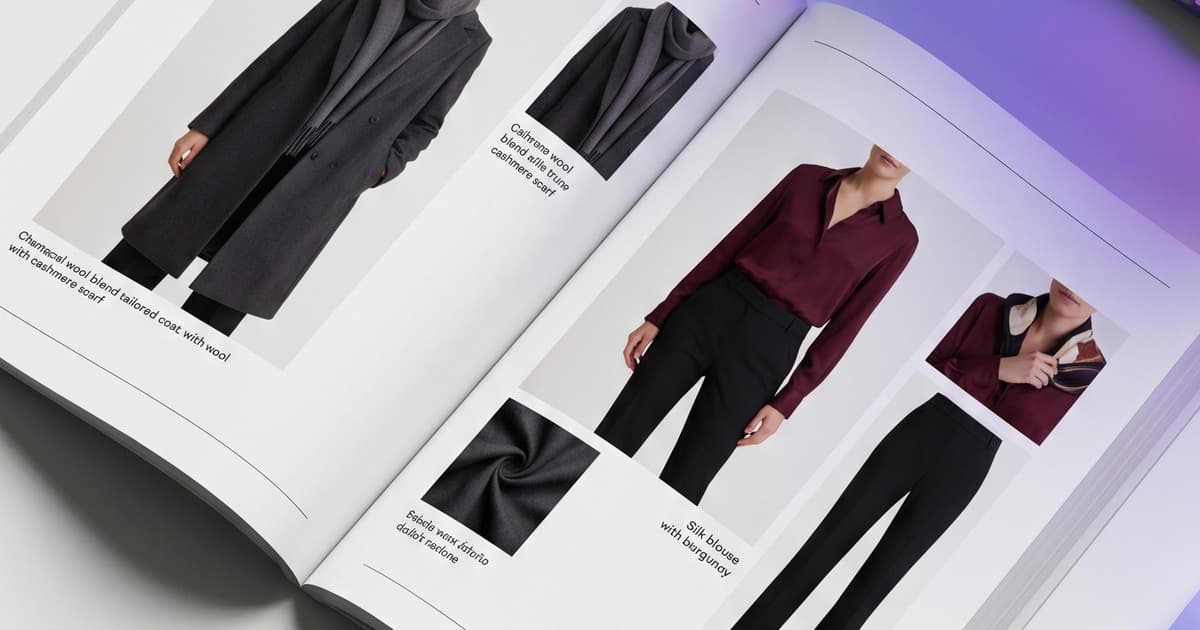
Every fashion brand knows the feeling: your new collection is weeks away from arriving, wholesale buyers want to see it now, your launch date is locked in, and you have zero finished samples to photograph.
This is the seasonal crunch — and it kills more launch timelines than any other single factor in fashion production.
The brands that win are the ones who've figured out how to decouple lookbook production from physical inventory. AI makes that possible.
The Traditional Seasonal Lookbook Timeline (And Why It Breaks)
Let's walk through how seasonal lookbook production typically works — and exactly where it falls apart.
How the old timeline is supposed to go
- Months before launch: Finalize collection designs, send to production
- 6–8 weeks before launch: First samples arrive from manufacturer
- 4–6 weeks before launch: Book photographer, models, location, styling team
- 3–4 weeks before launch: Shoot day(s) — hopefully samples fit, hopefully they're clean, hopefully everyone shows up
- 2–3 weeks before launch: Post-production editing, layout design
- 1–2 weeks before launch: Lookbook finalized, distributed to buyers and posted online
- Launch day: Everything goes live
On paper, this works. In practice, it almost never goes according to plan.
Where it actually breaks
Samples arrive late. Manufacturing delays are the rule, not the exception. If your samples arrive 2 weeks late, your entire lookbook timeline collapses — unless you push the launch, which creates its own cascade of problems.
Samples arrive damaged or wrong. Colors don't match. Stitching is off. The sample you receive looks nothing like the design. You can't shoot it yet. Another week gone.
The shoot itself creates delays. Models cancel. The location falls through. The photographer's editing backlog is longer than expected. Every link in this chain is a potential failure point.
Wholesale buyers don't wait. B2B buyers need to see your collection before their order windows close — which often happens before your retail launch. If your lookbook isn't ready, you miss the buying cycle entirely and wait another season.
The result: Brands either rush the lookbook (and it shows), push the launch date (and lose momentum), or skip the wholesale window (and lose revenue).
What AI Changes About Seasonal Production
AI lookbook generation doesn't just speed things up — it fundamentally changes when in the timeline you can produce lookbook-quality content.
With traditional photography, you need the physical garment in front of a camera. That's a hard dependency that has always defined the timeline.
With AI, the inputs are different:
- Tech packs (design specifications, measurements, technical drawings)
- Flat-lay photographs of early samples or even pre-production fabric swatches
- Digital design files from your CAD or PLM system
- Mood boards and reference imagery
You don't need finished, retail-ready samples. You need enough to give the AI a clear picture of the garment. In many cases, brands can generate lookbook-quality imagery weeks before they'd ever be ready to book a traditional shoot.
The AI Seasonal Lookbook Workflow
Here's how the production process looks when you replace the traditional shoot with AI generation:
Step 1: Prepare your garment inputs (Day 1)
Instead of waiting for finished samples, you work with what you have:
- Early samples: Even imperfect early samples work. A flat-lay on a clean background is enough for the AI to understand the garment.
- Fabric swatches + tech pack: For garments that haven't arrived yet, submit your design specs and material references.
- Previous season pieces in similar silhouettes: For colorway variations, AI can work from an existing garment and apply new colors/patterns.
The preparation step typically takes a few hours, not days.
Step 2: Define your seasonal aesthetic (Day 1–2)
Every season has a visual identity — a color palette, a mood, a setting. With AI, you define this upfront:
- Background environments: Sun-drenched Mediterranean terrace for summer, cozy layered interiors for fall/winter
- Lighting style: Soft and airy or rich and moody
- AI model selection: Choose models that fit your brand's casting direction — diverse, size-inclusive, brand-aligned
- Styling context: What accessories, textures, and layering complete the look
This is essentially your art direction brief, and it takes a fraction of the time of a traditional pre-production meeting.
Step 3: Generate (Day 2–3)
Upload your garments, apply your aesthetic parameters, and generate. Depending on collection size:
- 10–30 pieces: Results in hours
- 50–100 pieces: Typically a full business day
- 100+ SKUs: One to two days with batch processing
You review, select the best outputs, and request re-generations for any shots that don't land right. The iteration cycle is fast — minutes rather than hours or days of waiting for a photographer's editing queue.
Step 4: Layout and distribute (Day 3–5)
With your generated images in hand, you move straight into lookbook layout. Because AI generation maintains visual consistency — same model, same lighting, same color grading across all pieces — the layout process is dramatically faster. There's no post-production work to make everything match.
From generation to a print-ready or digital lookbook PDF: 2–3 days for a full collection.
Total timeline: 5–7 business days from inputs to finished lookbook
Compare that to the traditional 6–8 week window. And crucially: you can start this process the moment you have early samples or even just flat-lays — not when finished production samples arrive.
Real Scenarios Where This Changes Everything
Scenario 1: The wholesale buyer window
Your SS27 collection needs to be presented to wholesale buyers in March. Your production samples won't arrive until late February. Traditionally, you'd be racing against a 2-week window to shoot, edit, and produce a lookbook.
With AI: You shoot flat-lays of your first samples the day they arrive (or even earlier, using tech pack inputs), run AI generation, and have a wholesale-ready lookbook before your buyer meetings — with time to spare for adjustments based on buyer feedback.
Scenario 2: Pre-order campaign launch
You're launching a pre-order campaign 8 weeks before your collection ships. You have one production sample per colorway, and they're not perfect yet. You can't photograph them in a way that would look polished.
With AI: That imperfect sample becomes input. You generate clean, professional on-model lookbook shots that represent the final product accurately. Your pre-order page looks like a finished collection launch. Customers buy with confidence.
Scenario 3: Trade show presentation
You're presenting at a trade show 6 weeks out. Your collection is in production and you have technical drawings and 3 finished samples. You need a polished visual presentation — not sketches.
With AI: Generate full lookbook imagery from your available samples and tech packs. Bring printed lookbook pages to the show. Buyers see a professional, cohesive collection — not a half-finished prototype.
Scenario 4: The last-minute drop
A trend opportunity emerges and you want to add a capsule drop to your seasonal lineup. You have 2 weeks. There's no time to book a traditional shoot.
With AI: Generate the capsule lookbook in 2–3 days. Launch on time. Capture the trend window.
Consistency Across the Full Seasonal Collection
One of the underrated advantages of AI for seasonal lookbooks is visual consistency.
In traditional shoots, maintaining consistency across a full collection is genuinely difficult:
- Multi-day shoots may have slightly different lighting setups
- Models change between sessions
- Post-production corrections introduce subtle variations
- If you do reshoots, matching the original look exactly is hit-or-miss
AI generates every image from the same base parameters. The same virtual model, the same lighting model, the same background environment, the same color treatment — across your entire collection, whether it's 15 pieces or 150.
For buyers reviewing a wholesale catalog, that consistency signals professionalism and brand control. For consumers browsing your seasonal campaign, it creates a cohesive visual story that builds brand identity.
Seasonal Lookbooks as Multi-Channel Content Assets
The images you generate for your seasonal lookbook aren't just for the lookbook itself. Every AI-generated shot is a high-resolution content asset you can repurpose across your entire marketing calendar:
- Product detail pages (PDPs): On-model shots for every SKU
- Email campaigns: Seasonal launch announcements, collection previews, buyer emails
- Social media: Feed posts, stories, reels stills across Instagram, TikTok, Pinterest
- Paid ads: Facebook/Instagram/TikTok creative with consistent visual identity
- Wholesale line sheets: Professional imagery for B2B distribution
- Website banners and hero images: Collection feature sections
One AI lookbook production session generates enough content to fuel your entire launch campaign. That's not possible with traditional shoot economics — where more photos means more cost.
For a deeper look at how to turn one AI shoot into a full content calendar, see Fashion Brand Content Calendar: How AI Makes Every Shooting Day a Content Goldmine.
The Pre-Order Advantage: Content Before Product Exists
One of the most powerful applications of AI seasonal lookbook production is for pre-order launches.
Increasingly, fashion brands — especially direct-to-consumer and independent labels — are moving to pre-order models. They present the collection, take orders, then go into production. This reduces inventory risk and improves cash flow.
The problem: pre-order requires compelling visuals before you have product to photograph.
AI changes the math on this entirely.
With tech pack data, design files, or even sketches plus fabric references, you can generate lookbook-quality images that accurately represent your final product. Pre-order pages look like finished collection launches. Crowdfunding campaigns have the professional visual credibility that drives conversions.
The key is accuracy — AI-generated pre-production images need to align with what customers actually receive. This means working from precise design inputs and reviewing outputs carefully against your specs. When done right, it's not "fake" imagery — it's a high-quality technical representation of the final product, the same way architectural renders represent buildings that don't exist yet.
See also: From Flat-Lay to Full Lookbook: How AI Transforms Product Photos into Editorial Content for how basic flat-lay inputs generate polished lookbook outputs.
What to Look for in a Seasonal AI Lookbook Platform
Not all AI photo tools are equal for seasonal lookbook production. Here's what matters for this specific use case:
Garment fidelity: The platform needs to accurately represent your garments — fabric texture, drape, construction details, color accuracy. Generic AI image tools often distort these. Purpose-built fashion AI maintains garment integrity.
Collection-scale consistency: You need the same model, lighting, and aesthetic applied uniformly across 15, 50, or 150 pieces. This requires a platform built for batch production, not single-image generation.
Aesthetic control: You need to define and lock in a seasonal look — background environment, lighting mood, styling direction — and apply it consistently.
Speed: For seasonal production to actually solve the timing problem, generation needs to happen in hours, not days. Batch throughput matters.
Revision cycles: You'll want to re-generate shots that don't land right. Fast turnaround on revisions is critical.
Export formats: For wholesale, you need print-ready high-res files. For digital, you need web-optimized assets. The right platform handles both.
The Competitive Reality
The brands that have figured out AI seasonal lookbook production have a structural advantage that compounds over time.
They launch every collection on schedule — no more rushed lookbooks or pushed dates. They hit wholesale buyer windows consistently. They run pre-order campaigns with confidence. They enter every season with a full content library ready to deploy.
Brands still dependent on traditional production timelines are working with an inherent handicap. They're constantly racing the calendar, making trade-offs between speed and quality, and missing opportunities because their content isn't ready.
The gap between AI-enabled brands and those still running traditional workflows is only going to widen as AI generation quality improves and speeds up.
Seasonal lookbook production is one of the clearest, most concrete ROI cases for AI in fashion — because the costs of the old approach are so visible and quantifiable: late launches, missed buyer windows, rushed content, reshoot costs.
Getting Started with AI Seasonal Production
If you've never done an AI-generated lookbook before, the seasonal collection is a practical place to start. Here's a simple first approach:
- Pick one category from your upcoming collection (e.g., tops or outerwear — pieces where fit and styling are important)
- Prepare flat-lays of your available samples, even early ones
- Define your seasonal aesthetic: 3–5 words that describe the visual mood you're going for
- Run a test generation with 3–5 pieces to calibrate the output
- Review, refine parameters, and scale to the full category
Most brands find the first test generation takes a few hours and produces publishable results for 60–70% of shots, with the remainder needing adjustments. By the second or third session, teams develop a rhythm and the hit rate climbs significantly.
Ready to Launch Your Next Season on Schedule?
Missing a launch date or a wholesale buyer window isn't a production problem — it's a revenue problem. AI seasonal lookbook production removes the hard dependency between your timeline and your samples, giving you the flexibility to produce professional content whenever you need it.
Tellos AI Photo Studio is built specifically for fashion brands producing at collection scale. Upload your garments, define your seasonal aesthetic, and generate consistent, high-quality lookbook imagery in a fraction of the time — without booking a single shoot day.
Whether your next collection drops in 6 weeks or 6 months, start producing content now.