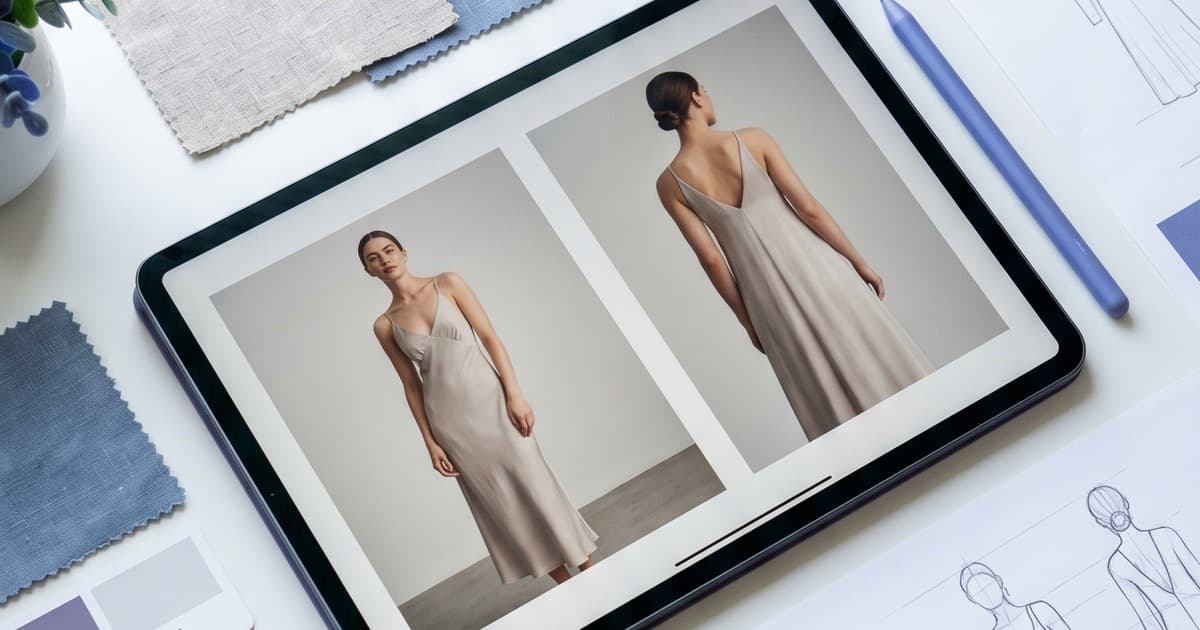
You've finalised the designs. The factory has confirmed production. Launch is six weeks out — but your pre-order page is live today, and it needs images.
There's one problem: no samples exist yet.
This is one of the most common and most painful bottlenecks in fashion ecommerce. Brands launch pre-orders to validate demand, fund production, or lock in wholesale buyers — but without physical product, traditional photography is off the table. The result is either a delay that kills momentum, or a live page built on mood boards and sketchy mockups that don't convert.
AI-generated product content changes that equation entirely. Here's how forward-thinking fashion brands are using it to launch compelling pre-order campaigns, crowdfunding pages, and collection previews — before a single sample leaves the factory.
The Pre-Order Problem Nobody Talks About
Pre-order selling has exploded across fashion ecommerce. It de-risks inventory, creates urgency, and helps small brands fund production without taking on debt. But the content gap is real.
Consider the typical pre-order timeline:
- Design finalised → 3–4 months before launch
- Production starts → 2–3 months before launch
- Samples arrive → 2–6 weeks before launch
- Photography scheduled → 1–3 weeks before launch
- Edited images delivered → days before launch (if you're lucky)
By the time you have professional visuals, half your pre-order window has already passed. The brands that win at pre-order selling are the ones who can show the collection convincingly from day one — not from week eight.
The same problem shows up in slightly different forms across different business models:
- Crowdfunding campaigns (Kickstarter, Indiegogo) need images to go live at launch, but production hasn't started yet
- Wholesale buyers expect a proper lookbook at trade shows, often months before production finishes
- Investor decks need polished visuals to communicate brand vision — not sketches
- DTC pre-launches need hero images, social content, and email assets before samples ship
In each case, the solution used to be: delay until you have samples, or publish sub-par visuals and hope customers will buy on faith. Neither is a great option.
What AI Can Work With (Before Any Samples Exist)
The good news is that AI image generation doesn't need a physical garment to produce a realistic product photo. It needs information about the garment — and fashion brands typically have plenty of that before production starts.
Here's what works as input:
Tech Packs and Technical Drawings
A tech pack is a detailed specification document that describes every aspect of a garment: silhouette, measurements, fabric type, colour references, construction details, hardware, and trims. AI models trained on fashion imagery can translate these specifications into realistic visualisations — especially when combined with fabric swatches or Pantone references.
Digital Design Files
If your team works in tools like Adobe Illustrator, CLO 3D, or Browzwear, you likely already have digital versions of your garments. These flat or 3D renders are excellent inputs for AI image generation. The AI can take a clean digital render and project it onto a realistic AI model, complete with fabric draping, natural lighting, and appropriate styling.
Flat Lay Photographs of Fabric and Trims
Even when no garment exists, you often have fabric swatches, buttons, zips, labels, and other components. AI can use these as texture and colour references when generating product imagery — helping ensure the output matches your actual production materials.
Sketches and Mood Boards
For earlier-stage projects, detailed sketches with clear colour and fabric annotations can work as a starting point. The results are less precise than with tech packs, but still far more professional than presenting bare sketches to buyers or backers.
The AI Pre-Order Content Workflow
Here's how a modern fashion brand can move from finalised design to a live, image-rich pre-order page — without waiting for samples.
Step 1: Prepare Your Inputs
Gather your design assets. For best results: tech pack PDFs, any 3D renders, fabric swatches photographed flat on a neutral surface, and colour references (Pantone codes or accurate hex values).
Write a clear brief for each garment: silhouette type, intended styling, target customer aesthetic (minimal, streetwear, elevated basics, etc.), and any specific styling requirements (tucked vs. untucked, specific footwear pairing, outdoor vs. studio setting).
Step 2: Generate On-Model Visuals
Upload your inputs to your AI studio. For a pre-order content workflow, the most valuable output is on-model photography — it shows customers exactly how the garment looks worn, which is what drives purchase decisions.
Choose AI models that match your brand's aesthetic and represent your target customer. One of the key advantages of AI model casting is that you can instantly select from a diverse range of ages, body types, and aesthetics without agency fees or availability constraints.
Generate multiple shots per garment: front, back, detail, and at least one lifestyle or editorial-style image. Even for a pre-order page, variety gives customers confidence.
Step 3: Build a Cohesive Collection Narrative
Pre-order content isn't just about individual product shots — it's about selling the collection as a whole. AI makes it straightforward to maintain visual consistency across every piece: same model, same lighting setup, same background treatment, same colour grading.
This level of catalog visual consistency is actually harder to achieve in traditional photography, where slight differences in lighting or post-processing across a day's shoot can make a collection look disjointed.
Arrange your AI-generated images into a full lookbook layout: editorial opener, individual product pages, styling groupings (outfits built from pieces in the collection), and a closing spread. This is the content that converts wholesale buyers at trade shows and makes crowdfunding backers feel confident enough to commit.
Step 4: Extract Individual Asset Variants
From the same generation session, pull the assets you need for every channel:
- Pre-order page hero images (wide landscape crops)
- PDP thumbnail grid (front, back, detail)
- Social content (square and portrait crops, editorial shots)
- Email campaign visuals (header image, product thumbnails)
- Paid advertising creatives (multiple size variants)
You're essentially running a content calendar production session for a collection that doesn't physically exist yet.
Real Use Cases: Where Pre-Order AI Content Wins
Crowdfunding Campaigns
Crowdfunding is built on vision-selling. Backers are investing in something that doesn't exist yet — which makes visuals more important, not less. A Kickstarter page with realistic AI-generated product imagery showing the garments worn by diverse models in appropriate settings will dramatically outperform one built on sketches and fabric swatches.
The AI content also gives you a full asset library for your campaign updates, social posts during the campaign window, and backer communications — keeping momentum going throughout the funding period.
Wholesale Trade Shows
Wholesale buyers expect a professional presentation. Showing up to a trade show with a polished digital lookbook of your incoming collection — even if samples haven't arrived — positions you as an organised, credible brand. Many buyers will place conditional orders based on a strong presentation.
AI-generated lookbooks give you the option to launch each seasonal collection at the optimal moment for the buying calendar, not when your samples happen to be ready.
Investor and Press Decks
Fashion investors and press contacts want to see the brand vision, not just technical specs. AI-generated editorial imagery communicates your aesthetic and market positioning in a way that design sketches simply can't. A deck built around polished editorial fashion photography signals that you understand your brand identity and have the creative vision to execute it.
DTC Pre-Launch Campaigns
Building a waitlist or running early-access pre-orders is one of the most effective DTC strategies for new collections and brand launches. Email capture pages, social teasers, and early-bird offers all need compelling visuals. AI lets you run a full pre-launch campaign — with a complete content asset library — while your factory is still in production.
The Accuracy Question: Managing Customer Expectations
Let's address the elephant in the room. If you're generating product images before the garment exists, how do you ensure the final product matches what you showed?
This is a legitimate concern, and it requires a thoughtful approach:
Accuracy Considerations
Colour matching is the most critical variable. AI image generation can interpret colour references differently depending on the lighting and model skin tone in the generated image. Always provide precise Pantone or RGB references, and review generated images carefully against your fabric swatches. If your fabric is a very specific, difficult-to-reproduce shade, note this in your pre-order messaging.
Drape and texture are generally well-represented for common fabric types (cotton, denim, jersey, structured woven). More unusual fabrics — iridescent materials, very lightweight chiffon, heavily textured knits — may require additional iteration to represent accurately.
Construction details like top-stitching, seam placement, and hardware may be simplified in AI-generated imagery. For technical or workwear pieces where construction details are a key selling point, this needs careful review.
Best Practices for Transparent Pre-Order Selling
- Include a clear note on your pre-order page: "Images are pre-production visualisations. Final product will be as accurate as possible to these images — minor variations may occur."
- Show fabric swatches and close-up material photography alongside AI-generated lifestyle imagery
- Provide precise measurements and fit guides — this reduces uncertainty and return risk more than any visual can
- If your factory produces a physical sample before launch, photograph it for a comparison image and update your page
The Conversion Reality
Pre-order buyers are already accepting a degree of uncertainty — they're buying something that won't arrive for weeks or months. Professional, realistic imagery reduces the psychological barrier to purchase significantly more than managing expectations through caveats does. The goal is to be accurate and honest, but not to under-sell your collection.
Pre-Order AI Content vs. Traditional Options: A Comparison
| Approach | Cost | Timeline | Visual Quality | Flexibility |
|---|---|---|---|---|
| Wait for samples | $0 extra | Delays pre-order by 6–10 weeks | High | None |
| 3D CGI renders | $500–3,000/piece | 2–4 weeks per piece | Medium-High | Low |
| Mood boards / sketches | Low | Fast | Poor for sales | High |
| AI-generated visuals | Low per image | Hours | High | Very High |
The cost and speed advantages of AI are obvious. But the flexibility column is worth highlighting: with AI, you can iterate. If the first generation of images doesn't quite capture the garment correctly, you adjust the prompt and regenerate in minutes. If a buyer requests specific styling or background options, you can accommodate that without scheduling another shoot.
How Much Content Can You Generate?
For context on scale: a typical AI catalog production session for a 15–20 piece collection can produce:
- 60–80 on-model product shots (multiple angles per piece)
- 20–30 editorial/lifestyle images for lookbook and social use
- 15–20 detail shots highlighting key design features
- A complete lookbook (10–15 pages) ready for PDF export
- 100+ social media crops from the above assets
All generated in a single session, typically within a few hours. Compare that to the cost and logistics of a traditional catalog shoot for the same volume, and the business case is straightforward.
And unlike traditional photography, none of this requires your samples to be in-hand, in-country, or even finished.
Getting Started: What You Need
To run your first AI pre-order content session, you need:
- Design specs — tech pack or detailed sketch with fabric and colour callouts
- Fabric reference images — even a phone photo of swatches on a neutral background works
- Brand brief — aesthetic direction, target customer, styling references
- AI studio access — a platform like Tellos that handles model selection, generation, and output management
You don't need a photographer, a studio, a model agency, a sample, or a post-production budget. You need your designs and a clear brief.
The first session will teach you a lot about how to input information for best results. Most teams find that after one or two collection cycles, the process becomes faster and more accurate as they develop a consistent briefing template.
The Broader Shift: Pre-Production Content as Standard Practice
The brands building the most sustainable competitive advantages in fashion ecommerce right now aren't waiting. They're treating pre-production AI content as a standard part of the product development timeline — not an afterthought.
When you can launch a pre-order page with full professional imagery on the same day designs are finalised, you shift the entire commercial model. You can test market response before committing to production quantities. You can refine your assortment based on pre-order data. You can pitch wholesale buyers months earlier with a credible presentation. You can build email lists and social audiences during the production window rather than scrambling for content after.
The production constraint on fashion marketing — you need samples before you can sell — is no longer a hard constraint. It's a choice.
Ready to Launch Before Your Collection Exists?
Tellos makes it straightforward to generate realistic, on-model product imagery from your designs — whether you're working from tech packs, flat lays, or digital renders. Build your pre-order lookbook, wholesale catalog, or crowdfunding campaign assets in hours, not weeks.
Explore Tellos AI Video Studio →
Launch your collection on your timeline — not your factory's.