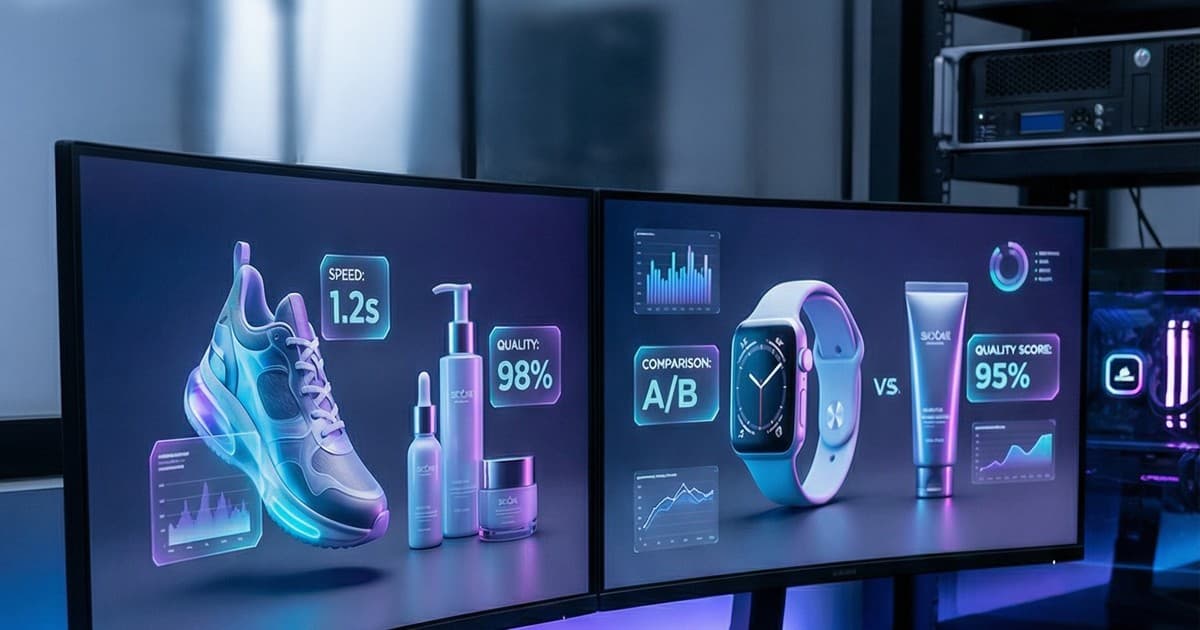
Quick answer: Nano Banana 2 is the better default for most ecommerce teams: it generates 1K images in 4-6 seconds versus 10-20 seconds for Nano Banana Pro, costs $0.101 vs $0.134 per 2K image and $0.151 vs $0.240 per 4K image, and reaches about 95% of Pro's quality. Nano Banana Pro is still worth the premium for hero campaign images, complex multi-subject scenes and large-format print. The strongest workflow uses NB2 for volume and Pro for the 10-20% of output that needs the highest quality ceiling.
If you're running product ads, building out a Shopify catalog, or managing creative for an Amazon brand - you've probably noticed that AI image generation just got more complicated. Since Google dropped Nano Banana 2 in February 2026, the question isn't whether to use AI for product imagery. It's which model, at which resolution, for which part of your workflow.
Nano Banana 2 and Nano Banana Pro are both powerful. Both come from Google's Gemini model family. Both support 4K output. So what actually matters for an ecommerce team? Let's break it down.
What Are These Models, and Why Should Ecommerce Brands Care?
Before we get into the comparison, here's the quick context.
Nano Banana Pro was Google's flagship AI image generation model - built on the Gemini 3 Pro architecture. It was designed for professional-grade creative work: brand campaigns, high-fidelity hero images, complex multi-subject scenes. If you've been using it for product photography stand-ins or catalog visuals, you know it delivers.
Nano Banana 2 is the next-generation model, built on the faster Gemini 3.1 Flash architecture. It became the default image model in the Gemini app on February 26, 2026. It's faster, cheaper, and introduces two features that matter a lot for ecommerce: Image Search Grounding (real-world web knowledge baked into generation) and Thinking Mode (adjustable reasoning depth per generation).
The way to think about it: Pro is the studio camera. NB2 is the smartphone camera that's now good enough for almost everything - and faster for everything else.
For an ecommerce operation generating hundreds or thousands of images per month, that distinction has real cost and workflow implications.
Nano Banana 2 vs Pro: Price, Speed and Quality Benchmark
Here's how the two models stack up on the dimensions that matter most to ecommerce teams:
The pricing difference doesn't look huge per image - but at scale, it's significant. If your team generates 10,000 images/month at 4K, that's $1,510 with NB2 vs. $2,400 with Pro. A 37% cost saving, with nearly equivalent output quality for most use cases.
7 Differences That Actually Matter for Ecommerce
1. Real-World Knowledge (Image Search Grounding)
This is NB2's most underrated feature for ecommerce brands. Image Search Grounding gives the model access to real-world web data during generation. That means it can render brand logos, known product styles, cultural references, and real-world locations more accurately than a model working from training data alone.
For a Shopify brand targeting international markets, or an Amazon seller with category-specific imagery needs (think: specific sneaker silhouettes, known packaging styles, regional aesthetics), this is a genuine differentiator. Pro doesn't have this capability at all.
2. Architecture and What It Means
NB2 runs on Gemini 3.1 Flash - optimized for speed and throughput. Pro runs on Gemini 3 Pro - a deeper, quality-first architecture with more capacity for complex scene understanding.
In practice: Pro is better at scenes with multiple subjects, precise spatial relationships, and subtle lighting setups. NB2 handles single-product shots, lifestyle imagery, and ad creatives with near-identical quality - just much faster.
3. Generation Speed (3–5x Faster)
This is the headline stat, and it matters operationally:
- 1K resolution: NB2 = 4–6 seconds | Pro = 10–20 seconds
- 4K resolution: NB2 = 15–30 seconds | Pro = 30–60 seconds
If you're running an A/B testing pipeline for ad creatives, or doing rapid iteration on product imagery for seasonal campaigns, NB2's speed compounds dramatically. A creative team generating 50 variants per day on Pro could theoretically run 150–250 with NB2 at the same wall-clock time.
4. Image Quality - The 95% Problem (And Why It's Not a Problem)
Pro produces richer textures, more natural lighting and shadow gradients, and superior spatial composition. NB2 hits approximately 95% of Pro's quality on standard ecommerce use cases.
For most product catalog shots, social ad creatives, and lifestyle imagery - the gap is invisible to a consumer scrolling their feed. Where it shows up: hero images for print, large-format display ads, and premium brand campaigns where every pixel is scrutinized.
One notable exception: NB2 outperforms Pro on Chinese character text rendering. If you're selling in Asia-Pacific markets and need multilingual text overlaid on images, NB2 is the better choice.
5. Thinking Mode - Better Prompts, Better Outputs
NB2's Thinking Mode lets you dial in how much reasoning the model applies to each generation:
- Minimal: Fast, great for simple product shots with clear prompts
- High: More deliberate composition, better for complex lifestyle scenes
- Dynamic: The model decides based on prompt complexity
For ecommerce teams, this is practically useful. You don't want the model burning compute time "thinking" about a straightforward white-background product shot. But for a campaign hero image with a specific mood, lighting, and lifestyle context - High Thinking can meaningfully improve first-pass quality and reduce revision cycles.
Pro has no equivalent feature.
6. Text Rendering
If you're overlaying product names, pricing callouts, or taglines directly in generated images, text accuracy matters.
- Pro: ~94% character accuracy
- NB2: ~92% character accuracy
The difference is small, and NB2's edge in multilingual rendering (especially CJK scripts) means it can actually be the better choice for brands targeting non-English-speaking markets. For pure English text overlays, Pro has a slight edge - but for most use cases, both models are reliable enough.
7. Aspect Ratio Flexibility
NB2 supports 14 aspect ratios vs Pro's 10. The additions that matter for ecommerce:
- 1:4 and 4:1: Ultra-wide banners and vertical format ads
- 1:8 and 8:1: Splash screens, app store hero banners, email headers
If you're managing creative across multiple ad platforms - Meta, TikTok, Pinterest, Google Display, email - the broader aspect ratio support in NB2 reduces the need for post-generation cropping and resizing. That's a real workflow win.
How Ecommerce Teams Should Actually Use These Models
The good news: you don't have to pick one. The best ecommerce creative workflows use both models strategically.
The Hybrid Approach
Many professional ecommerce operations are already running a tiered workflow:
- NB2 at 0.5K–1K: Rapid ideation, prompt testing, concept exploration. Dirt cheap, almost instant.
- NB2 at 2K: Refinement and review rounds. Near-Pro quality at a fraction of the cost.
- Pro at 4K: Final hero assets only - the homepage banner, the flagship product shot, the brand campaign imagery that runs in paid media at scale.
This approach reduces overall generation costs by up to 42% while preserving quality where it actually matters.
When to Default to NB2
Use NB2 as your go-to model when:
- Building out product catalogs - bulk generation of consistent product imagery across hundreds of SKUs
- Running A/B tests on ad creatives - you need 20+ variants fast, not 5 variants slowly
- Operating in multilingual markets - NB2's text rendering advantage in non-English scripts is meaningful
- Working with tight content deadlines - social campaigns, flash sales, seasonal pushes
- Keeping costs predictable - NB2's lower per-image cost makes budget forecasting easier at scale
When Pro Is Worth the Premium
Reach for Pro when:
- Producing hero images for paid campaigns - the images that drive the most spend deserve the highest quality floor
- Maintaining visual consistency across a series - character sheets, campaign sets, brand asset libraries where coherence across generations matters
- Complex multi-product compositions - think lifestyle shots with multiple products, human subjects, environmental context, and specific lighting
- Print or large-format output - retail signage, packaging, lookbooks where 4K quality is non-negotiable
Pricing Reality Check for Ecommerce Teams
Let's run the actual numbers for a mid-scale ecommerce operation generating 5,000 images per month at 2K resolution:
Scale that to 20,000 images/month (realistic for larger catalog operations or heavy A/B testing shops), and you're looking at $7,920/year in savings - just by defaulting to NB2 for non-hero content.
Both models support Batch Mode at 50% off for non-time-sensitive generation jobs. If you're doing overnight catalog refreshes or scheduled bulk generation, always use batch.
How Tellos Uses Both Models - So You Don't Have To Think About It
This is where the model decision stops being your problem.
Tellos is an AI video platform built specifically for ecommerce - and under the hood, it applies exactly the tiered model logic described above, automatically, based on where each piece of content sits in your workflow.
Here's how Tellos puts both models to work for your brand:
-
High-volume content generation (catalog assets, ad variants, social formats): Tellos routes to Nano Banana 2, using its speed, cost efficiency, and Image Search Grounding to generate accurate, on-brand product visuals at scale - without burning budget on Pro-level compute for every frame.
-
Hero content and brand-critical assets (campaign launches, homepage features, premium ad placements): Tellos applies Nano Banana Pro where the quality ceiling matters - ensuring your flagship visuals reflect the full capability of Google's best model.
-
Video creative workflows: Tellos takes AI-generated imagery from both models and feeds it into video generation pipelines using Sora, Kling, Runway, Pika, and more - transforming static product visuals into shoppable video content without a production crew.
The result: you get the speed of NB2 where you need volume, the quality of Pro where you need impact, and a video layer on top that turns your best imagery into converting content - all from a single platform.
You don't have to manually route prompts between models, manage API keys for both, or decide on a per-image basis which tier to use. Tellos handles the model logic so your team stays focused on the creative strategy, not the infrastructure.
For Shopify and Amazon brands that need to produce more content, faster, without proportionally increasing creative costs - that's the compounding advantage. See how Tellos approaches AI-powered ecommerce content.
Real Ecommerce Scenarios: Model Decision Guide
Scenario 1: Shopify fashion brand, 300 SKUs, seasonal refresh → NB2 at 1K for white-background product shots (catalog), NB2 at 2K for lifestyle variants, Pro at 4K for the hero banner and homepage feature.
Scenario 2: Amazon seller, 50 ASINs, main image testing → NB2 with Thinking Mode (High) at 2K for main image variants. Batch mode for 50% off. Run 5–10 variants per ASIN cost-effectively, pick winners, then Pro for the final version.
Scenario 3: D2C skincare brand, global markets including Korea and Japan → NB2 across the board - Image Search Grounding for regional aesthetics, superior CJK text rendering for localized overlays, broader aspect ratios for platform-specific ad formats.
Scenario 4: Brand running Meta and TikTok ads at scale → NB2 for creative variation and testing volume, Pro for the 3–5 "hero" creatives that get the highest daily budget allocation. AI-generated ad creatives are increasingly the standard for high-performing ecommerce campaigns - the key is knowing which tool fits each layer of the funnel.
Where AI Images Fit in a Full Ecommerce Creative Stack
AI image generation models like Nano Banana 2 and Pro are solving the static visual layer of ecommerce content. Product photos, ad backgrounds, lifestyle imagery, catalog assets - all of that is increasingly generated, not shot.
But ecommerce content doesn't stop at static images. The fastest-growing format in product marketing is video - and that's exactly the layer Tellos adds on top. That's the direction ecommerce content is heading, and the brands building these pipelines now are compressing content costs dramatically.
What's Coming Next
Google is clearly building toward a unified AI creative stack. Nano Banana 2's Image Search Grounding and Thinking Mode feel like early versions of features that will eventually be table stakes. A few things to watch:
- Thinking Mode evolution: Expect more granular control and task-specific reasoning modes as Google refines this
- Video generation integration: The Gemini 3.1 Flash architecture that powers NB2 is also the foundation for Google's video generation work - expect tighter image-to-video pipelines
- Pricing compression: As NB2 adoption scales, batch mode pricing may drop further. The 0.5K tier is already extremely cheap for rapid prototyping
Frequently Asked Questions
Is Nano Banana 2 better than Nano Banana Pro?
For most ecommerce work, yes. Nano Banana 2 is 3-5x faster, cheaper per image, reaches about 95% of Pro's quality on standard product and lifestyle shots, and adds Image Search Grounding, Thinking Mode and 14 aspect ratios. Nano Banana Pro still wins on complex multi-subject scenes, subtle lighting, English text accuracy and hero or print assets where every pixel is scrutinized.
How much does Nano Banana 2 cost compared with Nano Banana Pro?
Nano Banana 2 costs $0.101 per image at 2K and $0.151 at 4K, while Nano Banana Pro costs $0.134 at 2K and $0.240 at 4K. At 10,000 images a month in 4K that is $1,510 with NB2 versus $2,400 with Pro. Both models support Batch Mode at 50% off for jobs that are not time-sensitive, such as overnight catalog refreshes.
How fast is Nano Banana 2 compared with Pro?
Nano Banana 2 generates a 1K image in about 4-6 seconds and a 4K image in 15-30 seconds. Nano Banana Pro takes 10-20 seconds at 1K and 30-60 seconds at 4K. In practice, a creative team producing 50 variants per day on Pro could theoretically produce 150-250 with NB2 in the same wall-clock time, which compounds quickly in A/B testing pipelines.
Which Nano Banana model gives better quality for paid ads?
Use both. Nano Banana 2 handles creative variation and testing volume for Meta and TikTok ads, since the quality gap is usually invisible in a scrolling feed. Switch to Nano Banana Pro for the 3-5 hero creatives that get the highest daily budget, plus large-format display ads and premium campaigns, where Pro's richer textures, lighting and composition justify the higher per-image price.
Which Nano Banana model is best for high volumes of image generation?
Nano Banana 2. It is faster and cheaper, supports a low-cost 0.5K tier for rapid prototyping, and its Batch Mode is 50% off. A tiered workflow of NB2 at 0.5K-1K for ideation, NB2 at 2K for refinement and Pro at 4K only for final hero assets can reduce overall generation costs by up to 42% while protecting quality where it matters.
The Bottom Line
For most ecommerce teams in 2026, Nano Banana 2 should be your default model. It's 3–5x faster, ~25% cheaper at 4K, reaches 95% of Pro's quality on standard product and lifestyle imagery, and brings genuinely useful exclusive features (Image Search Grounding, Thinking Mode, wider aspect ratios).
Nano Banana Pro earns its premium for the 10–20% of your output that truly demands the highest quality ceiling - hero images, complex compositions, and large-format assets that anchor your brand visually.
The winning strategy isn't choosing one. It's building a workflow where each model does what it's best at - and having a platform that handles that routing automatically.
Start Building Smarter Ecommerce Content
AI image generation is just one layer of a modern ecommerce content stack. Tellos takes both Nano Banana 2 and Pro, applies them where they perform best in your workflow, and layers AI video generation on top - so your best product visuals become converting video content automatically.
No crew. No studio. No manual model management. Just your products, AI generation, and content that converts.