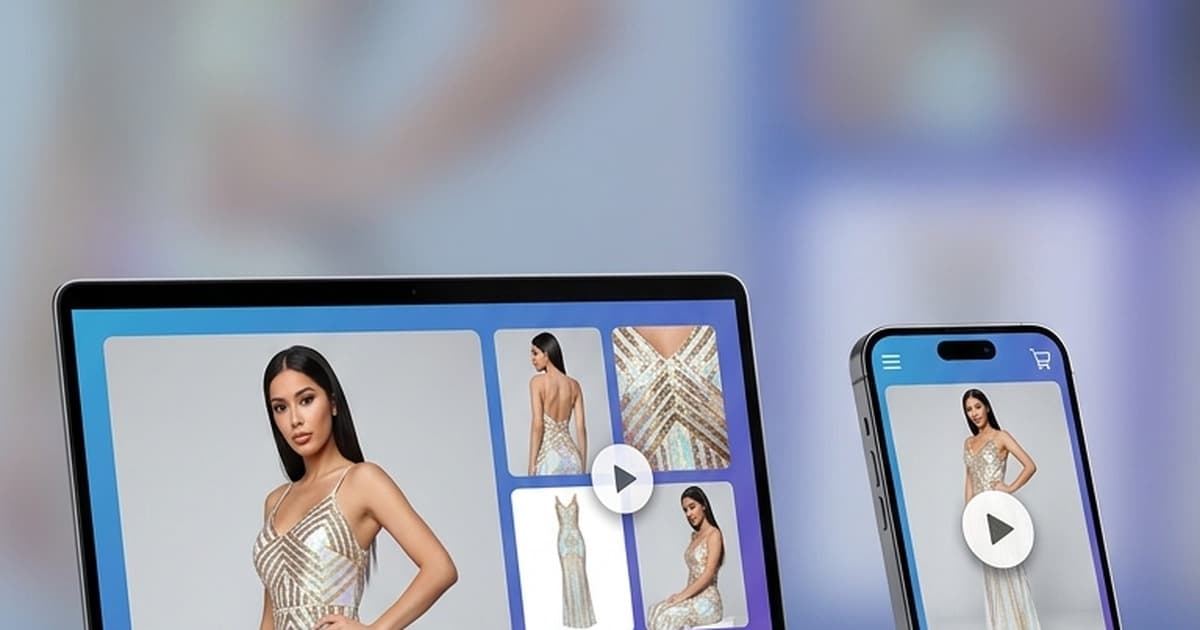
The difference between a 2% conversion rate and a 6% conversion rate on a fashion product page almost never comes down to pricing or copy. It comes down to visuals, and specifically, whether shoppers can picture themselves wearing or using what you are selling.
Most fashion brands know this in theory. But in practice, the economics of photo and video production create a two-tier system: hero SKUs get the full treatment (multiple angles, on-model shots, video), while the rest of the catalog gets a single flat-lay on a white background and a bullet list of fabric specs. That second tier is where most of your revenue lives, and it is quietly bleeding conversion.
This post covers what actually moves the needle on a fashion PDP, the data behind visuals and returns, and how AI is changing the cost equation so operators can upgrade every product page, not just the ones at the top of the funnel.
What Shoppers Actually Need Before They Buy
Fashion is fundamentally a tactile category. You cannot touch the fabric through a screen, so shoppers rely on visuals to answer a set of questions they probably could not articulate but are absolutely asking:
- How does this actually fit? (Not "what are the measurements" - but how does it drape, where does it hit on the body, does it look stiff or soft)
- What does it look like on a real person? (Flat-lay and ghost mannequin shots are useful but they do not substitute for on-model)
- How does it move? (Especially relevant for dresses, knitwear, wide-leg trousers, anything with flow)
- What does the texture look like up close? (Linen that creases, wool that pills, metallic that catches light differently)
- Will this match what I already own? (Color accuracy under different lighting conditions)
When a product page cannot answer these questions, the shopper either bounces or, increasingly, orders anyway and returns the item. Both outcomes cost you money.
The Data: Why Visuals Are Your Highest-Leverage PDP Investment
You do not have to guess at the impact. The data is consistent across multiple studies:
Video drives add-to-cart rates up significantly. Shoppers who watch a product video are measurably more likely to add to cart, with studies citing lifts in the 64-80% range depending on category and video type. For fashion specifically, where fit and movement are the main purchase anxiety, the effect is even stronger.
Multiple angles reduce uncertainty. Research from product page optimization studies consistently shows that PDPs with 5 or more images outperform those with 1-2 images. More views mean fewer surprises when the item arrives.
Returns drop when visuals are thorough. The average fashion return rate sits between 20-40% depending on the brand and channel. A meaningful portion of those returns are driven by "it looked different than expected." Better visuals, particularly video showing how an item moves and fits, directly addresses this. Brands that add video report return rate reductions in the range of 10-25%.
On-model images outperform flat-lay for apparel. For clothing, shoppers convert better when they can see how an item looks on a body. This is obvious in hindsight, but many mid-market fashion brands still rely heavily on product-only images because on-model shoots are expensive.
The math is simple: if a product page generates $10,000 per month in revenue, a 30% lift from better visuals is $3,000/month. The question is not whether investing in visuals pays off. The question is how to do it at scale without a budget that only works for your top 20 SKUs.
The Traditional Visual Production Problem
Here is the tension: the brands with the most to gain from better PDPs are often the ones with the least capacity to produce content at scale.
A traditional on-model fashion shoot costs anywhere from a few thousand to tens of thousands of dollars per day depending on talent, location, and production crew. Even at the low end, if you have 500 SKUs and want 3-4 looks per SKU across 2-3 models, the math becomes unworkable fast.
Video production compounds the problem. A 30-second product video with professional production, editing, and licensing can easily run $2,000-5,000 per SKU. For a catalog of any real size, that is simply not on the table.
So operators make a rational but expensive choice: concentrate resources on the products most likely to recoup the investment. The hero SKUs get video. The seasonal items, the slower-moving styles, the regional exclusives - they get basic imagery and hope that shoppers are forgiving.
The practical result is a catalog where a fraction of your products are fully optimized and the rest are conversion-capped by their own product pages. You are not losing those customers to competitors with better products. You are losing them to uncertainty - the uncertainty that comes from not having enough visual information to click Add to Cart.
You can read more about the economics of traditional fashion shoots versus AI in our breakdown of fashion photography costs in 2026.
How AI Changes the Equation
The reason this problem has a different answer in 2026 than it did in 2022 is AI-generated imagery and video. Not as a gimmick or a shortcut - but as a genuine production infrastructure that changes the cost per asset dramatically.
Here is what that means in practice:
On-model images without a model. AI platforms like Tellos can take your existing product flat-lay or ghost mannequin images and generate on-model versions - different body types, different ethnicities, different styling contexts - without a shoot. What used to require booking talent, a studio, a photographer, and post-production can now be turned around in hours at a fraction of the cost. If you want to explore this workflow in detail, see our guide on going from flat-lay to on-model with AI.
Video from existing photos. This is where the current generation of AI models - Kling, Runway, and similar foundation models - becomes genuinely transformative for fashion. You can take a static product image and generate a video showing the garment in motion: a dress flowing as someone walks, a jacket as someone reaches for something, knitwear in a soft lifestyle setting. Tellos is built on top of these AI video models and makes it practical to run this workflow at catalog scale, not just for your top 10 products. See our AI fashion video generator guide for how this works end to end.
Scale across the catalog. This is the part that changes the math. When you can produce on-model images and product videos for $15-50 per SKU instead of $500-5,000, the economics flip. You can now upgrade every product page, not just the hero SKUs. You can A/B test visual treatments. You can refresh seasonal content without scheduling a new shoot.
Custom AI models trained on your brand. For brands with a strong visual identity, generic AI outputs can feel off-brand. The more sophisticated approach, available through platforms like Tellos, is to train a custom AI model on your brand's existing content so every generated asset looks consistent with your established aesthetic. We cover this in detail in our post on custom AI models for fashion brands.
Fashion PDP Optimization: What "Good" Actually Looks Like
Before getting to the checklist, it helps to have a concrete picture of what a high-converting fashion PDP has that a low-converting one does not.
Image Set
A properly optimized fashion PDP should have:
- Hero image: Clean, well-lit on-model front shot. Neutral or lifestyle background depending on brand positioning.
- Secondary images (minimum 4-6 total):
- Back view
- Side or 3/4 view
- Detail shots (fabric texture, hardware, stitching, closure)
- Flat-lay or product-only shot (useful for showing construction and color accuracy)
- Lifestyle context shot (on-model in a setting, not just a studio)
- Model diversity: At minimum, show the item on 2 different body types. Shoppers respond to seeing themselves in the product, and a single sample-size model excludes the majority of your customer base.
- Color accuracy: If the color matters (and it always does in fashion), include a controlled color shot alongside the lifestyle images.
Video
At minimum, every fashion PDP should have a short video (15-30 seconds) that shows:
- The garment in motion - walking, turning, reaching
- The drape and movement of the fabric
- Key details that are hard to read in static images
The video does not need to be a production piece with voiceover and music. A clean, close-up movement video often outperforms over-produced lifestyle content because it is answering a specific question (how does this move?) rather than selling a feeling.
For brands investing more heavily, a second video showing a styling context or fit comparison across sizes performs well for reducing returns and increasing customer confidence.
The Optimization Checklist: Fashion PDP
Use this as your audit framework. Rate each element as Present, Partial, or Missing, then prioritize fixes based on conversion impact.
Imagery
- Minimum 5 images per SKU
- At least one on-model front view
- At least one back/side view
- At least one fabric/detail close-up
- Color shown accurately (not just in lifestyle lighting)
- Multiple models shown (size inclusivity)
- Images load fast (compressed but high resolution for zoom)
Video
- At least one video showing garment movement (15-30 sec)
- Video autoplays on desktop (muted) or is prominently CTA'd
- Video shows garment being worn and moving, not just a slideshow of stills
- Video is mobile-optimized (vertical or square format if primarily mobile traffic)
Product Copy
- Size guide linked prominently (not buried in footer)
- Fabric composition and care instructions clear
- Fit notes included (runs small/large, model is X height wearing size Y)
- Shipping and return policy easily accessible (ideally visible on the PDP itself)
Trust Signals
- Reviews visible above the fold or near the Add to Cart
- Fit-related review excerpts surfaced (these are the most conversion-relevant reviews for fashion)
- Return policy is shopper-friendly and clearly visible
Technical
- Page speed under 3 seconds on mobile
- Images use modern formats (WebP, AVIF) where possible
- Video hosted on CDN, not embedded from YouTube (autoplay restrictions apply)
- Add to Cart button sticky on mobile scroll
Prioritizing Your PDP Improvements
If you are working through a large catalog with limited time, here is a practical prioritization framework:
Tier 1 - High revenue, missing video: Products generating significant revenue but with no video. Adding even a basic movement video here has the highest immediate ROI.
Tier 2 - High return rate, thin imagery: Products with above-average return rates and only 1-2 images. Better visuals directly address the return driver.
Tier 3 - High traffic, weak conversion: Products getting solid organic or paid traffic but converting below your catalog average. This is usually a trust and visualization problem that better imagery solves.
Tier 4 - New arrivals: Set a standard that all new products launch with the full visual set. Do not let the backlog grow.
This is where AI production capacity becomes a multiplier. If you can generate on-model images and product videos at catalog scale, you do not have to triage as aggressively - you can run through the full catalog over a 30-60 day period rather than just addressing the top 50 products.
For a look at how fashion brands are structuring this kind of content operation at scale, our 2026 AI content creation playbook for fashion brands covers the workflow in detail.
The Return Rate Argument
Worth dwelling on returns for a moment because it is often underweighted in PDP optimization discussions.
Fashion return rates have been trending upward for years, driven partly by the "order multiple sizes, return what does not fit" behavior that fast, free returns have normalized. But a meaningful portion of returns are genuine expectation mismatches - the item looked different on screen than in person.
The breakdown typically looks something like this:
| Return Reason | % of Fashion Returns |
|---|---|
| Did not fit as expected | 30-40% |
| Looked different than pictured | 20-30% |
| Changed mind / did not like in person | 15-25% |
| Defect or quality issue | 5-15% |
| Other | 5-10% |
The first two categories - fit expectations and visual mismatch - are directly addressable through better PDPs. On-model imagery from multiple body types addresses fit anxiety. High-quality video with texture and detail close-ups addresses visual mismatch. Fit notes in copy reduce the size uncertainty.
Each return costs you 2-4x the logistics cost of the original fulfillment (pick, pack, ship, receive, inspect, restock). If you can reduce your return rate by 10-15 percentage points through better PDPs, the savings often significantly outweigh the cost of the visual production investment.
Making the Business Case Internally
If you are trying to get budget for PDP visual upgrades, here is how to frame it:
Current state analysis: Pull your top 50 revenue-driving products. What percentage have video? What percentage have on-model imagery from more than one model? This baseline is usually worse than people expect.
Conversion rate gap: Compare the conversion rate of products with video versus products without. If you do not have this data yet, industry benchmarks (video pages outperforming static by 30-80%) are a reasonable proxy.
Return rate by visual quality: If you can segment your returns by products with thorough imagery versus thin imagery, the correlation is usually visible and compelling.
AI production cost estimate: Get a cost-per-SKU estimate for AI-generated on-model imagery and video. Compare that to the incremental conversion and return savings at your current traffic volumes.
The math tends to close quickly, especially for brands with return rates above 20% or catalogs where a significant portion of SKUs have thin imagery.
Putting It Together with Tellos
The workflow for upgrading a fashion catalog's PDPs at scale looks like this in practice:
- Export your product catalog with existing imagery (flat-lays, ghost mannequins, studio shots)
- Define your model preferences - body types, skin tones, styling contexts
- Generate on-model images for each SKU through Tellos's AI photo studio
- Generate product movement videos from your static images using Tellos's AI Video Studio
- Review, QA, and push updated assets to your Shopify, Amazon, or other storefront
- Monitor conversion and return rate changes by cohort
The result is a fully upgraded catalog without booking a single shoot day. For brands with hundreds or thousands of SKUs, this is the only approach that makes economic sense.
If you have been limiting your PDP visual investment to hero products because the cost of a full-catalog upgrade was prohibitive, the math has changed. AI production makes it feasible to give every product in your catalog the visual treatment that used to be reserved for your best sellers.
Start Optimizing Your Fashion PDPs Today
If your fashion catalog has products sitting on thin imagery and no video, those pages are costing you add-to-cart rates every day. The fix is not complicated - it is a visual quality problem with a clear solution.
Tellos's AI Video Studio lets you generate on-model photos and product movement videos at catalog scale, starting from your existing product imagery. No new shoots, no model booking, no production timelines.
You can go from a white-background flat-lay to a fully-optimized PDP with multiple on-model angles and a 15-second movement video in a matter of hours - and do it for every product in your catalog, not just the top 20.