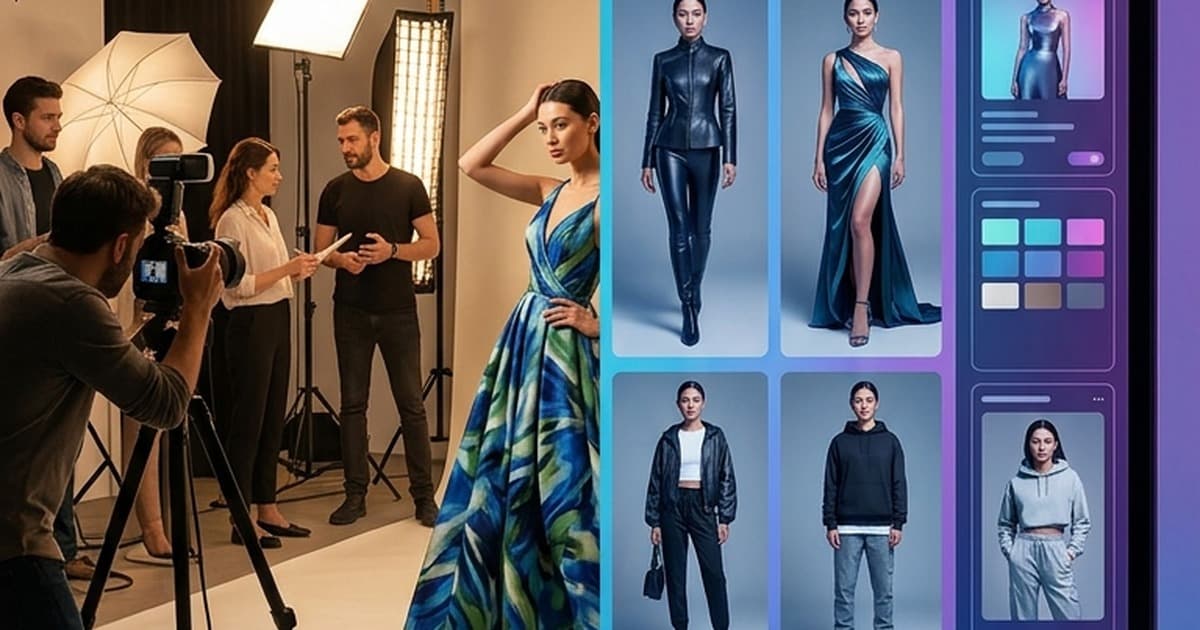
Quick answer: A lean 2-day traditional on-model shoot for 100 SKUs (200 images) costs about $24,700 in 2026, or roughly $123 per image, once photographer, studio, models, hair and makeup, styling, retouching and logistics are counted. AI-generated on-model photography from existing flat-lays costs about $1-$5 per image, so the same 100 SKUs with 3 images each runs $300-$1,500 instead of $24,000-$45,000. The fastest way to reduce fashion photo shoot costs is to use AI for catalog and PDP images and keep traditional shoots for campaign and editorial work.
If you're running a fashion brand with 100+ SKUs, your photography spend is either your biggest operational bottleneck - or it should be.
A single traditional on-model photoshoot day runs $5,000 to $25,000 when everything is counted honestly. Most brands don't count everything honestly. They budget for the photographer, forget the stylist, underestimate retouching, and then get blindsided by the reshoot invoice two months later.
This post breaks down every line item in a traditional fashion photoshoot, compares it to what AI-generated on-model photography actually costs in 2026, and shows the real ROI math for a mid-size brand working through 100 to 500 SKUs per season.
What a Traditional Fashion Photoshoot Actually Costs
Let's build this from first principles. A production-quality on-model fashion shoot involves more roles than most ecommerce teams plan for.
Photographer
A professional fashion photographer with ecommerce experience charges $1,000–$3,500 per day in most major markets. That rate covers shooting time only - it doesn't include post-production or licensing.
Expect:
- $1,000–$1,500/day for emerging photographers with a solid portfolio
- $1,500–$2,500/day for mid-tier professionals with brand client experience
- $2,500–$5,000+/day for senior photographers or those with editorial credentials
Most brands try to shoot 20–40 looks per day. At 40 looks, that's $37–$87 per look just for the photographer.
Studio Rental
A proper photography studio with lighting equipment, backdrops, and changing rooms costs $300–$1,500 per day, depending on city and studio quality.
- Basic studio (white cyclorama, standard lighting): $300–$600/day
- Mid-tier studio (multiple backdrops, lighting setups): $600–$1,000/day
- Premium studio (full production facilities, lifestyle sets): $1,000–$2,500/day
If you're shooting lifestyle content with custom set builds, add set design and props: typically $500–$2,000 on top.
Model Fees
This is where costs escalate fast. Model fees vary dramatically based on booking source:
- In-house or micro-influencer models: $200–$600/day
- Agency model (standard): $600–$1,500/day
- Agency model (editorial experience): $1,500–$4,000/day
- Plus-size or specialty fit models: $500–$2,000/day
Most brands need 1–3 models per shoot day to hit variety targets. Multiple models = multiple fees, multiple fitting sessions, multiple schedules to coordinate.
If you're shooting 100 SKUs and aiming for 2 model looks per product, you're looking at a multi-day shoot. And that means this line item compounds.
Hair & Makeup Artist (HMU)
A professional HMU artist for fashion ecommerce runs $400–$1,200 per day. Expect to pay the upper end for experienced artists who can maintain consistency across a long shoot day.
If you want both a hair stylist and a makeup artist as separate roles (which most editorial-quality shoots require), double this number: $800–$2,400 per day for the HMU team.
Wardrobe Stylist
A stylist handles garment prep, steaming, fitting adjustments, and on-set dressing. Day rates run $400–$1,000, and for a shoot with 50+ looks, you'll often need both a lead stylist and a styling assistant.
Don't skip this. Unstyled shoots produce unusable photos - wrinkles, poor fit, inconsistent presentation - and create retouching problems that cost more to fix than the stylist would have cost to hire.
Post-Production and Retouching
This is the most systematically underestimated cost in fashion photography. Brands budget for the shoot day and forget that every image needs to be:
- Color-graded and exposure-corrected
- Retouched for blemishes, stray hairs, background artifacts
- Resized and reformatted for different platforms
- Organized, tagged, and delivered
Per-image retouching costs: $20–$80 depending on complexity.
- Basic cleanup (background removal, color correction): $20–$40/image
- Full beauty retouching: $50–$120/image
- Composite work or background replacement: $80–$200/image
For a 100-SKU shoot with 3 images per SKU, that's 300 images. At $40/image average: $12,000 in post-production alone.
Logistics and Miscellaneous
Every shoot has logistical costs that don't fit a clean line item:
- Sample shipping (to studio, from manufacturer, returns): $200–$800
- Garment pressing/steaming at studio: $150–$400
- Catering for crew: $300–$600 (half-day) to $600–$1,200 (full day)
- Equipment rentals (specific lenses, lighting, props): $200–$800
- Casting fees (if using an agency): $200–$500
- Creative director or art director (if not the photographer): $500–$1,500/day
Total miscellaneous: $1,000–$4,000 per shoot day.
The Full Traditional Shoot Cost Model
Let's put this together for a realistic mid-size brand scenario: 100 SKUs, 2 images per SKU = 200 deliverable images, shot in 2 days with a small crew.
| Line Item | Day 1 | Day 2 | Total |
|---|---|---|---|
| Photographer | $2,000 | $2,000 | $4,000 |
| Studio rental | $800 | $800 | $1,600 |
| Model (2 models) | $2,400 | $2,400 | $4,800 |
| HMU team | $1,200 | $1,200 | $2,400 |
| Wardrobe stylist | $700 | $700 | $1,400 |
| Post-production (200 images × $40) | - | - | $8,000 |
| Logistics & misc | $1,500 | $1,000 | $2,500 |
| Total | $24,700 |
Per-image cost: ~$123 Per-SKU cost (2 images): ~$247
And this is a lean, well-managed shoot. Add one reshoot day, a second model option, or any editorial complexity, and you're past $35,000.
The Hidden Costs Most Brands Miss
The line-item total above is what a shoot should cost. Real-world shoots almost always have additional expenses that get absorbed quietly into budgets.
Reshoots
Reshoots happen. Samples arrive damaged. Garments didn't photograph as expected. Client requests a different background after seeing the first selects. A model becomes unavailable mid-campaign.
Industry average: 15–25% of shoots require some level of reshoot. Budget for it.
A partial reshoot day (half-day studio, model, photographer): $3,000–$8,000.
For a 100-SKU catalog, expect at least 10–20 products to need reshoots at some point during the season.
Seasonal Updates
Fashion brands typically run 2–4 collections per year. That means this entire cost structure repeats. For a brand with 200 active SKUs that refreshes imagery twice a year:
- Annual photography spend: $40,000–$100,000+
This number doesn't include the cost of the content team managing all of this - coordinating shoots, reviewing selects, managing retouchers, organizing assets in a DAM system.
Opportunity Cost and Time-to-Market Delay
Traditional photo production timelines add 4–8 weeks from concept to live images. For trend-sensitive fashion brands, that gap has real commercial cost.
A product that arrives from the manufacturer in Week 1 but doesn't have usable imagery until Week 6 has lost 5 weeks of potential sales. At any reasonable conversion rate, that's measurable revenue gone.
The Diversity and Inclusivity Tax
Shoppers expect to see products on diverse models. Running three or four different model options for your catalog - different body types, skin tones, heights - multiplies model fees, multiplies shoot time, and multiplies post-production.
Brands that are serious about inclusive representation on their PDPs are effectively running 3x the photography budget just to cover model diversity.
What AI-Generated On-Model Photography Costs in 2026
Tellos AI Photo Studio converts flat-lay or mannequin shots into photorealistic on-model images. You bring your product images. The AI brings everything else.
Here's what the cost structure looks like for the same 100-SKU brand:
Inputs You Already Have
Most fashion brands already have flat-lay or ghost mannequin photography - it's the cheapest format to produce. If you don't, a flat-lay shoot for 100 SKUs costs roughly $1,500–$3,000 (no models, minimal crew). If you already have these assets, your input cost is essentially zero.
AI Generation Cost
With Tellos, you upload your flat-lays and generate on-model photos at scale. The economics per image are dramatically different from traditional photography:
| Approach | Cost per Image | 100 SKUs × 3 images |
|---|---|---|
| Traditional on-model shoot | $80–$150 | $24,000–$45,000 |
| AI-generated on-model (Tellos) | $1–$5 | $300–$1,500 |
For 100 SKUs with 3 on-model images each (different poses, different model options), you're looking at $300–$1,500 total - compared to $24,000–$45,000 for the traditional approach.
What You Get That Traditional Photography Can't Offer
The cost savings are the headline, but the operational advantages go further:
Model diversity at no extra cost. With AI photo studio, you can generate the same product on multiple AI models - different body types, skin tones, heights - for the same per-image cost. There's no model booking fee for the second or third variation.
Instant reshoots. If a client wants a different background, different lighting, or a different pose, you regenerate. No rebooking, no studio, no crew. The iteration cost is essentially zero.
Same-day turnaround. Upload in the morning, have approved images by afternoon. For trend-responsive brands, this changes what's operationally possible during a launch.
Seasonal updates without a production cycle. When a new season launches, you update your imagery by uploading your new flat-lays - not by coordinating a three-week shoot. As covered in our post on AI fashion photoshoots, this is where the real velocity advantage lives.
How to Reduce Fashion Photo Shoot Costs: ROI for 100–500 SKUs
Let's run the numbers for a brand at different catalog sizes.
Scenario A: 100 SKUs, 2 Seasons/Year
Traditional approach:
- 2 shoot days per season × $25,000 = $50,000/year
- Reshoot allowance (20%): $10,000/year
- Seasonal update shoots: included above
- Annual total: ~$60,000
AI approach (Tellos):
- Flat-lay photography (one-time, or already have it): $2,000
- AI generation (100 SKUs × 4 images × 2 seasons): ~$800
- Team time (reviewing and approving): ~$500
- Annual total: ~$3,300
Annual saving: ~$56,700 ROI on AI subscription: 17x+
Scenario B: 300 SKUs, 3 Seasons/Year
Traditional approach:
- 5 shoot days per season × $25,000 = $125,000/year
- Reshoot allowance: $25,000/year
- Post-production: $36,000/year (300 SKUs × 3 images × $40)
- Annual total: ~$186,000
AI approach (Tellos):
- Flat-lay photography: $5,000–$8,000/year (if needed)
- AI generation (300 SKUs × 4 images × 3 seasons): ~$3,600
- Annual total: ~$11,600
Annual saving: ~$174,000
Scenario C: 500 SKUs, 4 Seasons/Year
At this catalog size, traditional photography is functionally impossible to keep current. Most brands at 500+ SKUs are already defaulting to flat-lays for the majority of their catalog and only doing on-model for hero products.
That's the conversion gap right there. The majority of your catalog underperforms because you can't afford to shoot everything on-model.
With AI, the constraint disappears. Every SKU gets on-model imagery. The math:
Traditional (on-model for hero products only, ~30%):
- 150 SKUs on-model per season × $80/image × 3 images × 4 seasons: $144,000/year
- Remaining 350 SKUs on flat-lay: $25,000/year
- Total: ~$169,000/year - plus a 70% catalog with suboptimal imagery
AI approach (full catalog on-model):
- Flat-lay photography (full catalog): $10,000/year
- AI generation (500 SKUs × 4 images × 4 seasons): ~$8,000
- Total: ~$18,000/year - with 100% of catalog on-model
The gap isn't just cost. It's competitive positioning. Brands on the AI approach have every product represented at its best. Brands on the traditional approach are splitting their budget to cover only their top sellers.
The Conversion Rate Multiplier
The cost comparison above focuses on production spend. But the revenue impact of better imagery compounds on top.
On-model product photos outperform flat-lays by 20–30% in conversion rate - a figure consistently reported across ecommerce platforms and A/B testing studies. For a brand doing $2M in annual revenue with a 2.5% baseline conversion rate:
- Improving conversion by 20% across the catalog = $400,000 in additional annual revenue
- At a 25% gross margin, that's $100,000 in additional gross profit - from imagery alone
That's before accounting for reduced bounce rate, higher average order value from better cross-sells, and lower return rates when shoppers can accurately visualize fit.
The photography budget isn't a cost center. It's a conversion optimization lever. And AI changes the math entirely.
What AI Photography Doesn't Replace (Yet)
To be clear about where AI-generated imagery sits in 2026:
AI excels at:
- Product page hero shots (PDP images)
- SKU-level catalog photography at scale
- Size-inclusive and diverse model representation
- Seasonal refreshes and quick-turn product launches
- Flat-lay to on-model conversion
Traditional photography still adds value for:
- High-fashion editorial and campaign imagery (brand storytelling, not just PDPs)
- Video content and motion assets (though AI video studio is closing this gap)
- Press and lookbook content where editorial direction is the point
- Hero lifestyle shoots for brand identity moments
The smart approach is not either/or. Use AI to cover your full catalog on-model at scale. Use traditional photography selectively for campaign-level content where editorial craft is the product.
For most Shopify brands, that means 90% AI + 10% traditional - and a fraction of the previous photography budget.
How Tellos Handles the Technical Side
The common concern with AI-generated fashion imagery is fidelity. Will it actually preserve the garment accurately - the texture of a heavy linen, the sheen of a satin blouse, the ribbing on a knit?
Tellos AI Photo Studio is built specifically for apparel. Its AI model is trained on fashion photography, not general-purpose image generation. It preserves:
- Fabric texture and surface detail (silk, denim, knitwear, technical fabrics)
- Stitching, seams, buttons, hardware, and print placement
- Garment silhouette and fit lines
- Color accuracy under different lighting conditions
The model swap feature lets you apply the same garment across multiple AI models - different body shapes, skin tones, proportions - without any degradation in garment fidelity. As detailed in our post on mannequin-to-model AI photography, the underlying diffusion model understands garments structurally, not just visually.
If you're curious about results before committing budget, Tellos has a free plan that lets you test your own products.
Frequently Asked Questions
How can fashion brands reduce photo shoot costs?
The biggest saving comes from replacing on-model catalog shoots with AI-generated on-model images built from flat-lay or ghost mannequin photos, which drops cost per image from $80-$150 to about $1-$5. Beyond that, budget honestly for retouching and a 15-25% reshoot allowance, and reserve traditional shoots for campaign, editorial and hero lifestyle content where creative direction is the point.
How much does fashion photography cost in 2026?
Fashion photographers charge about $1,000-$3,500 per day, with senior or editorial talent at $2,500-$5,000+. Add studio rental ($300-$1,500 per day), models ($200-$4,000 per day each), hair and makeup ($400-$1,200 per artist), a stylist ($400-$1,000), retouching ($20-$80+ per image) and $1,000-$4,000 in logistics. A full on-model shoot day typically totals $5,000 to $25,000.
Do live models or mannequins convert better in fashion ecommerce?
On-model product photos outperform flat-lays by 20-30% in conversion rate, a range widely reported in ecommerce A/B testing. Shoppers can see fit, drape and proportions on a person, which also helps reduce returns. That is why brands at 500+ SKUs that shoot only hero products on-model leave most of their catalog underperforming, and why converting mannequin and flat-lay shots to on-model images pays off.
How do fashion brands scale product photography across hundreds of seasonal SKUs without a studio?
They shoot inexpensive flat-lay or ghost mannequin images, which for 100 SKUs costs roughly $1,500-$3,000, and then generate on-model images with an AI photo studio. Each seasonal refresh becomes an upload of new flat-lays rather than a new shoot. Turnaround is same-day, model diversity costs nothing extra, and reshoots become regenerations, so volume can grow without adding studio days.
How do I keep product image quality consistent across 500+ SKUs per season?
Use one repeatable pipeline: a standard flat-lay or mannequin input, the same AI models, backgrounds and lighting for every SKU, and a human review step before images go live. An apparel-specific AI studio should preserve fabric texture, stitching, hardware, print placement, silhouette and color. At 500 SKUs and 4 seasons, this approach runs about $18,000 per year versus about $169,000 for traditional.
What does a realistic fashion shoot cost model include?
A complete shoot cost model covers the photographer, studio rental, model fees, hair and makeup, wardrobe stylist, post-production per image, and logistics such as sample shipping, steaming, catering, equipment and casting. Then add hidden costs: reshoots, repeated seasonal shoots, 4-8 weeks of time-to-market delay, and extra model fees for diverse representation. Divide by deliverable images to get your true cost per image.
The Bottom Line
Traditional fashion photography is expensive, slow, and scales linearly with catalog size. That made sense in 2015. In 2026, it's an operational ceiling for most growing brands.
Here's the actual summary of what changes with AI:
| Factor | Traditional | AI (Tellos) |
|---|---|---|
| Cost per image | $80–$150 | $1–$5 |
| Turnaround time | 4–8 weeks | Same day |
| Model diversity | Extra cost per model | Included |
| Reshoot cost | $3,000–$8,000/day | Near zero |
| Full catalog coverage | Budget-constrained | Unlimited |
| Seasonal refresh | New shoot required | Upload new flat-lays |
The economics aren't close. And for brands at 100+ SKUs - where the traditional model starts to collapse under its own weight - the question isn't whether to use AI photography. It's why you haven't started yet.
Ready to Cut Your Photography Budget?
Tellos AI Photo Studio converts your existing flat-lays into studio-quality on-model photos. No bookings, no crews, no six-week timelines.
Start with a free plan and see what your products look like on model - before you commit to anything.