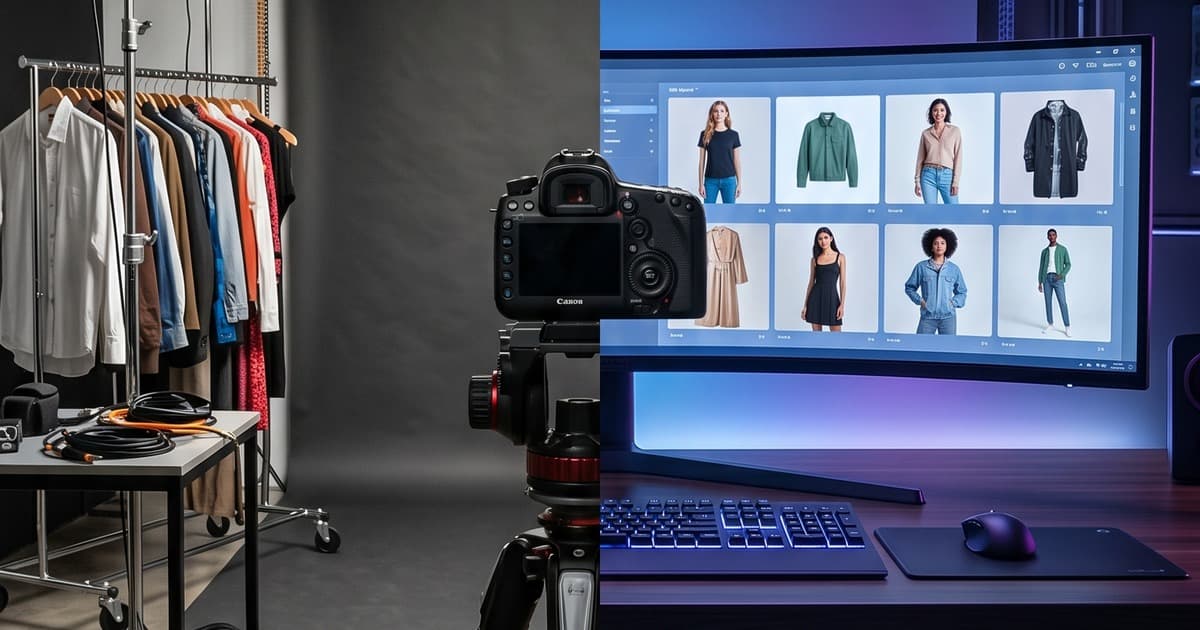
The debate about AI replacing traditional photography isn't really a debate anymore — it's a use-case routing problem. By 2026, most serious ecommerce operators have stopped asking "AI or traditional?" and started asking "AI where, traditional where?"
The answer, once you break it down by use case, is pretty clear. Let's go through it.
The State of Catalog Photography in 2026
The numbers don't lie. AI-generated product images have gone from novelty to standard operating procedure for volume catalog work over the past 18 months. But "standard" doesn't mean "universal" — and the brands burning budget on AI for their campaign hero shots, or still booking full studio shoots for every SKU, are leaving money on the table in both directions.
Here's what's actually happening in the market:
- Traditional photography holds a commanding lead for hero images, editorial campaigns, and lifestyle shots where brand identity is everything
- AI photography has taken over for PDP (product detail page) catalog images, especially for fashion, home goods, and accessories
- The hybrid approach — AI for volume, traditional for flagship — is what most 8-figure brands are running today
The shift isn't about quality anymore. It's about what kind of quality, at what scale, at what cost.
Use Case Breakdown: Where Each Approach Wins
PDP Images: AI Wins on Scale
Product detail page images are the highest-volume, most consistent image need in ecommerce. A typical fashion brand with 200 SKUs per season needs 4-8 images per product — that's 800 to 1,600 images, minimum, every season.
With traditional photography:
- You need to book models, studios, stylists, photographers
- Turnaround is days to weeks per shoot
- Any product variation (color, size, minor design change) means rebooking
- A new SKU added late in the season? You're looking at a costly reshoot
With AI (specifically brand-trained AI — more on that below):
- Upload your flat lay or ghost mannequin shot
- Generate on-model or lifestyle versions in minutes
- Swap backgrounds, lighting, model diversity, seasonal context instantly
- Add a new SKU the day it's approved — no waiting
This is exactly the workflow brands are using with tools like Tellos AI Photo Studio — turning existing product images into full PDP galleries without a single studio session. If you haven't seen what brand-trained AI looks like on real product images, this comparison is worth reading.
Verdict: AI wins on scale for PDPs. The quality is there, the cost per image is dramatically lower, and the iteration speed changes how teams plan launches entirely.
Wholesale Catalogs: AI Wins on Speed
Wholesale catalogs have a different problem than PDPs: they're deadline-driven. Buyers want to see your full line before they commit — and if your catalog isn't ready for market week, you're out of the conversation.
Traditional catalog shoots for wholesale typically involve:
- 3-5 day studio blocks
- Sample management across dozens of styles
- Post-production timelines of 2-4 weeks
- Version control headaches when products change
AI catalog production collapses this timeline. With a solid AI workflow, a 200-SKU catalog can go from samples to finished images in under a week. Some brands are running it in 2-3 days.
There's also a flexibility advantage that's underrated: wholesale often needs regional variations. A buyer in Germany wants a different lifestyle context than one in the US. With AI, you're generating location-appropriate backgrounds and styling at zero marginal cost per variant.
We broke down the full AI catalog production workflow for fashion brands in this guide to AI catalog production — the speed comparison alone is worth the read.
Verdict: AI wins for wholesale catalogs. Speed-to-market is the critical variable, and AI has a structural advantage traditional photography cannot close.
Campaign Hero Shots: Traditional Still Has the Edge
Let's be honest about where AI still falls short.
Campaign hero shots — the images that lead your seasonal creative, power your paid social, anchor your email campaigns — are where traditional photography retains a real quality edge. Not because AI can't produce beautiful images, but because:
- Brand-specific lighting and feel is hard to replicate at campaign quality — the way your signature photographer lights a product, the specific warmth of your brand palette, the "this is unmistakably us" quality — that's still easier to capture in studio
- Lifestyle integration with real environments — placing your product genuinely in a real New York apartment or Malibu beach house has an authenticity AI struggles to match at campaign level
- Art direction and iteration — great campaign work involves a conversation between creative directors, photographers, and subjects that AI generation hasn't replaced
- Talent and storytelling — campaigns that feature people (models, customers, founders) doing things still benefit enormously from real shoots
That said, the gap is closing. Brand-trained AI is significantly better than generic AI for campaign work — custom models trained on your specific aesthetic can get you to 80% of campaign quality for certain shot types.
The practical approach most brands take: shoot campaign hero content traditionally, then use AI to extend it — generate variations, resize for different platforms, create seasonal color-way swaps. You get the authentic core content plus AI-powered leverage.
Verdict: Traditional still has the edge for campaign hero shots. But use AI to scale and extend that traditional content, not replace it.
Generic AI vs. Brand-Trained AI: The Quality Gap You Can't Ignore
This is where a lot of teams get confused — and where the "AI images look fake" complaints come from.
Generic AI tools (off-the-shelf image generators) produce technically impressive images that often feel disconnected from your brand. The lighting is generic, the aesthetic is vanilla, and seasoned buyers can often spot them immediately. Using generic AI for catalog images is the equivalent of using a stock photo that almost matches your product.
Brand-trained AI is a fundamentally different product. These models are trained on your specific:
- Product photography history
- Brand color palette and lighting preferences
- Model aesthetic and styling direction
- Background and environmental preferences
The output looks like your photography — because it was trained on your photography. The difference in output quality between generic and brand-trained AI is significant enough that they're practically different categories of tool.
This is why the quality bar for AI catalog photography has risen dramatically in the past year. Early "AI vs traditional" comparisons were usually testing generic AI. Today's comparisons, using brand-trained models, are a very different story.
For fashion specifically, custom AI model training for fashion brands is now a genuine alternative to traditional shoots at catalog scale — not a compromise.
The Hybrid Approach: What Most Brands Are Actually Doing
By mid-2026, the most common configuration at serious ecommerce brands isn't "fully AI" or "fully traditional" — it's a structured hybrid:
| Shoot Type | Approach | Rationale |
|---|---|---|
| Campaign hero images | Traditional photography | Brand identity, art direction, authenticity |
| PDP gallery images | AI (brand-trained) | Scale, cost, iteration speed |
| Wholesale catalog | AI | Speed-to-market, variant flexibility |
| Ghost mannequin/flat lay | Traditional (once per SKU) | Source asset for AI generation |
| Platform adaptations | AI | Resize, reformat, localize existing assets |
| Model diversity variants | AI | Multiple model options without rebooking |
The practical workflow looks like this:
- One traditional shoot per season — capture hero campaign content, source flat-lay/ghost mannequin shots for all SKUs
- AI generation from source assets — turn those flat lays into on-model PDPs, lifestyle images, wholesale catalog shots
- AI for variants and updates — new colorways, late-season additions, regional variants all handled with AI
This approach gets you the brand authenticity of traditional photography and the scale and speed of AI — without the full cost of either approach alone.
Cost Modeling: 200-SKU Catalog, Both Ways
Let's put real numbers to this. Here's what a 200-SKU catalog actually costs with each approach, assuming you need 6 images per SKU (1,200 images total) with 3 model options each.
Traditional Photography Route
| Cost Item | Estimate |
|---|---|
| Studio rental (4 days @ £1,500/day) | £6,000 |
| Lead photographer | £4,000 |
| 3 models (4 days each @ £600/day) | £7,200 |
| Stylist + assistant (4 days) | £3,200 |
| Art director | £2,400 |
| Post-production (1,200 images) | £6,000 |
| Sample logistics | £800 |
| Total | £29,600 |
| Cost per image | ~£24.70 |
And that's a lean production. Add in travel, specialist props, agency markup, or reshoots for late-arriving samples and you're easily at £35,000–£45,000.
Timeline: 4–6 weeks from shoot date to final images.
AI Photography Route (Brand-Trained)
| Cost Item | Estimate |
|---|---|
| Flat lay / ghost mannequin shoot (source assets only) | £4,500 |
| Brand model training (one-time) | £800 |
| AI generation — 1,200 images | £1,200 |
| Post-production QA and retouching | £1,800 |
| Total | £8,300 |
| Cost per image | ~£6.90 |
Timeline: 5–8 business days from source assets to finished catalog.
The Numbers
| Metric | Traditional | AI | Difference |
|---|---|---|---|
| Total cost (200 SKUs, 6 images) | £29,600 | £8,300 | AI saves 72% |
| Cost per image | £24.70 | £6.90 | AI saves 72% |
| Timeline | 4–6 weeks | 5–8 days | AI saves 75%+ time |
| Adding late SKUs | Full reshoot cost | ~£40/SKU | AI saves 98%+ |
| Model diversity variants | Full reshoot | Marginal cost | AI wins decisively |
The 72% cost saving compounds dramatically once you factor in:
- Seasonal updates (4x per year instead of 1-2x)
- Adding new colorways mid-season
- Regional variations for different markets
- Model diversity across demographics
At scale, brands running AI-first catalog production are spending what they used to spend on one traditional shoot on an entire year of catalog content.
What to Actually Do Next
If you're still running your entire catalog through traditional shoots, the math above should prompt a rethink. If you've tried generic AI and weren't impressed, brand-trained AI is a genuinely different experience.
The entry point is straightforward:
- Run your next flat-lay or ghost mannequin shoot as planned — you need source assets regardless
- Use those assets to generate your first AI catalog batch (200 images is a reasonable test)
- Compare output quality and cost against your last traditional production
- Calibrate your hybrid split based on what you find
Most brands that do this test once don't go back to 100% traditional shoots. The quality is there, the economics are compelling, and the iteration speed changes what's possible for your merchandising team.
For brands already using AI for photos, the next logical step is AI product video — turning your catalog images into short-form product content for TikTok, Reels, and Amazon listings without additional shoots.
Ready to See What Brand-Trained AI Looks Like on Your Catalog?
Tellos AI Photo Studio handles the full stack — flat lays to on-model images, ghost mannequin to lifestyle, single-SKU to 200-SKU batch generation. Brand-trained models mean the output looks like your photography, not generic AI.
The brands getting the most out of this aren't replacing their photographers — they're freeing their creative team to focus on the campaign work that actually moves the needle, while AI handles the volume catalog work that used to eat most of the budget.
Start with Tellos AI Photo Studio and see what your catalog looks like when it's not bottlenecked by shoot schedules.