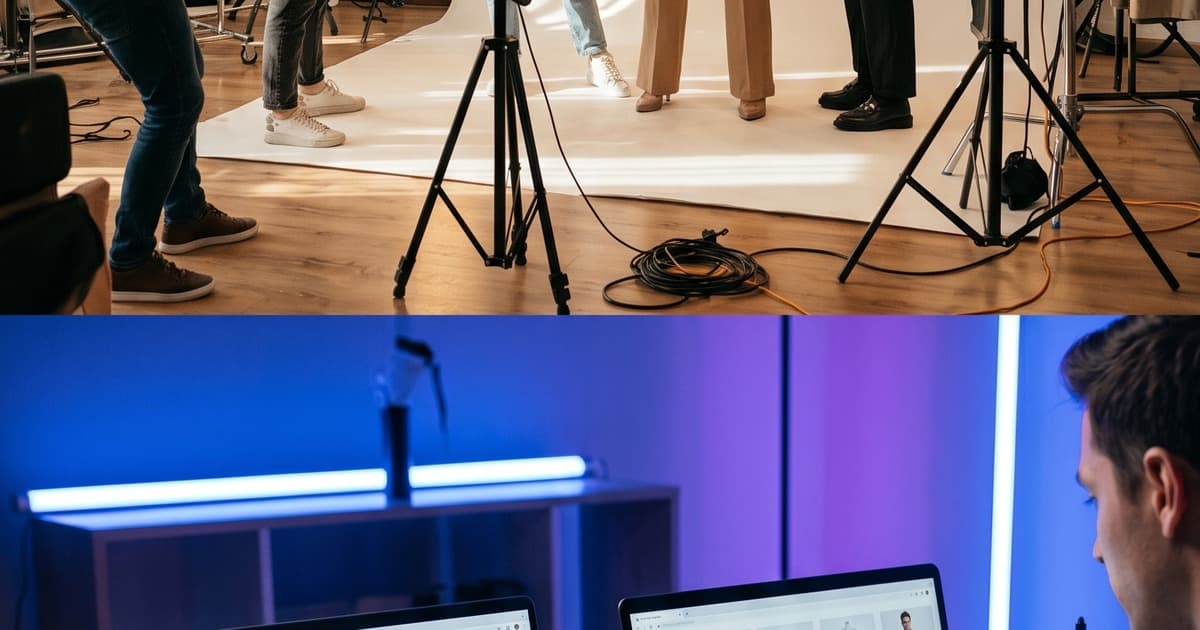
A traditional fashion shoot starts at 7 AM when the production assistant unlocks the studio. By 8 AM the photographer is building light rigs. By 9 AM the first model arrives, moves through hair and makeup, gets dressed, gets briefed on the look, and steps in front of the camera. By 10 AM you are finally capturing images.
By 2 PM the crew is on their second catering run, you are on your twelfth look, and you are already doing the math on whether you can finish the planned 30 SKUs before the studio rental expires at 6 PM.
That is the reality of a traditional shooting day for a fashion brand. And it is the reality that a growing number of operators are choosing to skip entirely.
The AI shooting day looks completely different. You upload product images in the morning. You receive a full catalog of on-model content by the afternoon. No call times. No model agencies. No weather holds. No overtime invoices.
This post walks through both days in detail, compares the output numbers, and explains why the switch is accelerating faster than most people in fashion expected.
What a Traditional Shooting Day Actually Looks Like
Before we compare, it is worth being precise about what a traditional AI shooting day is replacing. Most operators undercount the complexity until they are living through it.
The Crew You Need
A production-quality on-model shoot requires a minimum crew of five to seven people:
- Photographer - $1,500 to $3,500 per day depending on market and experience level
- Studio rental - $500 to $1,500 per day for a proper cyclorama with lighting rigs
- Model or models - $600 to $4,000 per day, per person, from a legitimate agency
- Hair and makeup artist - $400 to $1,200 per day, often a two-person team
- Wardrobe stylist - $400 to $1,000 per day, plus assistant fees for larger shoots
- Production assistant - $250 to $500 per day
That crew bill alone lands between $4,000 and $14,000 before a single image is captured.
The Timeline of a Shooting Day
A real production schedule looks like this:
| Time | Activity |
|---|---|
| 7:00 AM | Studio access, lighting setup begins |
| 8:00 AM | Photographer arrives, lighting test shots |
| 9:00 AM | Model arrives, hair and makeup begins |
| 10:00 AM | First look styled, first shots captured |
| 10:45 AM | First outfit change, model rotation |
| 12:00 PM | Lunch break (mandatory for crew contracts) |
| 1:00 PM | Afternoon session begins |
| 1:30 PM | Second model's hair and makeup (if running two models) |
| 2:00 PM | Shot review, selects, any reshoots flagged |
| 3:30 PM | Second model session, faster rotation |
| 5:00 PM | Final looks, cleanup shots |
| 6:00 PM | Studio overtime begins ($150 to $300/hour) |
| 7:00 PM | Wrap, strike, sample repackaging |
That 12-hour window, realistically, produces 25 to 40 finished looks. If you are shooting multiple colorways per style, you are looking at 15 to 25 distinct SKUs of usable output, depending on complexity.
What Kills Your Output Volume
The bottlenecks are not the camera. They are the transitions:
Outfit changes take 8 to 15 minutes each when you include steaming, fitting adjustments, accessory swaps, and re-composing the shot. For a 30-look day, that is 4 to 7 hours in transitions alone.
Model fatigue is real. By hour six, energy drops, expressions flatten, and the stylist is fighting harder to maintain look consistency. Most photographers try to front-load the most complex shots for the first half of the day.
The review bottleneck happens when the brand's creative director or ecommerce manager needs to approve selects on-set. If anyone is remote, add lag. If they have notes, add time.
Weather and cancellations are the wildcard. A model calls out sick the morning of a shoot and your entire carefully coordinated day collapses. Rescheduling a full crew on short notice costs money even if you do not shoot.
Post-Production Is Not Included
The shooting day invoice does not include the images. Retouching runs $20 to $80 per image depending on complexity. For a 30-SKU shoot with three images per SKU, that is 90 images at roughly $40 average - another $3,600. Color grading, background removal, resizing for different platforms, and asset delivery typically take one to two weeks after the shoot day.
The real cost of a well-run 30-SKU shoot, fully loaded, is $18,000 to $30,000. The timeline from pre-production planning to final image delivery is four to six weeks.
What an AI Shooting Day Looks Like
The AI version of a shooting day has the same goal - on-model product photography ready for your catalog - with a radically different operational structure.
Morning: Upload Your Products
You do not need a studio. You do not need a team. What you need are product images. These can be:
- Flat lays shot on a clean surface or swept background
- Ghost mannequin shots from your existing photography library
- Hanging garment shots on a standard clothing rack
- Existing packshot images from your manufacturer or supplier
If you are shooting from scratch, a single photographer and a neutral backdrop can capture 80 to 120 flat lay images in a morning. The technical bar is much lower because you are capturing fabric detail and silhouette, not art directing a model.
Upload those images to your AI photo studio platform. For a 50-SKU collection, this takes 15 to 30 minutes.
Specify Your Output Parameters
This is the step that replaces the entire pre-production process:
- Model demographics - body type, skin tone, age range, ethnicity
- Diversity requirements - generate the same garment on three different body types without three model bookings
- Pose direction - editorial standing poses, lifestyle movement, detail close-ups
- Background and setting - clean studio white, lifestyle environments, brand-consistent backdrops
- Image count per SKU - front, side, detail, lifestyle: define your per-SKU image set once and apply it to every product
This configuration takes 20 to 30 minutes for a full seasonal collection.
Afternoon: Review Your Catalog
AI generation at production quality runs 15 to 45 minutes per batch depending on the platform and image count. A 50-SKU collection at three images per SKU produces 150 images. Most of those render while you are doing something else.
By the time you sit down for a review session, your catalog exists. The review is approval and light curation, not creative problem-solving. You are not fixing bad light or flagging tired expressions. You are selecting from a consistent set of generated outputs and making minor adjustments where needed.
Final delivery to your product team - catalog-ready, platform-formatted, background-removed assets - happens the same day.
The Output Volume Comparison
This is where the operational difference becomes impossible to ignore.
Traditional Shoot: Output Per Day
| Metric | Typical Range |
|---|---|
| SKUs photographed | 25 to 40 per day |
| Images delivered | 75 to 120 (3 images/SKU) |
| Time to final delivery | 1 to 2 weeks post-shoot |
| Model diversity options | 1 to 2 models per day |
| Colorway variants | Requires separate shoot time |
| Total cost (fully loaded) | $18,000 to $30,000 per shoot day |
| Cost per final image | $90 to $150 |
AI Shooting Day: Output Per Day
| Metric | Typical Range |
|---|---|
| SKUs processed | 50 to 200+ per day |
| Images delivered | 150 to 600+ (3 images/SKU) |
| Time to final delivery | Same day |
| Model diversity options | Unlimited - any configuration |
| Colorway variants | One upload generates all variants |
| Total cost (fully loaded) | $200 to $1,500 depending on platform/volume |
| Cost per final image | $1 to $8 |
The output volume difference is not incremental. It is structural. A brand that could afford to shoot 200 SKUs per season with traditional photography - at two shoot days at $25,000 each - can now photograph their entire catalog at a fraction of the cost and turn it around in days instead of weeks.
As we covered in detail in our fashion photography cost breakdown, the per-image cost gap alone justifies the operational shift for brands above roughly 30 SKUs per season. Below that threshold, traditional shooting remains viable. Above it, the math becomes increasingly difficult to justify.
The Logistics That Simply Disappear
Beyond cost and volume, there is an operational complexity argument for the AI shooting day that does not show up in any line-item spreadsheet.
No cancellations. The most expensive day in fashion production is a cancelled shoot day. You still pay for the studio. You still owe the photographer a kill fee. Models may or may not have cancellation clauses. On the day a call-out happens at 7 AM, you are looking at $5,000 to $8,000 in sunk costs for zero images. AI does not call out sick.
No weather. Outdoor or natural-light shoots are entirely at the mercy of conditions. Even studio shoots get affected by weather-related travel delays. The AI shooting day has no location, no travel, and no sky.
No overtime. The $150 to $300 per hour overtime charge that kicks in when a shoot runs long is one of the most painful line items in production. It always kicks in. AI generation does not have an hourly clock.
No sample logistics. Coordinating physical samples from supplier to studio, ensuring they arrive undamaged, pressed, and sized correctly, and then returning them after the shoot - this is a part-time job at scale. With AI, once a sample has been photographed flat, that flat image works for every future variant generation. The physical sample does not need to travel again.
No scheduling dependencies. Traditional shoots require aligning the calendars of a photographer, two models, a stylist, an HMU team, a studio manager, and whoever from your team is approving on-set. A single availability conflict shifts the entire production. AI generation has no scheduling dependencies.
For brands running seasonal launches with multiple collections, these logistics add up to weeks of project management time per year. That time simply does not exist in the AI workflow.
Where Traditional Shoots Still Make Sense
The AI shooting day is not the right answer for every single use case. It is worth being specific about where traditional photography still earns its cost.
Hero campaign imagery - Brand campaign work, lookbook hero shots, editorial spreads with strong art direction and a specific creative vision are still best served by a photographer with a perspective. AI generation is optimized for catalog coverage, not for one-of-a-kind imagery with a distinctive look.
Video and motion content - A traditional shoot can be extended into video capture with the right setup. If your brief includes video assets, a shoot day may be more efficient than running separate AI image and video workflows. Though this gap is closing fast. AI video generation for fashion is becoming part of the same workflow.
Launch flagship products - For a hero product getting significant media and advertising spend, the incremental cost of traditional photography against the revenue potential often justifies the investment. Use AI for catalog breadth, traditional for flagship depth.
Relationship-driven creative - Some brands have long-standing relationships with photographers who understand their aesthetic deeply. That institutional knowledge has value. It does not mean the entire catalog needs to run through that workflow, but it does mean there is a hybrid model worth building.
The most operationally mature brands are already running this hybrid. AI handles the catalog - the 150 SKUs that need clean, consistent, on-model coverage across multiple colorways. Traditional photography handles the 10 to 15 hero pieces that lead the season's creative.
How the Shift Is Actually Happening
The brands adopting AI shooting days are not starting by eliminating their traditional workflow. They are starting by handling overflow.
The first use case is usually colorway coverage. A brand photographs a jacket in black. The same jacket exists in burgundy, forest green, and navy. Traditional photography would require four separate model shots. AI generation creates the colorway variants from the black shot in minutes. Zero incremental shoot time.
The second use case is size inclusivity. A brand wants to show the same garment on a size 2, size 10, and size 16 model. That is three bookings, three fitting sessions, three sets of model fees. AI handles all three from a single product upload - with virtual fashion models that represent your customers accurately.
The third use case is new arrivals velocity. When a brand is doing weekly or bi-weekly product drops, the traditional shoot cadence cannot keep up. New arrivals need images before they go live. AI generation fits that cadence without requiring a standing studio booking.
By the time a brand has run those three use cases, AI generation is handling 60 to 70% of their total image output. The remaining traditional shoot days cover hero content and campaign work. The full switch comes naturally.
What to Look for in an AI Photo Studio Platform
Not all AI generation tools are built for fashion at production scale. The gap between a general-purpose image generator and a purpose-built fashion AI is significant.
Things that matter:
- Garment accuracy - The AI must treat the product as fixed. Color, texture, print alignment, and fabric behavior cannot be altered. This is the single most important quality requirement for fashion catalog use.
- Model diversity controls - You need granular control over body type, skin tone, age, and demographics. A single "diverse" output option is not sufficient for a brand serving multiple market segments.
- Batch processing - SKU-by-SKU generation is too slow for catalog work. The platform needs to handle 50 to 200 SKUs in a single run.
- Output consistency - Images across a catalog need to feel like they came from the same shoot. Consistent lighting style, background treatment, and image character matter for how the catalog reads as a whole.
- Platform integration - Final assets need to reach your Shopify PDPs, your Amazon listings, and your advertising channels without manual formatting for each.
The AI photo studio workflow from flat lay to on-model that handles all of this in a single pipeline is the core infrastructure behind the shift from shooting days to AI shooting days.
The Compounding Advantage
The last argument for the AI shooting day is not about any single campaign or season. It is about what happens when you compound the efficiency over a year.
A brand running four seasonal collections per year with traditional photography at $25,000 per shoot day, two days per season, is spending $200,000 per year on photography. That number covers 160 to 320 SKUs. It does not include post-production, which adds another $30,000 to $50,000.
With an AI shooting day workflow, that same $200,000 budget covers the entire catalog output, post-production, and leaves room to invest in the handful of traditional hero shoots that genuinely require them.
The output volume difference is not hypothetical. Brands running full AI catalog production are consistently documenting 4x to 8x more imagery per dollar than their traditional counterparts. The image coverage that used to require a two-day shoot now comes from a morning upload and an afternoon review.
That is not a marginal improvement. It is a different category of operation entirely.
Start Your AI Shooting Day
The traditional shooting day is not going away overnight. But for brands doing more than 30 SKUs per season, the question is no longer whether to shift, it is how fast to shift and how to structure the hybrid.
The AI shooting day workflow starts with your existing product images. You do not need new photography infrastructure. You need a platform trained for fashion, built for catalog scale, and integrated with your sales channels.
Tellos AI Photo Studio is built exactly for this. Upload your flat lays or ghost mannequin shots, define your model parameters, and receive catalog-ready on-model imagery the same day. No crew bookings. No studio rental. No overtime.
See what a full AI shooting day looks like for your catalog at jointellos.com.