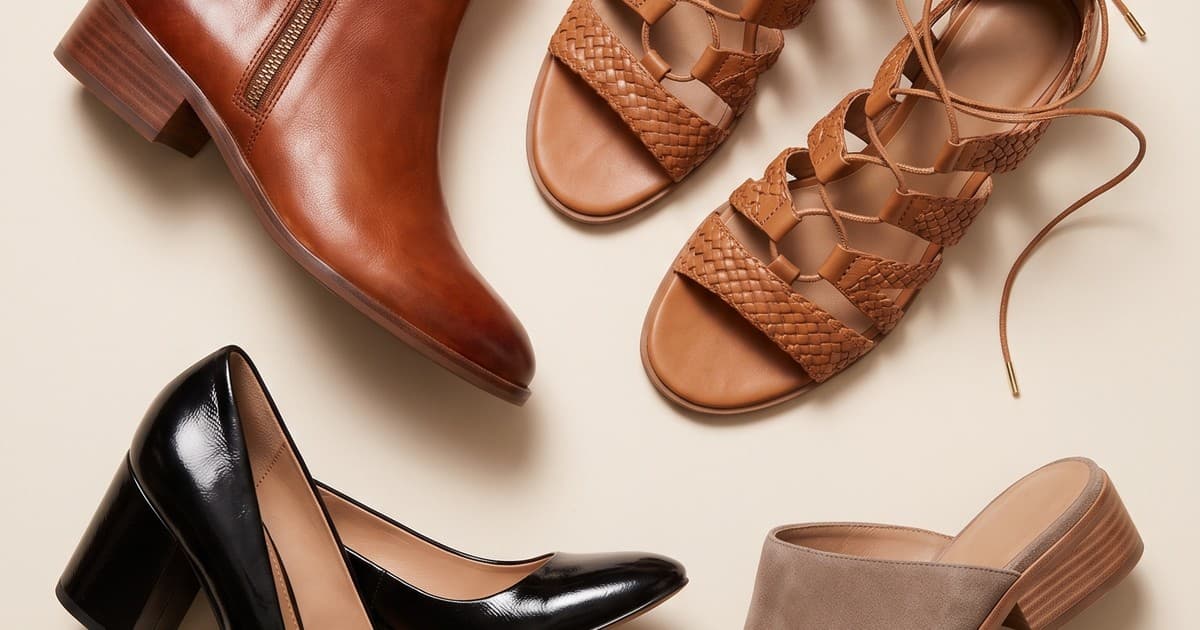
Most of the AI shoe photography conversation is written for sneaker brands. Sneakers get the demos, the case studies, and the marketing copy. Boots, sandals, heels, flats, and slippers get treated as an afterthought, even though they carry construction details that are arguably harder to photograph than a sneaker's mesh upper and midsole.
A boot has a shaft height, a heel counter, and a sole edge that shoppers zoom into before buying. A sandal has straps that need to read clearly against skin tone. A heel has an arch and a toe box shape that decides whether it looks elegant or clunky in a still image. None of that is solved by pointing a generic AI image tool at a product photo and asking for "shoes on a model."
This guide is for footwear brands outside the sneaker aisle: boots, sandals, heels, flats, mules, slippers, and everything in between. It covers what makes each category hard to shoot, the angle set buyers actually need, and how to build an AI photoshoot workflow that protects construction accuracy while still producing volume.
Why footwear outside sneakers gets shortchanged by generic AI tools
Sneaker photography has a huge training and reference base. Boots, sandals, and heels do not get the same attention from general-purpose AI image generators, and it shows in three recurring failure modes:
- Strap and buckle drift. Ankle-strap sandals, T-strap heels, and buckled boots frequently render with straps that shift position, merge into the foot, or lose a buckle between generations.
- Heel height and shape inconsistency. A kitten heel, a block heel, and a stiletto have different silhouettes. Weak AI pipelines regenerate a "generic heel" instead of preserving the actual heel geometry of the product.
- Material confusion. Suede, patent leather, canvas, and woven raffia all behave differently under light. Tools trained mostly on sneaker mesh and foam often flatten these materials into a single generic sheen.
These are not cosmetic problems. A boot listing with an inaccurate shaft height or a sandal image with a phantom extra strap creates the same outcome as a bad product description: shoppers order the wrong thing, and returns go up.
The angle set footwear buyers actually need
Marketplace guidelines and conversion data agree on a similar set of views, and it holds across footwear categories with small adjustments per style:
| Angle | Purpose | Category note |
|---|---|---|
| Three-quarter hero | The default listing image; shows silhouette at a glance | Universal |
| Lateral (outer) side profile | Full side silhouette, sole line, heel shape | Universal |
| Medial (inner) side profile | Arch support, inner construction | Especially important for boots, loafers |
| Front / toe | Toe box shape and width | Critical for heels, flats, dress shoes |
| Back / heel | Heel height, counter, pull tab | Critical for boots, mules, backless styles |
| Top-down | Strap layout, lace or buckle pattern | Critical for sandals, mary janes |
| Sole | Tread and construction | Growing buyer expectation across categories |
| On-foot | Real-world fit, scale, and styling | The image that reduces return-driven fit anxiety |
Boots add a variable sneakers don't have: shaft height and calf fit. A knee-high boot and an ankle bootie need distinct on-foot shots that show where the shaft sits relative to the leg. Sandals need a top-down shot that shows exactly how straps cross the foot, since that is often the deciding factor between similar styles. Heels benefit from a side profile taken at a slight downward angle, which is closer to how a shopper actually looks at their own feet in a mirror.
Skipping any of these because "the sneaker AI tool doesn't have that preset" is how footwear brands end up with thinner PDPs than their photographed competitors.
Building a construction-accurate footwear reference
Before generating anything, define what must stay fixed and what can flex, the same discipline that works for apparel:
- Locked construction details. Heel height and shape, shaft height, sole color and tread pattern, strap width and placement, buckle or lace hardware, stitching, and logo placement.
- Locked material and color. Leather grain, suede nap, patent shine, canvas weave, and the exact colorway being sold, not an approximation.
- Flexible variables. Model, foot pose, background, lighting direction, crop, and styling (bare foot, sock, cropped pant, dress).
- Use case. PDP hero, angle set, lifestyle on-foot, seasonal campaign, or marketplace-compliant white background.
- Review owner. Someone from product or merchandising who checks heel height, strap position, and sole detail against the actual sample before assets ship.
A useful brief for an AI photoshoot reads like: "Ankle boot, 5cm block heel, elastic side gore, round toe, cognac leather. Keep heel height and side gore visible in every angle. Generate three-quarter, both side profiles, back heel, top-down, sole, and one on-foot shot showing the shaft against a rolled denim hem." That level of specificity is what keeps output usable instead of "close enough."
Where this breaks down without a workflow layer
Feeding a single reference photo into a general AI image generator and asking for eight angles usually drifts. The heel height creeps, the strap count changes, or the sole pattern gets invented rather than preserved. Sora, Kling, Runway, and similar generative models are the underlying image and video technology that make this kind of output possible at all, but they are not a footwear production workflow by themselves. A platform like Tellos sits on top of that technology and enforces the locked construction details, the angle set, and the review step so a footwear team gets a usable, on-brand gallery instead of a pile of near-misses to sort through.
High-value AI use cases by footwear category
Boots: shaft height, calf fit, and seasonal styling
Boots sell on how the shaft sits against the leg as much as on the upper design. AI photoshoots let a brand show the same boot styled with jeans tucked in, jeans over the top, a skirt, and bare-leg, without re-shooting the product four times. This is also where seasonal campaign images (fall layering, winter styling) can be produced quickly around a locked reference, keeping the PDP fresh through a selling season without new studio time.
Sandals: strap clarity across skin tones
Sandals need on-foot images across a realistic range of skin tones so shoppers can judge how straps and color will look against their own feet. Re-shooting a sandal line on multiple foot models is expensive and slow. AI-assisted photography can generate that range from one accurate garment reference, provided strap position and buckle hardware stay locked across every variant.
Heels: silhouette-first hero shots
Heels are judged almost entirely on silhouette. A hero image that gets the toe box, vamp line, and heel shape right will outperform a technically sharp photo that subtly distorts the shape. This is the category where a strict "locked construction detail" list matters most, since even small AI drift in heel curvature changes how elegant or clunky the shoe reads.
Flats, mules, and slippers: comfort and material storytelling
These categories sell on comfort and material feel rather than height or hardware. Close-up material crops (knit, shearling, woven leather) paired with a relaxed on-foot lifestyle shot tend to convert better than a sterile studio image alone. AI content makes it practical to produce both the clinical PDP shot and the lifestyle shot from the same reference sample.
Colorway and material multiplication
Footwear brands frequently ship one silhouette across four to eight colorways and sometimes multiple materials (leather, suede, patent) within a single style. Traditionally that means a proportional number of shoot days. With an approved master reference and locked construction details, AI photoshoots can extend the same angle set across every colorway at a fraction of the time and cost, as long as each new color gets the same review pass as the original.
Fit anxiety and returns: the real cost of thin footwear imagery
Footwear has one of the highest return rates in fashion ecommerce, and a meaningful share of those returns trace back to imagery gaps rather than genuine sizing problems. A shopper who cannot see how a boot shaft sits against a calf, how a sandal strap crosses a wide foot, or how a block heel actually looks from the side is guessing. Guessing produces orders that come back.
Three imagery gaps drive a disproportionate share of footwear returns:
- Missing scale references. A shoe photographed alone on white, with no on-foot or size-comparison shot, gives no sense of proportion. Shoppers over-index on reviews and Q&A instead, and many just order two sizes to compare, which shows up as returns either way.
- Inconsistent lighting hiding true color. Cognac, tan, and camel leather look nearly identical under the wrong studio lighting. A shopper who receives a color that reads differently than the listing photo returns it regardless of whether the product itself was accurate.
- No detail shot for the feature shoppers ask about most. Customer service logs are a good source here. If support tickets keep asking "how high is the heel counter" or "does this strap adjust," that is a signal the PDP is missing an angle, not that shoppers are careless.
AI photoshoots make it economical to close these gaps because the marginal cost of one more angle, one more colorway, or one more on-foot shot from an approved reference is a fraction of a re-shoot. A brand that adds a scale-reference shot and a feature-detail crop to every footwear listing is addressing a return driver directly, not just adding more images for their own sake.
Turning support tickets into asset briefs
A simple habit worth building: once a month, pull the most common footwear-related questions from customer service and check whether the PDP gallery already answers them visually. If "does this run true to size" or "how does the ankle strap close" comes up repeatedly, that becomes the next AI photoshoot brief rather than a FAQ entry buried on a separate page. Shoppers act on what they see in the gallery before they ever open a Q&A section.
Marketplace and channel considerations
Footwear brands rarely sell through a single channel, and each one has its own image rules layered on top of the core angle set:
- Amazon requires a pure white background (RGB 255,255,255) for the main image, with the product filling most of the frame and no text or logos. Secondary images can carry on-foot and lifestyle shots.
- Shopify PDPs have more creative freedom and are the right place for the full angle set plus lifestyle and campaign imagery.
- Social and paid channels need vertical crops, faster visual hooks, and shorter attention-span framing, which usually means recomposing the same approved reference rather than generating entirely new content per channel.
Building the angle set once from a locked construction reference, then adapting crop, background, and format per channel, keeps the brand consistent everywhere while still meeting each channel's specific technical requirements. Trying to shoot each channel separately is exactly the kind of repeated coordination cost that AI photoshoots are meant to remove.
A practical rollout plan
- Pick one hero style per category you sell (one boot, one sandal, one heel) and build the full reference pack for each.
- Generate the full angle set for those styles first, and have merchandising review against the physical sample before scaling to the rest of the catalog.
- Extend to colorways once the base angle set and review process are proven for a style.
- Layer in lifestyle and seasonal variants (styling, backgrounds, campaigns) only after the PDP-critical angle set is locked and approved.
- Keep a rejection log. Track which angles or construction details tend to drift (straps, heel height, sole pattern) so briefs improve over time instead of repeating the same review notes every batch.
Footwear will always be a harder category to photograph than a T-shirt, sneaker-focused tools or not. The brands that win the PDP are the ones treating construction accuracy as a non-negotiable input, then using AI to multiply that accurate reference across every angle, colorway, and campaign a shopper actually needs to see before buying.
Ready to build a construction-accurate photo library for your full footwear line, not just sneakers? Try the Tellos AI Video Studio and turn one approved sample into a complete on-foot, PDP, and campaign asset set.