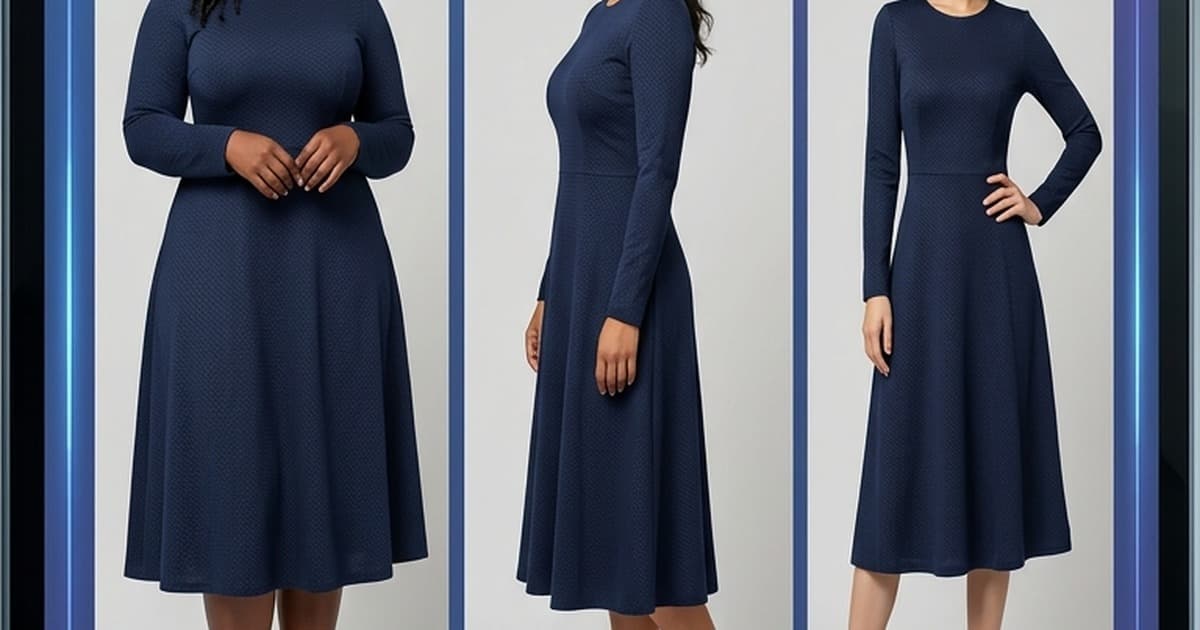
Every fashion brand has the same problem: you shoot a garment on one model, in one setting, for one audience. But your customers don't all look the same — and they don't all shop from the same market.
Until recently, showing the same product on five different models meant five different shoots. Five sets of bookings, five studio days, five post-production workflows, and five times the budget.
AI model swap changes that entirely. One garment image. Multiple AI models. Infinite product page variations — in hours, not months.
Here's what AI model swap actually is, why representation and personalization now have a direct line to revenue, and how leading fashion brands are using it to diversify product pages at scale.
What Is AI Model Swap?
AI model swap is the ability to take a product image — typically an on-model photo or a flat-lay — and re-render it on a completely different AI model, without reshooting.
You keep the garment exactly as it is: the fabric, the fit, the drape, the color, every stitch. What changes is who's wearing it. You can swap:
- Skin tone — from fair to deep, across the full spectrum
- Body type — petite, plus-size, athletic, tall, curvy
- Age — young adult, mature, senior shopper demographics
- Ethnicity and features — to match specific regional markets
- Styling and pose — different stances, gestures, settings
- Gender — menswear brands showing gender-fluid or unisex fits
The core technology is a combination of garment segmentation (isolating the clothing from the original image) and AI diffusion generation (rendering the same garment on a new model in a photorealistic way). When done well — with custom-trained AI — the result looks indistinguishable from a real photo.
This is fundamentally different from simple background removal or basic photo editing. A true virtual model fashion swap preserves every physical property of the garment across the new render: the way denim bunches at the knee, the way silk drapes over the shoulder, how knit stretches across the chest. The garment travels with all its characteristics intact.
Why AI Model Swap Matters for Fashion Brands
Representation Is Now a Conversion Lever
Shoppers buy when they can see themselves in the product. That's not a soft social value — it's a hard commercial reality backed by conversion data.
Studies consistently show that shoppers are significantly more likely to purchase when they see their own body type or demographic reflected in product photography. For plus-size shoppers especially, seeing a garment on a model with a similar build correlates directly with reduced return rates — because they can actually assess fit.
For brands that currently shoot on a narrow range of models, this is untapped conversion potential sitting on every single PDP.
What AI model swap enables:
- Show every product on a diverse set of models by default
- Give shoppers a model filter so they can view products on the model most similar to them
- Reduce sizing anxiety and return rates by giving shoppers realistic fit visualization
- Build authentic brand perception around inclusivity — without it being performative
The last point matters. Representation that lives on the product page — on every garment, in every size — is different from a diverse brand campaign. It's practical, shopper-serving inclusivity.
Personalization at Scale Is Now Possible
Personalization in fashion has historically meant recommendation engines ("you might also like…"). AI model swap opens a new layer: visual personalization at the product-image level.
Imagine a shopper on your PDP who's previously indicated they're 5'2" and petite. Instead of seeing a 5'9" straight-size model, they see the garment rendered on an AI model with their approximate build. Same product. Same image quality. Totally relevant fit view.
This isn't science fiction — it's the logical end state of what AI model swap technology enables today.
Early adopters are already A/B testing model diversity on PDPs and seeing measurable lifts in add-to-cart rates. The brands leaning hardest into this are in the 200–2,000 SKU range: large enough to have real catalog breadth, small enough that traditional multi-model shoots have always been financially out of reach.
Global Market Expansion Without Reshooting
Here's a use case that doesn't get enough attention: regional market adaptation.
A fashion brand expanding from Western Europe into Southeast Asia, the Middle East, or Latin America faces a quiet but real challenge — product photography often doesn't reflect local shoppers. Models from the original market don't always resonate with a new audience.
Traditionally, this meant organizing market-specific shoots in each new region. That's expensive, logistically complex, and slow.
With swap model AI fashion capabilities, a brand can:
- Take their existing product library — already shot for one market
- Run AI model swaps against region-appropriate AI models
- Deploy localized product pages for each market — same products, local-feeling presentation
This dramatically lowers the cost of international expansion. What used to require a dedicated local shoot per market now requires a few hours of AI generation and an afternoon of quality review.
How AI Model Swap Works Technically
Step 1: Garment Isolation
The first step is segmenting the garment from the source image. If you're starting from an on-model photo, the AI isolates exactly the clothing layer — separating it from the original model's body, skin, hair, and background.
This is precision work. A good garment segmentation pass captures:
- Fine fabric edges (lace, mesh, frayed hems)
- Transparent or sheer materials
- Complex silhouettes (ruffles, asymmetric cuts)
- Accessories integrated with the garment (belts, hood drawstrings)
If you're starting from a flat-lay, this step is simpler — the garment is already isolated from any model. This is one reason flat-lay photos are actually ideal starting points for AI model swap workflows: they're clean, well-lit, and require no body segmentation.
Step 2: Model Conditioning
Next, the target AI model is defined. This can mean:
- Selecting from a library of pre-built AI models (by body type, skin tone, features)
- Generating a custom AI model conditioned on specific brand parameters
- Using a real reference model photo as a conditioning input
The AI model isn't just a body shape — it's a full physical specification. How light hits the skin, how the model's proportions interact with the garment's cut, natural pose variations, expression, background environment — all of these are parameters.
Custom AI models (trained on brand-specific data) produce significantly better results than generic stock AI models. A custom model knows your brand's visual language — the lighting style, the pose palette, the background aesthetics you use — and renders the garment in a way that's consistent with the rest of your catalog.
Step 3: Garment-Conditioned Generation
The core generation step takes the isolated garment and the target model specification and produces a new, photorealistic image. The underlying technology is a diffusion model — the same class of AI that powers Midjourney, Stable Diffusion, and DALL-E — but specifically fine-tuned for garment fidelity.
The output isn't a collage or a composited image. It's a generated render where the model appears to physically be wearing the garment — with appropriate physics: the garment drapes, folds, stretches, and sits the way it would in reality on a body with those proportions.
Step 4: Quality Control
This is where a production-grade AI platform earns its value over consumer-grade tools. Automated quality passes check for:
- Garment distortion or artifacts
- Anatomical consistency of the model
- Color fidelity vs. the source garment
- Edge coherence (no halos, blurring, or ghosting along garment edges)
- Fabric texture preservation
Good platforms flag low-confidence outputs for human review before they enter your asset pipeline. That's the difference between "AI-generated content" as a buzzword and AI model swap as a production workflow.
Use Cases: Where AI Model Swap Gets Applied
Product Detail Pages (PDPs)
The most direct application. Most PDPs have 4–8 images per product. With AI model swap, you can have:
- 1 hero shot on your primary market's model
- 3–4 additional shots on models representing other demographics and body types
- A size-guide variant showing how the garment fits on different body proportions
This gives shoppers a richer buying experience and gives your brand automatic representation depth — without adding any photoshoot overhead.
A/B Testing Creative Variants
Swap model AI fashion makes it cheap and fast to test creative hypotheses:
- Does a model with a warmer complexion outperform a cooler one for this colorway?
- Does a petite model or a tall model better represent this silhouette for your core audience?
- Does a more casual pose outperform a structured one for this category?
Previously, running these tests required commissioning shoots for each variant. Now it's a queue of generation jobs. You can run 10 A/B tests simultaneously with different model variants and let performance data guide your default PDP imagery.
Global Localization
As covered above — adapting product pages for regional markets by swapping to market-appropriate AI models. Particularly valuable for:
- Southeast Asia — significant size and proportion variations from Western sizing standards
- Middle East — modest fashion presentations for markets where coverage preferences differ
- Latin America — demographic alignment for a fast-growing ecommerce market
- Plus-size and extended sizes — where showing the garment on the actual size range being sold dramatically reduces returns
Lookbooks and Campaign Content
AI model swap isn't just a PDP tool. Editorial lookbooks that previously required a diverse model casting call — which adds days of scheduling overhead — can now be produced from a single shoot base.
Generate the editorial-look hero shots on your primary model. Then use AI model swap to create a fully diverse lookbook that genuinely reflects your brand's commitment to representation, produced in a fraction of the time.
This is especially powerful for seasonal campaign launches, where speed-to-market is critical and production timelines are always compressed.
Size Inclusivity Visualization
For brands offering extended sizes (XS–4X or beyond), AI model swap enables something that's been genuinely hard to execute before: showing every product on a model that actually fits the size.
The standard approach is to shoot extended sizes separately — which most brands either can't afford or deprioritize. The result is that plus-size shoppers see a straight-size model on size 2X products, which is both commercially damaging (higher returns, lower conversion) and brand-damaging (signals that the brand doesn't actually consider them).
With AI model swap, showing a size 2X product on a body that looks like a 2X is just a generation job. It doesn't require a separate shoot or a separate budget.
What to Look for in an AI Model Swap Platform
Not all platforms deliver the same quality. Here's what separates production-ready from demo-ready:
| Feature | Why It Matters |
|---|---|
| Garment fidelity | Fabric details, texture, and fit must be preserved exactly |
| Custom AI model training | Generic stock models produce generic, off-brand results |
| Bulk processing | You need to run swaps across hundreds of SKUs, not one at a time |
| Quality flagging | Low-quality outputs need to be caught before they enter your pipeline |
| Model library breadth | Wide demographic range including body types, skin tones, ages |
| Brand consistency | Output style should match your existing catalog visual language |
Generic ai clothing try on model tools — the kind you find as browser extensions or one-off demos — are built for consumer experimentation. They're not built for catalog-scale production, brand consistency, or the precise garment fidelity that ecommerce product photography requires.
A production-grade platform is built for operators: it handles your entire SKU library, integrates into your content workflow, and produces output that goes directly to your PDP without needing manual cleanup for every image.
The Business Case: What Changes When You Can Swap Models Instantly
Let's put numbers to this. A mid-size fashion brand with 300 active SKUs wants to show each product on three different models (primary + two diversity variants):
Traditional approach:
- 3 shoot days × $15,000/day = $45,000
- 4–6 weeks production timeline
- Fixed assets — no ability to A/B test or iterate
- New shoots required for every new collection
AI model swap approach:
- 300 SKUs × 3 variants = 900 generated images
- Cost: a few hundred dollars per generation run
- Timeline: hours to days
- Dynamic — easy to update, iterate, or add new model variants anytime
- New collections: just upload the new garment images, run the same workflow
The economics aren't marginal. They're an order-of-magnitude difference. And because AI model swap is a reusable workflow — not a one-time production — the cost advantage compounds over time as your catalog grows.
Beyond raw cost, there's the opportunity cost of not doing this: every month your product pages show a single model type to a diverse global audience is a month of foregone conversion.
Internal Link: Related Capabilities
AI model swap fits within a broader set of AI-powered content capabilities that leading fashion brands are building:
- From Mannequin to Model: How AI Transforms Product Photography — the foundational flat-lay-to-on-model workflow
- AI Fashion Photoshoot: Studio-Quality Images Without a Shoot — the full picture of AI-powered fashion photography
- Custom AI Models for Fashion: Why Brand-Trained AI Outperforms Generic Tools — why model training is the key differentiator
These aren't separate tools. They're components of a single AI content platform that handles your catalog end-to-end — from the first flat-lay to a fully diversified, globally localized product page.
How Tellos Handles AI Model Swap
Tellos is built for exactly this workflow.
The Tellos AI Photo Studio handles the full model swap pipeline:
- Upload your existing photos — flat-lay, mannequin, or existing on-model shots
- Select your target model library — from Tellos's pre-built model set, or using a custom AI model trained on your brand
- Run bulk generation — across your entire catalog, not just single images
- Review and approve — quality-checked outputs land in your asset library
- Deploy to PDPs — assets are production-ready, formatted for your ecommerce platform
Custom AI model training means the outputs don't look generic. They look like your brand. Every swap is rendered in the visual language of your existing catalog — consistent lighting, consistent aesthetics, consistent quality.
And because Tellos runs this as a scalable platform rather than a one-off tool, you can add new model variants, run A/B tests, localize for new markets, and keep your entire catalog current without commissioning a single additional shoot.
Ready to diversify your product pages? Start with a free trial at jointellos.com and see what AI model swap looks like on your actual products.
The Bottom Line
AI model swap isn't a novelty. It's a production capability that directly addresses three real business problems fashion brands face every day:
- Representation — shoppers convert when they see themselves in the product
- Personalization — visual personalization at the image level is now possible and scalable
- Global expansion — entering new markets no longer requires market-specific shoots
The technology is here. The economics are compelling. And the brands that build AI model swap into their standard content workflow now will have a structural advantage in catalog depth and market reach over those still running single-model shoots.
One garment. Every model. Every market. That's the future of fashion product photography — and it's available today.