Traditional model casting is a logistical nightmare dressed up in glamour. Weeks of agency emails, go-sees that go nowhere, day rates that blow your budget, and a very real chance your booked model cancels the morning of the shoot. For brands producing seasonal lookbooks and catalogs, it's the single biggest bottleneck in the entire production pipeline.
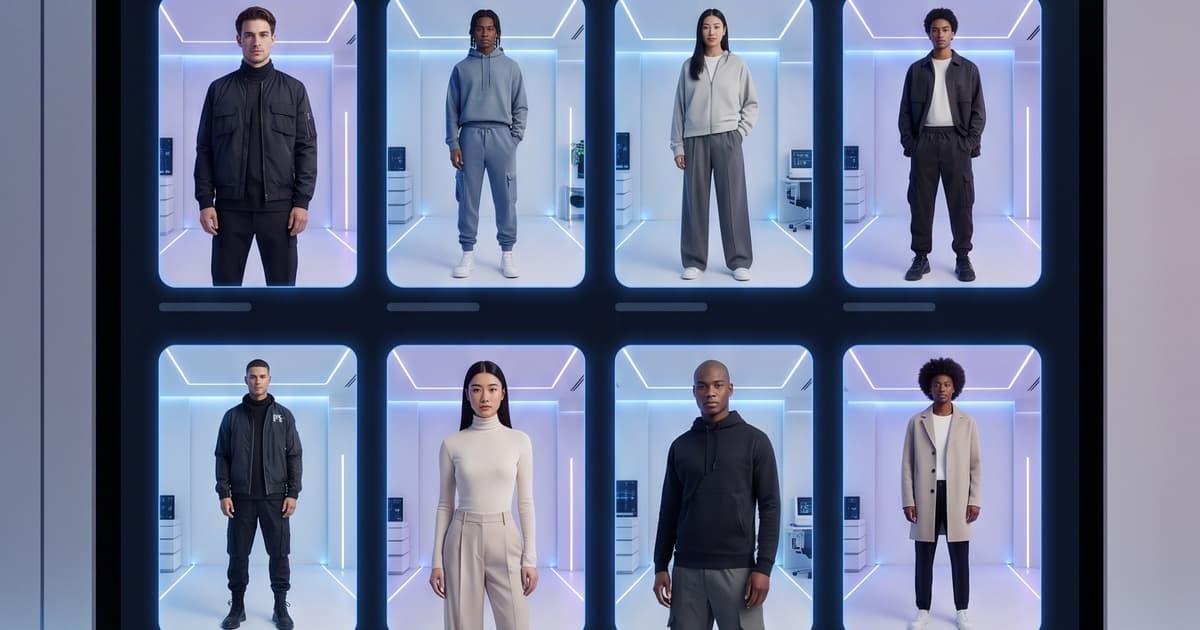
AI model casting changes that completely. Instead of searching through agency books, scheduling fittings, and crossing your fingers, you browse a library of AI-generated virtual models, select the ones that fit your brand, and start generating content immediately. No agencies. No go-sees. No cancellations.
Here's how it works — and why more fashion brands are making the switch.
The Traditional Model Casting Process (and Why It Breaks)
Before unpacking the AI alternative, it's worth understanding exactly what traditional casting costs you — in time, money, and headspace.
The Casting Timeline
A typical lookbook casting cycle runs like this:
- Brief the agency (1–2 days): Send specs — height, sizing, look direction, shoot dates, budget.
- Receive composites (3–5 days): Agency sends a deck of options. You review, shortlist, and request go-sees.
- Go-sees (1–2 days): Models come in. Some don't fit samples. Some have conflicts. Some just don't translate on camera the way their card suggests.
- Confirm and negotiate (2–3 days): Day rates, usage rights, exclusivities, travel costs if applicable.
- Fittings (1 day before shoot): Final check that garments actually work on the selected model. Last-minute swaps if not.
- Shoot day: The model is finally on set. If something goes wrong — illness, injury, a scheduling clash — you're scrambling.
Add it up and you're looking at 2–4 weeks of pre-production just for casting. That's before a single photo is taken.
The Cost Reality
Model fees vary enormously, but for a mid-tier agency model in a major European or US market, you're typically looking at:
- Day rate: €500–€2,000+ depending on experience and market
- Usage rights: Often a separate fee on top, especially for digital/social
- Agency commission: 20–30% on top of the model's day rate
- Overtime: Shoots that run long get expensive fast
For brands running multiple seasonal catalogs — spring/summer, autumn/winter, plus campaign content — model casting is a recurring, significant cost that compounds across the year.
The Hidden Problems Nobody Talks About
Beyond the money, there are structural issues with traditional casting that don't show up on invoices:
Availability clashes: Your preferred model gets booked by someone else. You're back to square one two weeks before your shoot date.
Sample size limitations: Your samples come in a specific size. The agency's most available models don't fit. The fitting process becomes a search for whoever fits your garments rather than whoever best represents your brand.
Continuity across seasons: The model you used for last season's lookbook has moved agencies, raised their day rate, or relocated. Maintaining visual consistency season over season is genuinely difficult.
Representation gaps: If you want your lookbook to show diverse models across skin tones, ages, and body types, you're coordinating multiple bookings — multiple go-sees, multiple day rates, multiple fitting sessions.
What AI Model Casting Actually Looks Like
AI model casting flips this process entirely. Instead of working outward from available talent, you start with your creative vision and select exactly what you need.
The Selection Process
With AI-powered platforms like Tellos, casting looks like this:
- Browse a model library: AI model libraries typically include hundreds of diverse virtual models across skin tones, hair types, apparent ages, and body types.
- Filter by attribute: Want a model with a specific look for a resort collection? Filter by aesthetic direction. Need a consistent male model for a workwear range? Select and lock in.
- Test on garments: Upload your product images and preview how different AI models present the garment before committing to a full catalog run.
- Confirm and generate: Once you've selected your model(s), generate the full lookbook shoot in hours — not weeks.
The "casting" decision that once took three weeks now takes an afternoon.
Diversity and Representation on Demand
This is one of the areas where AI model casting genuinely outperforms traditional approaches. Representing a diverse range of customers in your lookbook is both the right thing to do and a commercial advantage — customers are more likely to purchase when they see themselves in your content.
With traditional casting, achieving diversity requires:
- Multiple separate agency briefs
- Coordinating availability across multiple talent pools
- Higher per-shoot costs (more models = more day rates)
- More complex logistics on shoot day
With AI model casting, diversity is simply a selection choice. You can run the same collection on ten different AI models — different skin tones, different body types, different ages — without any additional coordination or cost. Every size variant, every colorway, presented on a model who reflects that customer segment.
For brands that want to show inclusive sizing, this is transformative. AI lookbook photography makes it practical to represent every size in the range, not just the sample size.
Matching Virtual Models to Brand Identity
One concern brands often raise: can AI models really carry a brand's visual identity? The short answer is yes — and in some ways, more reliably than human models.
What "Brand Identity" Means in Casting
When you cast a human model, you're looking for someone whose presence communicates your brand's values. A luxury brand wants a certain kind of poise. A streetwear brand wants attitude and energy. A sustainable basics brand wants approachability.
These qualities come through in things like: posture, expression, the way the model moves, and how they carry the garment.
AI models can be selected and configured to deliver these same qualities. The casting decision isn't about finding a person who happens to have these attributes — it's about designing for them directly.
Style Consistency Across a Collection
When you're shooting a 60-piece catalog, consistency matters enormously. If your photographer shoots three different days with slightly different lighting, or your model changes their hair between sessions, the catalog feels disjointed. Customers notice, even if they can't articulate why.
AI models don't have off days. The same virtual model presents your garments with identical posture, expression, and skin tone whether you're generating image one or image six hundred. The result is a catalog that looks like it was shot in a single perfect day — because in the AI pipeline, it essentially was.
This kind of consistency is also explored in our guide to fashion catalog photography tips and standards, where we dig into why visual uniformity drives better conversion rates.
Premium vs. Accessible Aesthetics
Different product categories need different model energy:
| Collection Type | AI Model Direction |
|---|---|
| Luxury / Evening | High fashion posture, neutral expression, editorial lighting |
| Casualwear / Basics | Natural, relaxed poses, approachable warmth |
| Sportswear | Dynamic poses, active energy |
| Workwear | Professional, composed, polished |
| Youth / Streetwear | Attitude, movement, edge |
With AI casting, you select for these aesthetics directly. No scouting required.
Season-Over-Season Consistency: The Game Changer
This is where AI model casting creates a genuinely structural advantage over traditional approaches.
The Continuity Problem in Traditional Casting
Fashion brands invest significantly in building a recognizable visual identity. When customers see your campaigns, they should recognize your brand before they see your logo. That recognition is built through consistent casting — the same aesthetic, the same type of model, season after season.
But human models have careers that evolve independently of your brand's needs. They get booked by bigger names. They raise their rates. They change agencies or markets. The model who anchored your last three seasons' lookbooks might simply not be available — or affordable — for your next one.
This forces a recasting process, a break in visual continuity, and often a subtle shift in brand perception that's hard to recover from.
AI Models Are Always Available
Your selected AI model doesn't book competing jobs. They don't change agencies. They don't age between your spring campaign and your autumn relaunch. The same virtual model who fronted your last lookbook is available — identically — for every future production.
This consistency pays compounding dividends:
- Customer recognition builds faster when the same visual identity reinforces season after season
- Brand memory strengthens — consumers start to associate the look with your label specifically
- Marketing assets stay cohesive — campaigns, PDPs, lookbooks, social content all feel like they belong to the same world
For brands building toward premium positioning, this is not a small thing. The visual coherence that luxury labels maintain through tightly controlled casting is now achievable for brands at any scale.
Practical Workflow: Running an AI Casting Session
Here's what actually happens when a brand uses Tellos for AI model casting and lookbook production:
Step 1: Upload Product Assets
Start with clean flat-lay images or on-hanger photos of your garments. These become the inputs for AI generation. The better your input images, the better the output — good lighting and a clean background on your flat-lays make a meaningful difference.
Step 2: Select Your Models
Browse the AI model library and shortlist options. It helps to brief yourself the same way you'd brief an agency — have a clear sense of:
- The demographic and aesthetic you're targeting
- Whether you need one signature model or a diverse cast
- Any specific styling elements (hair, makeup direction)
Step 3: Define Shot Types
Catalog shoots need a consistent set of shot types: front, back, detail, and often a three-quarter pose. Specify these as part of your generation brief. For lookbooks, you might add editorial-style shots with more dynamic composition.
The AI shooting day workflow goes deeper on shot type planning — it's worth reading if you're moving from traditional to AI production for the first time.
Step 4: Generate and Review
Generation typically runs in hours. You'll receive a full set of on-model images for review. If something isn't working — a specific garment isn't draping right, or a particular model isn't quite landing the brief — you can adjust and regenerate without rebooking, reshooter, or re-traveling anywhere.
Step 5: Export for Use
Final images export at production resolution, ready for your ecommerce platform, lookbook layout, wholesale catalog, or social media. No retouching backlog. No usage rights paperwork. No holdbacks.
Cost Comparison: Traditional vs. AI Model Casting
Let's put some numbers on this. Assume a mid-size fashion brand producing a seasonal lookbook with 50 SKUs.
| Cost Element | Traditional | AI (Tellos) |
|---|---|---|
| Agency fee / casting | €400–800 | €0 |
| Model day rate | €800–2,000 | Included |
| Usage rights | €500–1,500 | Included |
| Fittings (half day) | €200–500 | €0 |
| Shoot day (photographer, studio) | €2,000–5,000 | €0 |
| Post-production / retouching | €1,000–3,000 | Minimal |
| Total per collection | €5,000–12,000+ | Platform subscription |
The savings compound across multiple seasons. And that's before you factor in the time cost — weeks of project management that simply disappear from your team's calendar.
For a detailed breakdown of full catalog production costs, see our fashion catalog shoot cost breakdown.
When AI Model Casting Makes Most Sense
AI model casting delivers its biggest advantages in specific situations:
High SKU volume: The more pieces you need to shoot, the more AI's speed and cost efficiency compound. A 200-piece catalog that would require multiple shoot days becomes a single generation run.
Frequent releases: If you're dropping capsules, collaborations, or restocks throughout the year, maintaining an on-call AI model is far more practical than re-engaging agencies for every small release.
Inclusive sizing: Showing your full size range on appropriate models is practically difficult with traditional casting. With AI, it's a configuration choice.
International brands: If your products sell in multiple markets with different aesthetic preferences, AI lets you generate market-specific versions of the same catalog without international casting logistics.
Startups and growing brands: When your budget doesn't justify a full traditional shoot, AI casting removes the floor entirely — you don't need to reach a certain scale before professional lookbook content becomes accessible.
The Future of Model Casting in Fashion
The trajectory here is clear. AI model capabilities are improving rapidly — in photorealism, in pose variety, in garment simulation, and in the nuanced qualities that make a model photograph feel alive. The gap between AI and human model photography has closed dramatically in the past two years, and it continues to narrow.
What won't change is the structural advantage: AI models are infinitely available, endlessly consistent, and entirely customizable to your brand's needs. The casting process — with all its logistics, costs, and uncertainty — becomes optional.
That doesn't mean human models disappear from fashion. Campaign photography, runway, editorial for major publications — there are contexts where the authenticity of a human presence still carries weight. But for the catalog and lookbook production that drives the majority of a brand's day-to-day visual content needs, AI model casting is already the more practical choice.
Start Casting with Tellos
Tellos gives fashion brands the tools to cast, generate, and publish professional lookbook and catalog content — without agencies, go-sees, or shoot days.
Browse AI models, select your cast, and generate your next collection in hours — not weeks.
Whether you're launching your first lookbook or replacing a full seasonal production pipeline, AI model casting makes professional visual content accessible at every scale. Your next collection is ready when you are.