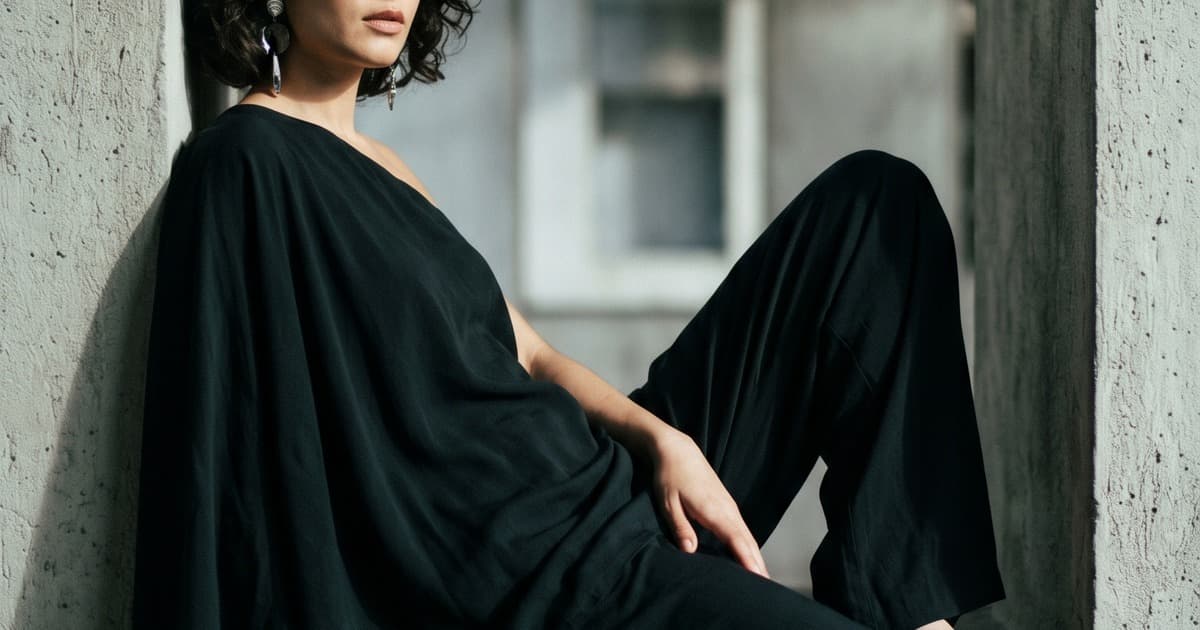
Editorial photography has always been fashion's highest-stakes visual language. It's the kind of imagery that doesn't just show a garment — it tells you who wears it, where they're going, and what kind of person they are.
A catalog photo says "this is a jacket." An editorial photo says "this jacket belongs to someone who takes early morning drives along coastal roads and doesn't own anything that doesn't have a story."
That emotional distance between catalog and editorial has historically come down to budget, creative direction, and crew. Now, AI is closing it — fast.
What Makes Editorial Photography Different From Catalog
Before we get into AI tools, it's worth being specific about what editorial actually means. Because not all "nice photos" are editorial, and understanding the difference matters when you're directing AI to create them.
Catalog photography prioritizes clarity:
- Consistent white or neutral backgrounds
- Standard angles (front, back, 3/4)
- Uniform lighting that renders color accurately
- One model, same pose format, every product treated identically
- Goal: show the product faithfully
Editorial photography prioritizes story:
- Location or styled environments that create context
- Deliberate lighting — often dramatic, moody, or atmospheric
- Model direction that conveys character, not just fit
- Art direction decisions: texture, color story, props, negative space
- Goal: create a feeling, then attach a product to it
The best fashion editorials feel like stills from a film you want to watch. The garments are part of the world, not the subject of a presentation.
This distinction matters because AI generation has traditionally excelled at catalog work — consistent outputs, controlled variables, repeatable results. The challenge was always editorial: can AI create something that feels intentional, not just technically correct?
How AI Generates Editorial-Quality Fashion Images
The short answer: it depends on how well you direct it.
AI image generation for fashion works by interpreting prompts that describe the visual you want — model, styling, environment, lighting, mood, composition. The more specifically you communicate the editorial concept, the closer the output gets to what a creative director would achieve on set.
Here's what AI can handle extremely well:
Mood and atmosphere Prompting for "overcast coastal morning, desaturated tones, soft directional light from the left" produces dramatically different results than "bright studio light." AI models trained on fashion and editorial photography understand lighting language the way a cinematographer does.
Environmental context A garment placed in a specific location — a brutalist stairwell, a sun-bleached terrace, a candlelit interior — immediately elevates its story. AI can generate these environments convincingly without booking a location, permits, or travel.
Composition and framing Art direction concepts like "tight crop, subject slightly off-center, shallow depth of field" translate well into AI prompts. You can direct for the same compositional tension that editorial photographers spend years developing instinctively.
Color story Editorial often has a defined color palette — the whole shoot runs warm and golden, or cool and blue-grey, or desaturated and dusty. AI can maintain this palette consistently across a collection of images in ways that would require significant post-production matching in a traditional shoot.
Creative Direction with AI: Building Your Brief
The biggest shift when moving to AI editorial is that creative direction happens in language before you ever see an image. You're writing the brief, not standing on set adjusting.
This is actually freeing for brands that have strong visual identity but limited production resources — your creative vision doesn't need a budget to execute.
A strong AI editorial brief has five layers:
1. The Subject
Who is the person wearing these clothes? Not demographics — character. "A woman who's been traveling for three weeks and is in no hurry to go home." This kind of direction informs posture, expression, energy — and the AI picks it up.
2. The Setting
Where are they? Not just a location, but a time of day, a weather condition, an atmospheric quality. "Late afternoon light through industrial windows" and "early morning in a quiet European kitchen" produce completely different visual worlds.
3. The Lighting
Editorial lighting is usually imperfect, directional, or deliberately dramatic. Describe what you want: "backlit with rim light creating a soft halo," "low-key, single light source from the right, deep shadows on the left side of frame," "diffused overcast natural light, soft and slightly grey."
4. The Mood
One or two adjectives: "languid and romantic," "sharp and urban," "quiet and introspective," "effortless confidence." These inform everything from color temperature to model expression.
5. The Composition
How is the subject in the frame? "Full-length, slight motion blur, urban background thrown out of focus." "Tight crop from chest up, subject looking away." "Low angle, subject dominant in frame against sky."
When you build prompts with all five layers, you're not asking AI to make a nice photo. You're giving it a complete visual brief.
Where AI Editorial Excels
Some use cases where AI editorial photography outperforms — or at least matches — traditional production:
Collections with a strong conceptual theme If your SS26 collection has a clear story — a specific era, a cultural reference, a color world — AI can execute that concept across all pieces with perfect consistency. Every image will feel like it came from the same shoot, because it did.
Small-team brands with big visual ambitions Direct-to-consumer brands often have sophisticated creative direction but limited production bandwidth. A founder with clear aesthetic taste can produce editorial-quality imagery for a full collection without hiring a team.
Rapid ideation and creative testing What if the shoot concept was "golden hour Marrakech" instead of "modern brutalist Tokyo"? With AI, you can test both in an afternoon and pick the one that resonates with your customer. In traditional production, you'd pick one and commit before you ever saw a result.
Lookbook production A lookbook lives or dies on visual coherence. AI editorial photography gives you consistent lighting, consistent color grade, and consistent compositional style across 30, 50, or 100 pieces — something that's genuinely difficult to achieve across multiple days of traditional shooting.
Social and campaign content Editorial images work hard on Instagram, brand websites, and campaign pages. AI-generated editorial content can produce a month's worth of visually distinct but brand-consistent content from a single well-structured brief.
Limitations to Understand
Honest answer: AI editorial photography is excellent but not without constraints. Here's where to manage expectations:
Complex fabric movement Dynamic shots — fabric billowing in wind, a coat caught mid-turn — are improving fast but still have an uncanny quality at the edges. Static or gently moving poses work better.
Unique or heavily structured garments The more unusual the construction of a piece, the harder it is for AI to render it accurately. Clean lines and standard construction translate reliably. Avant-garde architecture requires more iteration.
Hands The classic AI challenge. Hands in pockets, hands at sides, hands near face — all fine. Hands holding things or in complex positions still need review and sometimes iteration.
Specific model consistency across a full collection Getting the same AI model to appear consistently across 40 images with different styling and settings is manageable but requires attention. Platforms designed for fashion AI generation handle this systematically.
The practical approach: know these limits going in, plan your creative direction around them, and iterate on the outliers. They're not deal-breakers — they're constraints that good creative direction works within.
Using AI Editorial in Your Marketing Stack
AI editorial photography doesn't live in isolation. It feeds your entire content ecosystem:
Lookbooks and catalogs The obvious application. AI lookbook photography at editorial quality means your seasonal catalog can look like a magazine spread, not a product sheet.
Social media Editorial images perform differently on Instagram than catalog shots. They invite engagement, save, and sharing because they communicate aspiration, not just product. A brand that consistently posts editorial-quality AI content builds a distinct visual identity fast.
Campaign and hero imagery Your homepage banner, email header, paid social creative. Editorial quality lifts all of these. And because AI generation is fast, you can create campaign imagery for every launch, not just the major ones.
Wholesale and B2B catalogs Buyers respond to editorial presentation. When your line sheet has the visual weight of a magazine editorial, it communicates brand maturity — which matters for placement decisions.
Press and media Editors and stylists respond to strong editorial imagery. AI-generated editorial assets that look like they belong in a magazine are entirely usable as press assets.
The Economics of AI Editorial Photography
A traditional fashion editorial shoot — 10 looks, half-day location rental, photographer, first assistant, hair and makeup, stylist, model, catering, post-production — runs anywhere from €8,000 to €25,000+ depending on the market and talent level.
For a mid-size brand, that's a significant commitment. And you typically get enough images for one campaign — not a full content calendar.
AI editorial photography changes the unit economics completely:
| Scenario | Traditional | AI |
|---|---|---|
| 10-look editorial | €8,000–25,000 | Fraction of the cost |
| Turnaround | 2–4 weeks | Hours to days |
| Revisions | Expensive (reshoot) | Regenerate on demand |
| Volume | Limited per shoot day | Unlimited iterations |
| Consistency | Varies across days/locations | Controlled and repeatable |
The cost differential means brands can afford to produce editorial content not just for major seasonal campaigns, but for every collection, every collab, every content moment in their calendar.
What AI Doesn't Replace
Clear-eyed take: some things are still done better in a real studio with real people.
Highly specific talent-driven editorials When the whole concept is built around a specific model's charisma, or a photographer's unmistakable style, the editorial is about the collaboration as much as the clothes. That's a different creative product.
Hero campaigns for major brand moments Your annual campaign that anchors the whole brand expression for a season may still warrant traditional production at the highest end. The craft of a great photographer, the presence of a great model — there's a quality ceiling where AI hasn't arrived yet for the very best work.
Culture-forward brands where process is part of the story Some brands' identity is deeply tied to hand-crafted processes, real people, real places. For them, AI production could feel like it conflicts with the story they're telling.
But for the vast majority of fashion brands' visual needs — product photography, lookbooks, campaign imagery, social content, wholesale catalogs — AI editorial photography is already there. The gap between what AI can produce and what a mid-budget traditional shoot produces has largely closed.
Getting Started with AI Editorial Photography
The practical path:
-
Define your visual world — two or three reference images that represent the aesthetic you're after. Not necessarily fashion — film stills, art photography, location photography. What does the world your clothes inhabit look like?
-
Write a structured brief — use the five-layer framework above. Subject, setting, lighting, mood, composition. Be specific and intentional.
-
Start with one look — pick one hero piece and generate a range of editorial interpretations. Iterate on the brief until the results feel right.
-
Build from there — once you have a brief that's working, extend it across the full collection. Adjust for individual pieces while maintaining the core visual direction.
-
Review and select — AI generation produces options. Curate the same way a creative director would review contact sheets.
Make Editorial the Standard, Not the Exception
For a long time, editorial quality was a luxury — the visual level that major brands could afford for campaign moments and that smaller brands aspired to but rarely reached.
AI changes that calculus permanently. Editorial-quality photography is no longer a budget question; it's a direction question. Any brand that knows who they are visually and can communicate that clearly can now produce magazine-quality imagery at scale.
The brands that figure this out first — who build the creative direction muscle, who develop the prompting discipline, who invest in visual identity as seriously as product development — will look dramatically better than brands still producing the same catalog shots their competitors are producing.
Ready to Shoot Editorial?
Tellos gives fashion brands access to AI-powered visual production built for exactly this: editorial-quality photography at catalog scale.
Upload your garments, define your visual direction, and generate campaign-ready imagery across your full collection — without a crew, a studio, or a six-week production timeline.