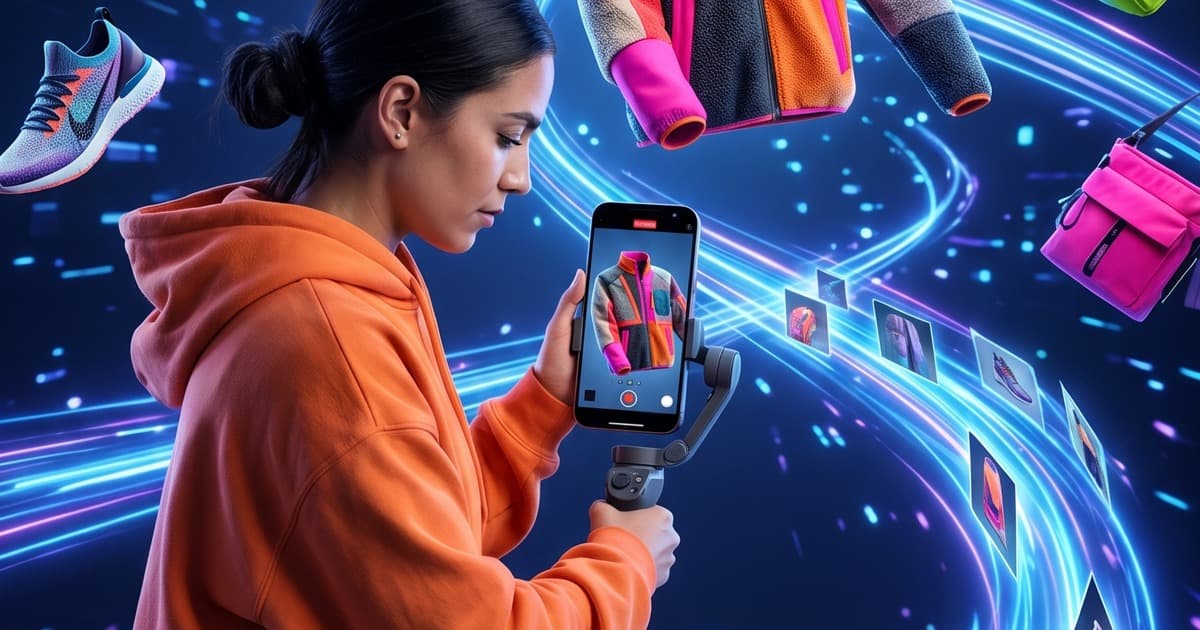
TikTok Shop has become the fastest-growing social commerce channel in fashion. Brands that were barely on TikTok two years ago are now generating a significant chunk of their revenue through it. And the ones doing the best numbers all have one thing in common: they're publishing video constantly.
Not weekly. Not daily. Multiple times a day, across multiple products, with fresh angles, updated hooks, and new styles every cycle.
That's the actual requirement. And most fashion brands, even well-resourced ones, are not set up to meet it.
This post breaks down why TikTok Shop demands so much video, why traditional content production can't keep pace, and how AI video generation is the practical answer for brands that want to compete seriously on the platform.
Why TikTok Shop Is Different From Every Other Channel
TikTok Shop is not just a checkout button bolted onto a social platform. It's a fundamentally different kind of commerce experience, and it has different rules.
On Shopify, your product page works for you around the clock. You optimize it once, drive traffic to it, and it converts (or doesn't) based on how well it's built. The asset is relatively stable.
On TikTok Shop, the video is the product page. When a viewer taps through to buy, they've already been sold by the video. The video handles discovery, education, desire, and the push to purchase all at once. There's no static page doing any of that work.
This changes the economics completely. A single well-optimized Shopify product page can perform for months. A single TikTok video peaks in 24 to 72 hours and then gets buried by the algorithm. The platform's engine is designed around novelty. Fresh content gets surface area. Old content gets nothing.
The result: TikTok Shop is a content treadmill. You either keep producing videos or you fall off the platform. There's no coasting.
The Volume Problem: What TikTok Shop Actually Requires
Here's what the math looks like for a typical mid-size fashion brand with, say, 50 active SKUs.
To compete meaningfully on TikTok Shop, you need:
- Multiple videos per product — different hooks, different angles, outfit combinations, different lighting scenarios. One video per product isn't enough because you need to test what converts and have fresh content when your top performer fatigues.
- Regular posting cadence — the algorithm rewards accounts that post consistently. Most successful TikTok Shop fashion sellers are posting 3–7 pieces of content per day across their account.
- Trend responsiveness — TikTok moves on audio trends, visual styles, and seasonal moments incredibly fast. A video style that works today can feel stale in two weeks if the trend has moved on.
- Product launch support — when you drop a new item, the first 48 hours matter enormously for whether it gets organic distribution. You need video ready to go immediately.
Add that up across 50 SKUs and you're looking at producing hundreds of videos a month just to maintain presence. That's before you account for A/B testing hooks, seasonal refreshes, or responding to viral audio trends.
Traditional video production can't survive that math.
Why Most Fashion Brands Can't Keep Up
The traditional fashion content production pipeline wasn't built for this. It was built for quarterly lookbooks, monthly ad refreshes, and seasonal campaign shoots. That rhythm made sense in an era when a great Instagram photo could live on your feed for six months without going stale.
Here's where the production bottleneck usually sits:
Logistics and scheduling. Booking a studio, a photographer, models, a stylist, and a videographer takes weeks of lead time. You can't spin up a video shoot in 24 hours when a trend is breaking.
Cost per video. A proper fashion video shoot with location, talent, and post-production can run anywhere from $2,000 to $10,000+ depending on production value. At those prices, producing 50–100 unique videos per month is simply not viable for most brands.
Post-production bottleneck. Even if you shoot enough raw material, editing takes time. Video editors aren't infinitely scalable. Cutting, captioning, color grading, formatting for vertical — that's time and money on every single clip.
Creative fatigue. Even with adequate budget, creative teams run out of ideas for new angles and hooks. There are only so many ways to style the same jacket before you're recycling the same concepts.
The brands that are winning on TikTok Shop aren't winning because they have bigger teams. They've solved the production problem in a fundamentally different way.
How AI Video Solves the Volume Problem
AI video generation flips the production model. Instead of starting from a shoot, you start from your existing product photos — images you already have in your catalog — and generate motion content from them directly.
This is what makes the math work:
No shooting required. Your product photos become the raw material. AI models analyze the image and generate realistic motion: fabric flowing, garments on-model, outfit transitions, close-up detail shots. The product you photographed once can become 20 different videos.
Hours instead of weeks. What would take weeks of scheduling, shooting, and editing now takes hours. You can go from product photo to TikTok-ready video in a single afternoon.
Scalable across your entire catalog. Because it's not a manual process for each product, you can apply it across your full SKU range. Every product gets video coverage, not just your hero items.
Variation on demand. Need a new hook? Generate a version with a different opening frame. Need a color variant? Feed in the photo of the alternate colorway. The variation that used to require a reshoot now requires a different input image.
This isn't about cutting corners on quality. When it's done well, AI-generated fashion video is visually compelling and converts. The question is whether you're using tools that understand fashion specifically — the way fabric moves, how garments should be presented, what makes clothing look desirable on screen.
We wrote more about the specifics of creating this content in our post on AI video ads for fashion on TikTok and Reels if you want to go deeper on the production side.
TikTok-Specific Format: What Actually Works
Not all video is equal on TikTok. The platform has specific characteristics that fashion brands need to understand before throwing content at it.
Vertical is non-negotiable
TikTok is a 9:16 platform. Content shot or formatted in any other aspect ratio is instantly recognizable as repurposed content, and the algorithm doesn't reward it. Every video you create for TikTok Shop should be native vertical from the start, not cropped from a landscape shoot.
If you're generating AI video for TikTok specifically, make sure your output is 9:16 vertical. Cropping a wider video to fit creates awkward compositions where key product details get cut off.
The hook is everything
TikTok's algorithm measures completion rate and watch time heavily. If your video loses viewers in the first two to three seconds, the platform stops distributing it regardless of how good the rest of the content is.
For fashion specifically, strong hooks tend to fall into a few patterns:
- The transformation reveal — a before/after moment that withholds the full look until a second or two in
- The product-in-motion opener — fabric flowing, a garment being worn naturally, movement that draws the eye
- The direct challenge or statement — text overlay or voiceover that addresses the viewer's exact situation ("If you're still wearing basics, watch this")
- Trending audio — matching your visual content to a viral sound that's currently getting distribution
We go deep on the psychology of hooks in our post on the first 3 seconds of fashion video ads. It's worth reading if you're about to start creating TikTok content at scale.
Short wins on Shop content
For TikTok Shop specifically, videos in the 15–30 second range tend to outperform longer content. The job of a Shop video is to show the product compellingly and get the viewer to tap the buy button. You don't have space for a narrative. Get to the product, make it look good, and make the purchase action obvious.
Product detail shots are your friend here. Close-ups of fabric texture, stitching quality, how a piece moves — these signals matter to fashion buyers who can't touch the product before buying. A good TikTok Shop video answers the "will this look good in person?" question visually.
Trend integration
TikTok's algorithm gives a temporary distribution boost to content that uses trending sounds and participates in active trends. For fashion brands, this means:
- Keep a playlist of currently trending sounds and have video templates ready to swap in new audio
- Watch for styling challenges and format-specific trends (e.g., outfit transition videos, "get ready with me" formats) that have fashion applications
- React quickly — a trend that's peaking today might be oversaturated in three days
The challenge is that trend-responsive content requires fast production. This is another place where AI video generation beats traditional production: you can create a trend-matching video in hours, not weeks.
The Content Mix That Works on TikTok Shop
Successful TikTok Shop fashion sellers don't publish one type of video. They run a content mix that serves different stages of the buying decision.
| Content Type | Purpose | Frequency |
|---|---|---|
| Product showcase | Pure product view, outfit combinations | Daily |
| Styling/how-to | Multiple ways to wear one item | 3-4x/week |
| Trend hooks | Trending audio + product highlight | When trends break |
| Social proof | Reviews, reposts of customer content | 2-3x/week |
| Behind the brand | Brand story, founder, process | Weekly |
The product showcase and styling content are where AI video generation is most immediately useful. These are high-volume, repeatable formats. You need a lot of them, they need to be consistently good, and the specific creative doesn't need to be hand-crafted — it needs to be fast and visually compelling.
The social proof and brand content still benefit from authentic footage, but that's a smaller proportion of your total output.
How Tellos Generates TikTok-Ready Fashion Videos
Tellos is built specifically for fashion and apparel brands that need video at volume. The core workflow is designed to get you from product photos to TikTok-ready content without the traditional production overhead.
Here's how it works in practice:
You upload your product images. These can be existing catalog photos, sample shots, even packaging images. The system works with what you have.
Tellos generates motion video from the still images. The AI models used by Tellos understand fashion specifically — how garments drape, how fabric moves, how to present clothing in a way that looks natural and appealing. The output is not generic AI video. It's video that looks like it was made for fashion.
You get multiple variations per product. Different angles, different motion styles, different lengths. You're not getting one video and hoping it works. You're getting a range of options to test.
Output is formatted for TikTok. Vertical 9:16, optimized for mobile viewing, with proper resolution for the platform. You're not reformatting content after the fact — it comes out ready to post.
You can iterate fast. Don't like the hook on a particular video? Adjust the input and regenerate. Testing a new color variant? Upload the new image. The cycle that used to take weeks of production scheduling now takes hours of generation and review.
If you're already doing shoppable video on Shopify, Tellos content works across both your TikTok Shop presence and your on-site video. The same assets serve multiple channels.
The Competitive Reality
Here's the honest picture: TikTok Shop has created a content arms race in fashion. The brands that are posting 3–5 videos per day across their catalog are gaining algorithmic distribution that compounds over time. The brands posting once or twice a week are invisible.
You can try to compete with traditional production, but the math doesn't close. You can hire more creators, but scaling a content team creates its own complexity and cost. Or you can change the production model.
AI video doesn't replace creative strategy. You still need to understand what hooks work, what your audience responds to, how to integrate trends intelligently. But it eliminates the bottleneck that turns good creative strategy into slow, expensive output.
The fashion brands winning on TikTok Shop right now have figured out that the content volume requirement is a technology problem, not just a creative one. They're solving it with AI video at scale.
What to Do Next
If you're running a fashion brand and TikTok Shop is either already part of your strategy or clearly needs to be, the first practical question is: how do you get from your current product photography to video content that can sustain a real posting cadence?
Start with your top 10 selling products. Those are the ones where volume matters most because the conversion upside is highest. Get AI video created for those first, see what the output looks like, test a few different hook approaches, and measure what the TikTok algorithm rewards.
Once you've validated the format for your brand, scaling to your full catalog becomes straightforward.
Tellos AI Video Studio is built for exactly this. Upload your product photos, generate TikTok-ready fashion video at scale, and publish across your TikTok Shop and paid social channels without the traditional production overhead.
If you're ready to stop falling behind on TikTok Shop content and start publishing at the volume the platform rewards, start with Tellos.