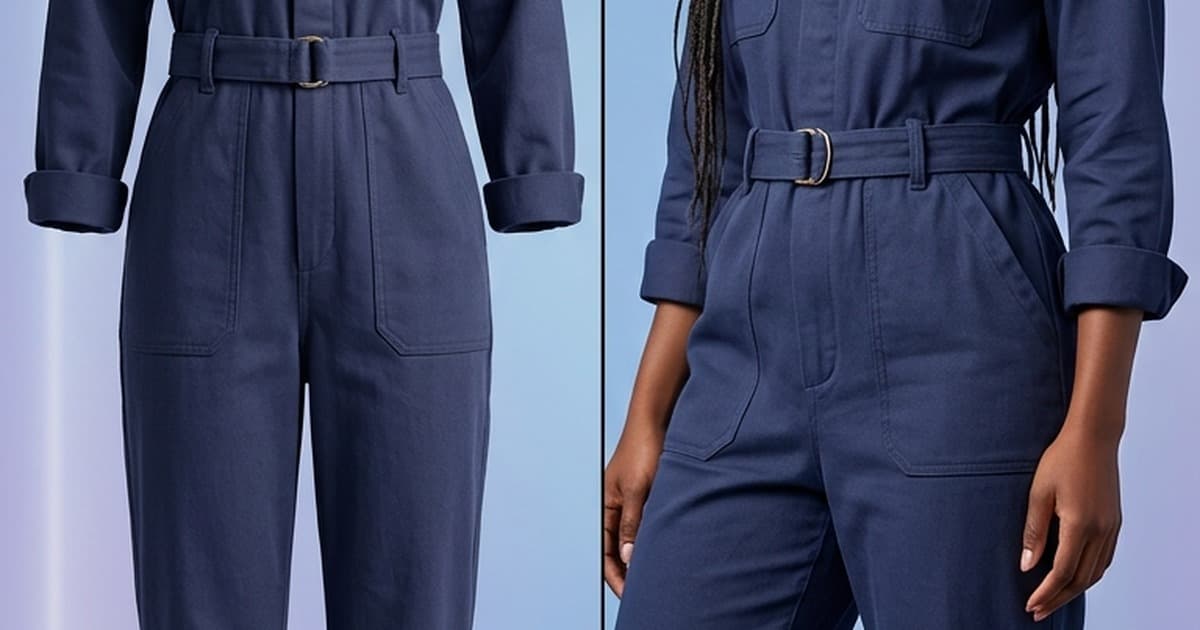
Your product photography is either selling your clothes - or quietly talking shoppers out of buying them.
Mannequin shots look clinical. Flat-lays look amateur. And both suffer from the same core problem: shoppers can't visualize how the garment actually fits, moves, or drapes on a real person. That disconnect costs you conversions every single day.
AI clothing photography solves it. You start with what you already have - a ghost mannequin image, a flat-lay, or even a hanger shot - and end up with a photorealistic on-model photo that looks like it came out of a professional studio. No models to book. No studio to rent. No six-week production cycle.
Here's exactly how it works, what it preserves, and why the brands adopting it are pulling ahead.
The Mannequin and Flat-Lay Problem Is Bigger Than You Think
Most fashion brands don't realize how much their photography format is costing them until they run a side-by-side test.
On-model product photos consistently outperform flat-lays and mannequin shots by 20–30% in conversion rate. That's not a marginal improvement - it's a significant revenue gap hiding in plain sight on your product pages.
The reason is behavioral. When a shopper lands on a product page, they're trying to answer a specific question: Will this look good on me? Flat-lays and mannequin shots can't answer that question. They show the product, not the product in use. The imagination required to bridge that gap is where purchase intent evaporates.
There's also a perception problem. Mannequin and flat-lay photography signals "small operation" to many shoppers - even if the product itself is excellent. Category leaders use on-model imagery. Aspirational brands use on-model imagery. When your catalog defaults to flat-lays because of budget or logistics constraints, you're unintentionally signaling that your brand isn't in that tier.
Why Brands Default to Flat-Lays Anyway
The cost math is brutal. A proper on-model photoshoot for a 50-piece collection - model fees, studio rental, photographer, stylist, retouching - runs anywhere from $15,000 to $50,000+. Per-image costs land between $200 and $600 depending on how efficiently you work.
For a brand with a growing catalog, that's not a one-time cost. It recurs every season. It scales linearly with every new SKU. And the timeline is just as painful as the budget: typical shoot-to-delivery timelines run four to six weeks, which means new products launch with placeholder flat-lays and get upgraded (if at all) weeks later.
So brands make a practical decision: shoot hero products on-model, let everything else live as flat-lays, and accept the conversion gap as a cost of doing business.
That tradeoff no longer makes sense.
How AI Converts Mannequin and Flat-Lay Images to On-Model Photos
The technology powering this shift is purpose-built generative AI trained specifically on fashion and apparel photography. It's not a general-purpose image tool adapted for clothing - it's AI that understands garments: how they drape, how they behave under tension, how fabric structure affects silhouette.
The workflow is straightforward:
- Upload your existing image - flat-lay, ghost mannequin, or hanger shot
- The AI analyzes the garment - identifying fabric type, texture, color, fit, construction details
- A model is selected or assigned - from a diverse library of virtual models, or using a custom-trained model for your brand
- The AI renders the garment on the model - generating a photorealistic image with your product worn naturally
- You receive a studio-quality on-model photo - ready for your PDP, category page, or social assets
The output isn't a rough composite or a CGI approximation. Modern AI fashion photography, powered by diffusion models and fine-tuned on garment-specific training data, produces images that routinely pass as real photography. Shoppers often can't distinguish them from traditional studio shots.
For a deeper look at the underlying workflow, see our guide on AI photo studio for fashion: turning flat-lays into on-model photos.
The Accuracy Question: Fabric, Fit, and Texture
The legitimate concern with AI-generated product photography is fidelity. If the AI renders your garment with the wrong color, misrepresents the fabric texture, or makes the fit look implausible - you create customer expectation mismatches that drive returns. That's worse than no image at all.
This is where purpose-built AI photo tools differ from generic image generators. General-purpose tools like Midjourney or DALL-E produce creative imagery, but they weren't trained to preserve product accuracy. They hallucinate details. They drift on color. They may generate a beautiful image that doesn't accurately represent your actual product.
AI clothing photography built for ecommerce is trained differently.
Fabric and Texture Fidelity
Purpose-built fashion AI understands the structural properties of different textiles:
- Denim: Rigid weave, minimal drape, visible texture - renders as stiff and structured
- Jersey knit: Stretch and cling, body-conforming silhouette - rendered accordingly
- Woven cotton: Matte surface, moderate drape, holds shape - treated differently than a cotton blend
- Silk and satin: High sheen, fluid drape, catches light differently - rendered with appropriate light response
- Technical fabrics: Structured, performance-oriented, often with surface texture - preserved accurately
The AI preserves visible weave patterns, ribbing, embroidery, print placements, and surface treatments. It doesn't smooth these out or substitute generic fabric textures. What's in your input image is what appears in the output.
Color Accuracy
Color drift is one of the most damaging forms of inaccuracy in AI-generated imagery. A product photo that shows a navy shirt as midnight blue or a hunter green jacket as olive creates returns as soon as the physical product arrives.
AI fashion photography pipelines calibrate color reproduction against the source image. The rendered output should be a faithful color match - not an artistic interpretation.
Fit and Silhouette
How a garment fits is arguably the most important thing a product photo communicates. Oversized, relaxed, slim-fit, cropped, high-waisted - these fit attributes are what shoppers are evaluating when they decide whether to buy.
AI photo tools preserve garment silhouette by analyzing the structural shape of the original image and maintaining those proportions when rendering on a model. The result: your slim-fit shirt renders as slim-fit, not as a boxy tee.
Scale: Processing an Entire Catalog in One Session
The economics flip entirely when you can generate on-model photography at scale.
Traditional photography scales linearly. Every additional product means another set of shots, another day of studio time, another round of retouching. The per-image cost stays high regardless of volume.
AI clothing photography doesn't have that constraint. The marginal cost of generating your 500th image is essentially the same as generating your 5th. Brands can now run every SKU through the pipeline - including colorway variants, size variants, and seasonal refreshes - without the cost becoming prohibitive.
The operational impact is significant:
- Every product page gets on-model imagery - not just hero products
- Colorway variants get consistent treatment - same model, same pose, different colorway
- New product launches immediately - no waiting for a photo shoot to be scheduled
- Seasonal refreshes happen in hours - not weeks
For a growing Shopify brand that's scaling from 50 SKUs to 500 SKUs, this isn't a nice-to-have. It's the only approach that makes financial sense.
What You Actually Control
The best AI clothing photography tools give operators meaningful control over outputs - they're not black-box systems that return a single generated image.
Model selection: Choose from a diverse library of virtual models covering different body types, skin tones, heights, and ages. Or use a custom-trained brand model for consistent identity across your catalog.
Pose and stance: Different product categories benefit from different poses. Outerwear photographs differently than activewear. Formalwear communicates differently than streetwear. Good tools let you specify pose intent.
Background and setting: Generate images against a pure white studio background for consistency, or place models in lifestyle environments - outdoor settings, urban backgrounds, interior scenes - to match your brand aesthetic.
Lighting style: Studio lighting for clean product pages. Natural light for a more editorial feel. Dramatic directional lighting for campaign imagery.
Output format: Portrait crop for PDP hero shots. Landscape crop for category headers. Square crop for Instagram. The same base generation can serve multiple placements.
Where AI Fashion Photography Fits in Your Stack
This isn't a replacement for every form of photography. It's a complement to your existing production workflow - and it fills specific gaps that traditional photography handles poorly.
Use AI clothing photography for:
- Long-tail SKUs that never make it into a traditional photo shoot
- Color variants of products you've already shot on one colorway
- Rapid-launch products that need immediate on-model imagery
- Catalog refreshes when brand positioning shifts but products don't change
- A/B testing different model representations against the same product
Where traditional photography still makes sense:
- Brand campaign imagery where authenticity and emotion are central
- Hero products with intricate details that benefit from artistic direction
- Video content where motion and human presence are the point
The brands winning at product content in 2026 aren't choosing between AI and traditional photography - they're using both strategically. Traditional for campaign-level storytelling. AI for catalog-level completeness.
Real Operational Benefits Beyond Conversion Rate
The 20–30% conversion uplift from on-model versus flat-lay imagery is the headline number. But the operational benefits compound in ways that show up elsewhere.
Reduced returns: When shoppers have a more accurate visualization of how a garment fits, they make better purchase decisions. Returns driven by fit expectation mismatches decrease.
Faster time-to-live: New products can launch with on-model imagery the day inventory arrives, rather than waiting for a photo shoot cycle. For trend-driven brands, that speed gap is revenue.
Consistent catalog presentation: When every product gets the same model, same pose, same lighting treatment, your catalog looks cohesive. Inconsistency - which is inevitable across multiple traditional shoots - erodes brand perception subtly but persistently.
Reduced production overhead: No shoot scheduling. No model coordination. No studio logistics. No retouching queue. The operational cost reduction goes beyond the direct per-image savings.
Scaling to Video: The Natural Next Step
On-model photography solves the still-image problem. But product pages that include video consistently outperform pages with photography alone - conversion uplifts of 40–80% are common in product video A/B tests.
The same AI-driven approach that converts flat-lays to on-model photography applies to video: you start with a product image and end up with a short video of that garment being worn, showing drape and movement. For fashion brands that want to show how a flowy dress moves or how a jacket sits in motion, AI-generated product video is the next layer.
Explore how brands are using AI video for ecommerce to boost Shopify and Amazon conversions without traditional video production.
You can also see how custom AI models trained on your brand's specific aesthetic allow for deep consistency across both photo and video formats: custom AI models for fashion brands.
And when you're ready to turn your product images into shoppable video content, check out our guide to shoppable videos for Shopify fashion brands.
The Competitive Landscape Is Already Shifting
Early adopters of AI clothing photography aren't just saving on production costs. They're building a structural advantage: a larger percentage of their catalog on-model, faster launch timelines, and more consistent brand presentation.
Brands that continue to rely on flat-lays and mannequin shots for long-tail products are leaving a measurable conversion gap open - a gap that their competitors are actively closing.
The technology is mature. The results are proven. The question isn't whether AI product photography works. The question is whether you start using it before your competitors do.
Start Converting Your Catalog with Tellos
Tellos is built for ecommerce teams that need to produce high-quality product content at catalog scale.
With Tellos AI Studio, you can:
- Upload flat-lay and mannequin images and receive photorealistic on-model photos
- Process entire catalogs in a single session - not individual products
- Maintain fabric accuracy, color fidelity, and fit representation
- Generate on-model photos, lifestyle imagery, and video content from the same product inputs
- Deploy assets directly to Shopify, Amazon, and your other sales channels
No photo shoot. No models. No six-week timeline. Just production-ready product imagery, at scale, as fast as your catalog grows.
If you're ready to turn your existing mannequin and flat-lay library into on-model imagery that actually converts, Tellos is built for exactly that. Your catalog is already shot. It's time to make it work harder.