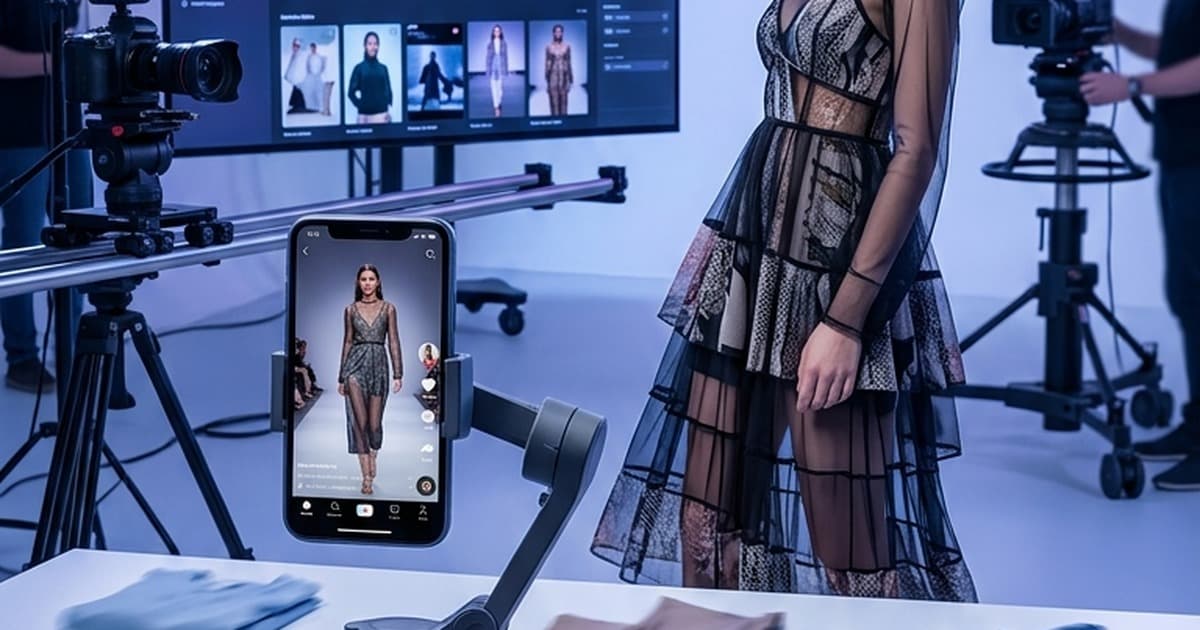
Video is not a channel anymore. It is the channel. For fashion brands in 2026, video has become the primary surface for product discovery, consideration, and purchase - on TikTok, on Instagram Reels, on your own product pages, and in paid social across every platform.
The brands that are winning are not necessarily the ones with the biggest budgets or the most recognizable names. They are the ones publishing fresh video content consistently, at the volume the algorithms demand, across every format their customers use.
The brands that are losing are still treating video like a campaign deliverable: one shoot per season, a handful of clips, rinse and repeat. That cadence is not just slower than the competition - it is invisible to it.
This post is a practical guide to building a fashion video marketing strategy for 2026 - one that addresses the real challenge: not just making good video, but making enough of it.
Why Video Is Non-Negotiable for Fashion Brands in 2026
Fashion has always been a visual category. The shift is not that visuals matter - it is that motion has overtaken still images as the dominant format for every stage of the buying journey.
Here is what the data looks like:
- TikTok now has over 1.5 billion monthly active users, with fashion one of its highest-grossing purchase categories. TikTok Shop is growing faster than any other social commerce channel.
- Instagram Reels generates 22% more engagement than static posts on the platform - and that gap has been widening every quarter.
- 73% of consumers say they prefer short video over text when evaluating a product before purchase.
- Product pages with video convert at rates 80-120% higher than those with images alone, depending on category - and fashion sits at the high end of that range.
The algorithmic reality compounds this further. Platforms like TikTok and Instagram reward freshness. A video that drives strong performance this week will have diminishing returns next week - not because it is bad content, but because the algorithm has already served it widely and moves on to newer material. Staying visible means consistently publishing new creative, not recycling what worked last month.
For fashion brands specifically, three video surfaces now require ongoing attention:
1. Short-form social video (TikTok and Reels): The primary product discovery channel for consumers under 40. Brands that do not publish here regularly are invisible to a large and growing segment of potential customers.
2. Paid social video ads: The performance marketing layer. Running effective paid campaigns across Meta and TikTok requires constant creative refresh - new hooks, new formats, new angles - to avoid creative fatigue and rising CPMs.
3. Product Detail Page (PDP) video: The conversion layer. Shoppers who watch a video on a product page are dramatically more likely to add to cart. This is now table stakes for competitive fashion ecommerce, not a differentiator.
Each of these surfaces has its own volume requirements, format specifications, and content cadence. Together, they add up to a demand that traditional video production was never designed to meet.
The Content Volume Problem: How Much Video Do Fashion Brands Actually Need?
Here is where most fashion brands run into trouble: they approach video as a creative project when it is actually a supply chain problem.
The volume requirements for competitive video marketing in 2026 look roughly like this:
| Channel | Weekly Need | Monthly Total |
|---|---|---|
| TikTok (organic + paid) | 5-10 clips | 20-40 |
| Instagram Reels (organic) | 3-5 clips | 12-20 |
| Meta paid social (ad creative) | 5-15 variants | 20-60 |
| PDP video (new SKU launches) | Varies by catalog | Ongoing |
| YouTube Shorts | 2-4 clips | 8-16 |
Even at the conservative end, a fashion brand running across TikTok, Meta, and Reels needs somewhere between 30 and 50 videos per month to feed all its channels properly. For brands with active paid social programs and large SKU catalogs, 80-100 per month is not unusual.
That is not a creative team problem. That is a production infrastructure problem.
Why Traditional Production Cannot Scale to Meet This Demand
Traditional video production for fashion follows a predictable path: brief the agency or internal team, book the studio and talent, shoot over one or two days, send to editing, go through approval rounds, get final files. The whole process takes two to four weeks from brief to delivery, costs between $5,000 and $30,000 per shoot depending on scale, and produces five to fifteen finished clips.
The math is simply broken. To produce 40 videos per month through traditional production:
- You would need to run two to three shoots per month, minimum
- At $10,000-$20,000 per shoot, that is $20,000-$60,000 in monthly production spend
- Each shoot requires coordinating talent, studio, stylists, photographer/director, and post-production
- The turnaround time makes trend-responsive content nearly impossible
For a DTC fashion brand doing $5M-$20M in revenue, spending $30,000+ per month on video production is not viable - especially when the content has a shelf life measured in weeks. Even for larger brands, the logistics alone make this kind of cadence impossible to sustain.
The result is that most fashion brands are caught in one of two failure modes:
Underproduction: Publishing 4-8 videos per month across all channels. Algorithms deprioritize the brand. Paid social creative fatigue sets in. CPMs rise, ROAS falls, and the brand becomes progressively less visible without a clear reason why.
Overinvestment: Spending heavily on shoots to meet volume demands, only to find the economics unsustainable. Margins get squeezed, the production team is exhausted, and the content still cannot keep pace with algorithmic demand.
Neither is a strategy. Both are symptoms of the same underlying problem: fashion video marketing was designed around a production model that does not scale to 2026 requirements.
How AI Video Production Breaks the Bottleneck
AI video generation has crossed a practical quality threshold. The underlying models - Kling, Runway, Sora, Pika, and their successors - can produce fashion content that performs on paid social, on Reels, on TikToks, and on product pages. The aesthetic gap between AI-generated and production-shot video has closed substantially in the last 18 months.
For fashion brands, the most immediately practical application is the photo-to-video workflow: take existing product photography - flat lays, on-model shots, lifestyle imagery - and animate it into short-form video content without filming anything new.
The Photo-to-Video Workflow
This is the highest-leverage starting point for most fashion brands because it requires zero new assets. Your product photo library, which you already have, becomes the raw material for an ongoing video content operation.
The workflow looks like this:
-
Select your source images. Product flat lays, on-model hero shots, lifestyle imagery, or detail shots. The cleaner the source (good lighting, sharp focus, clear product), the better the output.
-
Generate the motion clip. AI video models apply realistic motion - fabric drape, subtle camera movement, lighting shifts, model animation. A leather jacket catches the light. A dress moves as if the model is walking. A bag rotates with a cinematic pan.
-
Layer on hooks and text. The first two seconds of a TikTok or Reel determine whether someone keeps watching. Add your hook text, brand typography, and a CTA frame in post. Keep it minimal - the visual is doing the heavy lifting.
-
Export for each platform. 9:16 for TikTok/Reels/Shorts. 1:1 for feed. 16:9 for YouTube pre-roll. This step takes minutes, not hours, because you are exporting the same clip in different crop ratios - not re-producing content for each platform.
The full pipeline from product image to publishable video can run in under an hour for a batch of 10-15 clips. That changes the economics of video production completely. We go deeper on this in our guide to turning product photos into video content.
What AI Video Production Actually Costs
Compare the two models:
Traditional production for 40 videos/month:
- 2-3 shoots at $10,000-$20,000 each
- 2-4 week turnaround per shoot
- Limited variation (same shoot produces similar-looking content)
- Total: $20,000-$60,000/month
AI video production for 40 videos/month:
- Subscription or per-generation cost on an AI video platform
- 1-2 days from brief to finished content
- Unlimited variation (different prompts, styles, formats, hooks)
- Total: $500-$2,000/month depending on platform and volume
The ROI case does not require much analysis. The real question is not whether to integrate AI video - it is how to build the workflow so you can run it consistently at scale. For a full breakdown of the AI video studio approach, see AI Video Studio for ecommerce: create product videos without filming.
Beyond Photo-to-Video: Other AI Video Use Cases for Fashion
The photo-to-video workflow is the entry point, but it is not the ceiling. Fashion brands running mature AI video operations use these formats too:
- Styling and outfit videos: Multiple products shown together, transitions between looks, outfit builds. AI video models can generate these sequences without a styling shoot.
- Ad creative variations: Run 10-15 variants of the same ad with different hooks, different opening shots, different CTAs. This is what performance marketers actually need for proper A/B testing.
- UGC-style content: Authenticity-forward video that fits the aesthetic of organic TikTok content. AI-generated clips with UGC-style framing have consistently high engagement in fashion paid social.
- Product page video: Short, clean loops for PDPs. The goal here is not entertainment - it is conversion. A fabric detail that moves, a silhouette that rotates, a color that catches the light. This is where video has the most direct revenue impact. More on the PDP optimization angle in fashion product page optimization with video, AI photos, and conversions.
Building a Fashion Video Content Calendar With AI
The volume problem and the production solution are both clear. The harder operational question is: how do you organize 30-50 videos per month into a coherent content strategy rather than a random pile of clips?
The answer is a structured content calendar built around content types, not individual pieces.
Define Your Content Categories
Before you plan individual videos, establish your recurring content types. For most fashion brands, these break down into five or six categories:
1. Product spotlight videos - Single SKU focus, showcasing fit, fabric, and detail. These feed PDPs and organic social. Volume: 1-3 per active SKU per month.
2. Outfit/styling content - Multiple products in context. These perform well on Reels and TikTok because they show how pieces work together. Volume: 5-8 per week.
3. Paid social ad creative - Performance-optimized clips with explicit hooks and CTAs. Built for testing. Volume: 10-20 per month across all campaigns.
4. Trend-responsive content - Short-turnaround clips that respond to trending audio, visual formats, or cultural moments on TikTok. These require speed more than polish. Volume: 3-5 per week.
5. Brand content - Aesthetic, campaign-level video that communicates brand identity rather than selling a specific product. Lower volume, higher production ambition. Volume: 2-4 per month.
6. Educational/how-to content - Styling guides, care instructions, trend explanations. These build authority and drive search discoverability on YouTube and Pinterest. Volume: 2-4 per month.
Map Content to Channels and Cadence
Once you have your content categories, map them to channels and publish frequency:
| Content Type | Primary Channel | Frequency |
|---|---|---|
| Product spotlight | PDP + Reels | Per new SKU |
| Styling content | TikTok + Reels | 5-8x/week |
| Paid ad creative | Meta + TikTok Ads | Refresh weekly |
| Trend content | TikTok | As needed |
| Brand content | YouTube + Instagram | 2-4x/month |
| Educational | YouTube Shorts + Pinterest | 2-4x/month |
Build a Production Schedule Around Batches, Not One-Offs
The most efficient way to run AI video production is in batches, not individual pieces. Instead of producing one video per day, block two to four hours once or twice a week and produce 15-25 clips in a single session.
A practical batch production workflow:
-
Monday - content brief: Define which SKUs, which angles, which hooks for the week's production batch. Pull source assets from your product image library.
-
Tuesday/Wednesday - AI generation: Run your generation queue. For 20 clips, this takes two to three hours using an AI video platform.
-
Wednesday/Thursday - post-processing: Add hooks, text overlays, CTAs, and branding. Format for each platform. This is where a lightweight tool like CapCut, Adobe Express, or native platform tools comes in.
-
Friday - schedule and publish: Load your scheduler (Later, Buffer, or native platform schedulers) and set the week's publication queue.
-
Ongoing - performance review: Weekly review of what performed. High performers get remixed. Low performers get retired. Insights feed next week's brief.
This structure keeps content production predictable and sustainable without requiring daily production work.
Trend-Responsive Production: Speed as a Strategy
One of AI video's biggest advantages for fashion brands is turnaround speed. Traditional production cannot respond to a TikTok trend in 24-48 hours. AI video can.
When a sound, visual format, or cultural moment goes viral on TikTok, there is typically a 48-72 hour window where early adopters get significant organic reach before the trend is saturated. Brands that can identify a trend Monday morning and publish their version by Tuesday evening capture that window. Brands that need to book a shoot cannot.
The tactical setup for trend-responsive production is simple: keep a small library of formatted, unbranded AI video clips in common formats ready to go at all times. When a trend emerges, drop in the trending audio, add a text overlay, and publish. The pre-built asset library eliminates the production bottleneck entirely. We covered the mechanics of this in detail in AI video ads for fashion: TikTok and Reels content at scale.
The Approval Cycle Problem - and How to Solve It
Even with AI video generation handling production volume, many fashion brands hit a different bottleneck: approval cycles. If every piece of content requires sign-off from creative director, brand team, legal, and senior leadership before it can publish, no production workflow - AI or traditional - can keep pace with algorithmic demand.
The solution is not to eliminate approval - it is to move approval upstream.
Rather than approving individual pieces of content, approve templates, formats, and content categories. Create a clear set of brand guidelines for AI-generated video: approved color palettes, approved text styles, approved motion aesthetics, approved hooks. Once those guardrails are defined and signed off, individual content pieces within those guardrails can publish without individual review.
Reserve approval cycles for:
- New campaign launches that introduce new creative territory
- Content that tags specific people or references specific events
- Paid ad creative above a certain spend threshold
- Content that deviates from established templates
This keeps the oversight that matters while eliminating the drag on high-volume content.
Integrating Video Into Your Full Channel Mix
Video content does not exist in isolation. The most effective fashion brand video strategies create content that works across multiple surfaces and feeds into a broader conversion funnel.
Here is how the pieces connect:
Organic social video (TikTok/Reels) drives discovery and audience growth. The goal is reach and engagement, not direct conversion. This content should feel native to the platform - trend-responsive, authentic, relatively unpolished.
Paid social video drives traffic and conversion. This content is more explicitly commercial - product-focused, hook-led, CTA-driven. It should be tested in volume, with multiple variants running simultaneously to identify what resonates with different audience segments.
PDP video closes the loop at the moment of purchase intent. A shopper who came from a TikTok ad should land on a product page where video reinforces the purchase decision - showing the product in motion, in context, from multiple angles.
The integrated view looks like this: organic video builds the top of the funnel and warm audiences, paid video converts warm audiences, and PDP video converts high-intent visitors. Each layer needs its own content designed for its job.
For Shopify brands building this infrastructure, our breakdown of the best Shopify product video apps for fashion brands covers the tech stack you need for the PDP layer.
And for a broader view of the AI content strategy behind all of this, the AI content creation for fashion brands 2026 playbook covers the full stack - photos, video, and shoppable experiences.
What a Competitive Fashion Video Operation Looks Like in 2026
To make this concrete, here is what the content operation looks like for a fashion brand running this playbook well:
Output:
- 40-60 pieces of video content per month
- Coverage across TikTok, Reels, paid Meta, TikTok Ads, PDPs, and YouTube Shorts
- New ad creative refreshed weekly for all active campaigns
Production:
- AI video generation handling 80-90% of production volume
- Two to three batch production sessions per week
- One team member (or agency partner) managing the workflow end-to-end
Speed:
- Standard content: brief to publish in 48-72 hours
- Trend-responsive content: brief to publish in under 24 hours
- New SKU PDP video: same day as asset receipt
Cost:
- Monthly production spend: $1,000-$3,000 (AI platform + post-processing tools)
- Versus traditional equivalent: $30,000-$60,000+
Performance:
- Creative fatigue eliminated - new creative rotating weekly
- Paid social ROAS stabilized or improved due to constant creative refresh
- PDP conversion rates improved from video on product pages
This is not a hypothetical. This is what the leading fashion DTC brands are already running. The window to build this before it becomes table stakes is narrowing.
Build Your Fashion Video Content Engine With Tellos
The strategy is clear. The technology exists. The economics are compelling. What most fashion brands are missing is not insight - it is execution infrastructure.
Tellos AI Video Studio is built specifically for ecommerce and fashion brands that need to produce video at scale. It handles the full workflow from product image to finished video content, with outputs optimized for TikTok, Reels, Meta paid social, and product pages.
No studio booking. No talent coordination. No weeks-long production cycles. Upload your product photos, define your content direction, and get production-ready video in hours.
If you are ready to build the video content engine your brand needs for 2026, start with Tellos AI Video Studio and see how fast the workflow can move.
The brands winning on TikTok and Reels right now are not outspending you on production. They are outproducing you on speed. AI video is how you close that gap.