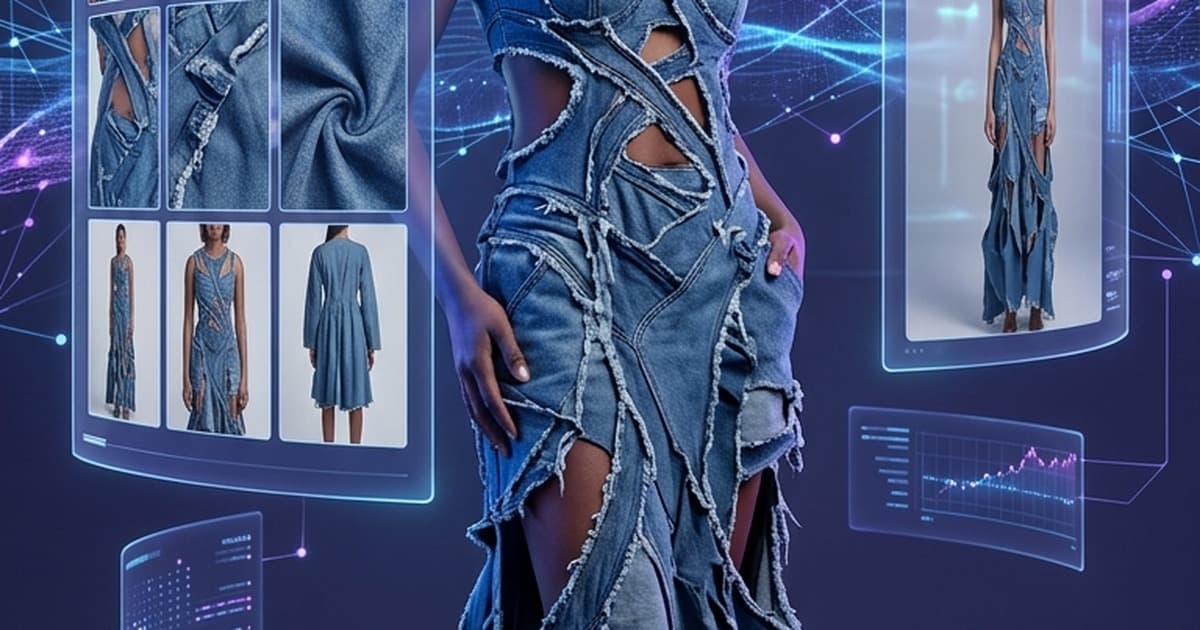
The brands that will dominate fashion ecommerce in 2026 are already doing things that would have sounded impossible in 2023.
They're launching seasonal campaigns without a single shoot day. They're publishing 50 product videos a week without a production crew. They're showing every product on every body type without booking a single model. And they're converting social views into purchases without redirecting anyone to a product page.
This isn't hype. It's the operational reality that early movers are already running at. The gap between brands that have adopted these capabilities and those still running traditional workflows is widening fast — and in fashion ecommerce, content velocity and personalization are now the primary competitive differentiators.
Here's what's actually happening, with the data and brand examples to back it up.
Trend 1: AI-Generated Content Is Replacing the Traditional Photoshoot
The economics finally tipped in 2025. AI-generated on-model photography went from "impressive demo" to "operationally viable" — and in 2026, it's the default choice for brands that have tried it.
The cost math is brutal. A traditional on-model fashion shoot runs $5,000 to $25,000 per day when you count photographer, studio, models, stylists, retouching, and logistics honestly. At that rate, a brand with 200 seasonal SKUs might spend $150,000–$400,000 annually just to keep product pages current. AI-generated imagery brings that per-image cost down to under $2 — often dramatically less at scale.
Our full breakdown of fashion photography cost in 2026 puts the total cost of ownership side-by-side. The ROI math is unambiguous for brands shooting more than 50 SKUs per season.
But cost alone isn't why brands are switching. The bigger unlock is speed and volume. When H&M can update product pages across 40 markets within 48 hours of a trend spike — because they're generating localized model images with AI rather than scheduling reshoots — the competitive advantage compounds quickly.
What forward-thinking brands are already doing:
- Generating diverse model representations without the cost and logistics of booking and shooting multiple models. A single product can now appear on 10 different body types, skin tones, and age ranges — matching the audience composition of each market segment
- Eliminating the reshoot cycle. When a product variant changes, traditional workflows require rebooking, reshooting, and reprocessing. AI workflows update in hours
- Killing the flat-lay bottleneck. Ghost mannequin and flat-lay photography — once the standard for volume shoots — is being replaced by AI-generated on-model imagery at a fraction of the cost and a fraction of the time
- Scaling lookbook production. Seasonal lookbooks that once required multi-day location shoots are being generated by AI in days, with full creative control over aesthetic, setting, and styling
The brands not yet on this path aren't just losing cost efficiency — they're losing content velocity to competitors who can move at AI speed.
Trend 2: Video-First Product Pages Are Becoming the Standard
The product page is changing. Static photography is no longer enough to close the sale.
Consumers expect video. According to Wyzowl's 2025 State of Video Marketing report, 89% of consumers say watching a product video has directly influenced a purchase decision. For fashion specifically — where fit, drape, texture, and movement matter — the gap between what a static image communicates and what a video communicates is even wider.
The operational challenge has always been production volume. Fashion brands can have thousands of active SKUs. Traditional video production at scale means either massive investment in production infrastructure or a very selective approach to which products get video — typically leaving the majority of catalog with static images only.
AI changes that math entirely. AI video generation tools can now convert static product photos into dynamic product videos — showing garment movement, drape, and texture — without filming a single frame.
What's working on video-first PDPs in 2026:
- Auto-play looping videos replacing hero images above the fold. Brands testing this are seeing measurable lifts in time-on-page and add-to-cart rates
- Movement-first content that shows how a garment moves, drapes, and fits in a way static imagery simply cannot — particularly critical for categories like dresses, knitwear, and outerwear
- Short-form social-style clips embedded directly in PDPs. The same format that performs on TikTok and Reels — casual, authentic, movement-led — is converting on product pages when integrated correctly
- Reduced returns as a measurable outcome. Better product visuals reduce return rates — and video is the highest-fidelity visual representation available. Brands using video PDPs are reporting return rate reductions of 15–30% in specific categories
The fashion product page optimization playbook has been rewritten. The brands setting the new standard aren't doing anything exotic — they're just systematically applying video where static used to live.
Trend 3: Personalization at Scale — From Broadcast to 1:1
The "everyone sees the same homepage" era is ending. Fashion ecommerce in 2026 is moving toward dynamic content experiences that adapt to individual signals — browsing behavior, purchase history, location, device, referral source, and more.
This isn't new as a concept. Amazon has been running personalized recommendation engines for two decades. What's new is that the content layer — not just the product recommendations — is becoming personalized. The hero imagery, the featured products, the editorial tone, the social proof presented — all of it can now adapt dynamically.
Several developments are converging to make this possible at meaningful scale:
AI-generated product imagery enables rapid variant creation. When you can generate a product image featuring a specific model aesthetic in seconds, creating localized or segmented hero imagery for different audience cohorts becomes operationally feasible. A brand can now show the same jacket on different model types, in different lifestyle settings, to different audience segments — without the cost of a multi-day shoot.
First-party data is becoming the competitive moat. With third-party cookies effectively deprecated and signal loss accelerating across paid channels, brands that have invested in building robust first-party data infrastructure are able to deliver meaningfully personalized experiences. Those that haven't are back to broadcasting.
ASOS's AI stylist experiment is instructive here. By layering AI-driven personalization over product discovery, they shifted from "here are items in your size" to "here's an outfit curated for your specific aesthetic" — a qualitatively different experience that improved both conversion and basket size.
The personalization stack that's working in 2026:
| Layer | What it personalizes | Technology |
|---|---|---|
| Discovery | Product recommendations, category ordering | Collaborative filtering, behavioral AI |
| Visual | Hero imagery, editorial aesthetic | AI image generation, dynamic creative |
| Content | PDP copy, social proof, fit guidance | LLM-generated content, dynamic CMS |
| Ads | Creative variants by segment | AI creative generation, automated testing |
| Post-purchase | Reorder nudges, cross-sell | CRM automation, purchase prediction |
The brands winning at personalization aren't doing all five layers at once. They're picking the highest-ROI layer for their specific situation — typically discovery and visual — and executing it well before expanding.
Trend 4: Shoppable Social Is Becoming the Primary Acquisition Channel
TikTok Shop's rapid growth has proved something the industry had been debating for years: consumers will buy directly in social apps without leaving the feed. The friction of "swipe up, leave app, find product, add to cart, check out" was always the conversion killer. Removing that friction moves the economics meaningfully.
In 2026, the shoppable social stack has matured to the point where a brand can run a fully integrated acquisition funnel inside TikTok, Instagram, and Pinterest — with product discovery, content interaction, and purchase all happening without leaving the platform.
The content format that wins is short-form video with embedded product moments. Not ads that look like ads — but editorial and creator-driven content where the product appears naturally and a single tap enables purchase. This is the format that drives the highest conversion rates in shoppable social, and it's also the most production-intensive to create at scale.
This is where AI video generation becomes the operational enabler. Scaling AI video ads for TikTok and Reels at the volume shoppable social demands — dozens of variants per week, each tested against different audience segments — requires a production model that traditional shoots simply cannot support.
What brands need to run effective shoppable social in 2026:
- Volume. The TikTok algorithm rewards consistent posting — 3–7 times per week is the effective range for brand accounts with growth intent. At that cadence, AI content generation is not optional; it's the only way to sustain it
- Speed. Trend cycles on TikTok move fast. Jumping on a sound, format, or aesthetic trend has a 48–72 hour window before it's stale. Brands with AI content workflows can respond; those without cannot
- Testing infrastructure. Shoppable social at scale is a creative testing machine. The winning brands are running 15–30 creative variants simultaneously, letting performance data determine which gets budget behind it
- Seamless checkout integration. The product setup for TikTok Shop, Instagram Shopping, and Pinterest Checkout requires proper catalog integration — and keeping that catalog current with accurate imagery and video is an ongoing operational challenge that AI tools are now solving
Setting up shoppable video on Shopify for fashion brands has become a standard workflow. The technical setup is increasingly straightforward — the content production bottleneck is the real challenge, and it's the one AI directly addresses.
Trend 5: AI-Trained Brand Models Are Replacing Generic Stock Aesthetics
This trend is less visible but arguably the most strategically important for brand differentiation.
Generic AI-generated imagery — the kind produced with off-the-shelf models and generic prompts — looks like generic AI-generated imagery. It has no brand DNA. It's recognizable as artificial in a way that undermines the premium perception that fashion brands work hard to build.
Custom-trained AI models, fine-tuned on a brand's own visual identity, produce a qualitatively different output. They capture specific aesthetic elements — lighting preferences, color grading, model type, styling conventions — and replicate them consistently across generated content.
Custom AI models trained on a fashion brand's specific aesthetic have become the differentiator between brands using AI tactically and brands using it strategically. The tactical users are saving money on shoots. The strategic users are building a defensible content capability that compounds over time.
The brands leading this in 2026 are building proprietary model fine-tunes as a core brand asset — as important to their visual identity as their brand guidelines or their color palette. This gives them AI content that doesn't look like everyone else's AI content.
The Convergence: Why These Trends Reinforce Each Other
These five trends don't operate in isolation. The brands seeing the biggest commercial impact are the ones running them in combination:
- AI photography provides the base visual asset layer — product images that are diverse, current, and consistent with brand identity
- AI video turns those images into dynamic PDP content and social-ready clips — feeding the video-first PDP strategy and the shoppable social channel simultaneously
- Personalization uses the expanded content library that AI makes possible — dynamically serving the right visual and copy variant to the right audience segment
- Shoppable social monetizes the video content that AI generates — closing the loop between content creation and revenue
The 2026 AI content creation playbook for fashion brands maps how these layers fit together operationally. The core insight: each AI capability multiplies the value of the others.
What to Do Now: The Priorities That Actually Matter
If you're an ecommerce operator reading this and trying to figure out where to start, here's the practical breakdown:
If you're running 50–200 SKUs per season:
Your highest-impact move is replacing or supplementing your traditional photoshoot with AI-generated on-model imagery. Start with your top 20% of SKUs by revenue. Generate AI imagery across multiple model types. Test it against your existing photography with real traffic. The conversion data will tell you quickly whether to go deeper.
If you're running 200+ SKUs per season:
At this scale, video-first PDPs become the priority. Your conversion rate on high-traffic product pages is probably being held back by static imagery for motion-sensitive product categories. Identify your top 50 products by visit volume, generate AI product videos for each, and measure the before/after conversion difference. The ROI case will be immediate and actionable.
If you're building an acquisition engine on social:
Your content production velocity is the constraint. You can't outspend your way to social acquisition efficiency anymore — you need to out-create. Build an AI video content workflow that produces 5–10 social-ready clips per week, systematically test them, and let data drive creative direction. The AI video ads strategy for fashion on TikTok and Reels is the operational blueprint.
Across all sizes:
Stop thinking of AI content tools as cost-cutting measures. The brands using AI most effectively in 2026 aren't using it to do the same thing cheaper. They're using it to do things at a scale and speed that would be physically impossible with traditional production — and that capability gap is creating real competitive moats.
The Brands That Will Own Fashion Ecommerce in 2027
The trajectory is clear. Fashion ecommerce is moving toward a state where:
- Every product appears on multiple model types — customized for each market and audience segment
- Every product page has a video component — either an AI-generated product video or shoppable social content embedded natively
- Content is served dynamically — adapting to user signals in real time rather than broadcasting the same experience to everyone
- Social is a primary purchase channel — not a traffic driver to a product page but the transaction layer itself
The brands that get there first won't necessarily be the biggest. They'll be the ones that made the operational decision to build AI content infrastructure while most competitors are still debating whether to do it.
The window for first-mover advantage is narrowing. The question isn't whether to adapt. It's how fast.
Tellos Enables All of This — Without Rebuilding Your Stack
Tellos is the platform built specifically for fashion and ecommerce brands that need to operate at AI speed.
Not a generic AI tool. Not a single-feature solution. A complete AI content studio that covers:
- AI product photography — on-model images, flat lays, lifestyle shots, generated from your existing product photos without a shoot
- AI video generation — convert product images into dynamic videos for PDPs, TikTok, Reels, and Amazon product pages
- Custom brand model training — fine-tune AI on your specific aesthetic so generated content looks like your brand, not everyone else's
- Shoppable video integration — embed AI-generated video directly into your Shopify product pages with native commerce functionality
Every trend covered in this post — AI-generated content, video-first PDPs, personalization at scale, shoppable social — is something Tellos enables out of the box.
Explore the Tellos AI Video Studio →
If you're ready to see what your product catalog looks like at AI scale, start with a free trial at jointellos.com. The gap between where you are now and where the leading brands in your category will be in 12 months is a content production decision. Make it now.