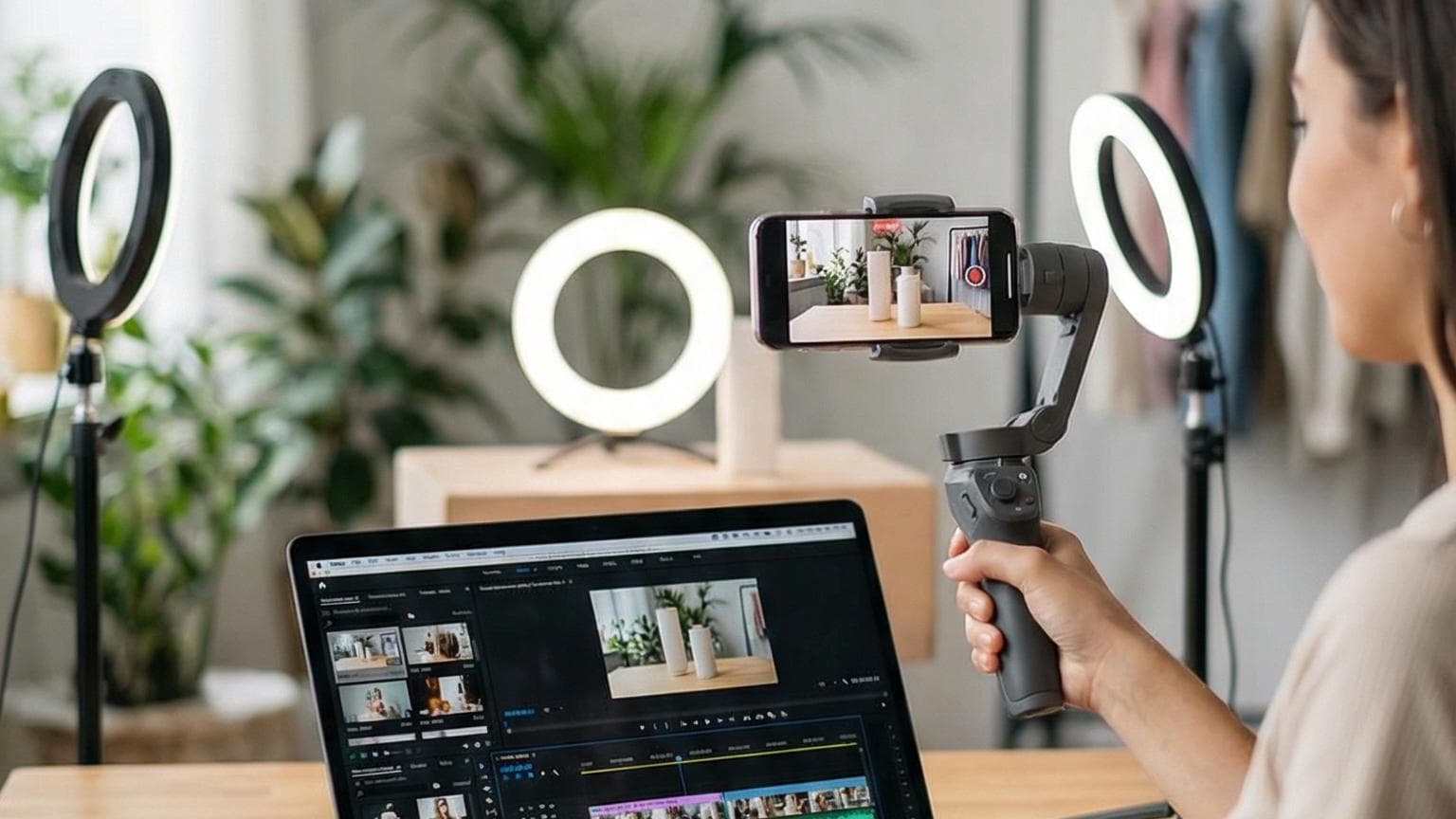
Short-form commerce video is getting more “product page” than “ad.”
TikTok is the clearest example. The platform keeps pulling shopping closer to the feed, closer to comments, closer to creators, and closer to the moment of intent. Instagram and Facebook are doing the same with Reels and Shops. Amazon is quietly doing it too, by rewarding listings that answer questions fast with richer media (video, A+ content, better PDP engagement signals).
This shift changes what wins.
It is no longer “make one hero video and run it everywhere.”
It is “ship 50-200 product-specific videos that match how people actually shop.”
For Shopify brands, Amazon sellers, and TikTok Shop operators, the bottleneck is not ideas.
It is production.
That is why AI video creation is becoming infrastructure for commerce teams - not a creative novelty.
This post is about one specific thing: how to build a scalable AI video workflow that feeds modern product pages across TikTok Shop, Instagram/Facebook, Amazon, and Shopify - without relying on constant filming, influencers, or heavy editing.
Why are product pages starting to look like feeds?
Because the feed is where buyers learned how to evaluate products.
People now expect:
- A quick “what is it” demo
- Fit and scale context (especially fashion and beauty)
- Social proof (UGC-style reactions, comments, comparisons)
- Objection handling (shipping, returns, sizing, ingredients, durability)
- Variations (colors, bundles, use cases)
Traditional PDPs were built for scanning.
Modern PDPs are built for reassurance.
TikTok just made that explicit by reimagining the product page experience around video-first discovery and proof. If you have not read it yet, this is the closest “north star” explanation of where commerce UX is heading: TikTok just reimagined the product page.
The implication is simple:
If your product page experience is video-poor, you will pay for it somewhere else - higher CAC, lower conversion rate, more returns, weaker repeat.
Who is this most relevant for right now?
This is for teams that already have demand signals but cannot keep up with content volume:
- Shopify D2C brands running paid social and needing weekly creative refreshes
- Amazon sellers competing on PDP conversion and ad efficiency
- TikTok Shop sellers who need daily-ish posting cadence and product-specific proof
- Instagram/Facebook commerce operators trying to make Reels shoppable and repeatable
- Lean teams that cannot book shoots every time a SKU changes
If you are selling fashion, apparel, accessories, beauty, home, or gadgets, this matters even more because customers need to see the product in context.
The new requirement: “PDP coverage,” not “content”
Most teams still plan video like marketing campaigns.
But the winners plan video like inventory.
Think in terms of coverage:
For each hero SKU, you want a library that covers the buyer journey:
- Hook (scroll stop)
- What it is (clarity)
- Why it is different (positioning)
- How to use it (demo)
- Proof (UGC-style testimonials, before-after, comparisons)
- Objections (shipping, sizing, materials, warranty)
- Variants (colors, fits, bundles)
- Gifting and seasonal angles
- Creator-style formats for TikTok/Reels
- Clean “Amazon-style” explainer formats for PDP and Sponsored Brands Video
That is not one video.
That is 20-80 videos per SKU over time.
And that is why teams hit the ceiling.
Why influencer and UGC pipelines break at scale
UGC and creators still work. They are just not a scalable dependency for baseline coverage.
Common failure modes operators see:
- You get 10 creators, but only 2 deliver usable footage
- The best creator content cannot be repurposed across every SKU or variant
- Usage rights, whitelisting, and brand safety slow everything down
- You cannot iterate fast enough (new hook, new claim, new angle) without re-briefing
- Your “UGC” becomes same-y because everyone copies the same script
AI UGC-style video is not about replacing creators.
It is about ensuring you always have:
- A consistent baseline of product videos
- Infinite iteration on hooks and angles
- Fast localization and variation
- Always-on testing velocity
Creators then become additive - not a bottleneck.
What does “AI video creation” actually mean for commerce teams?
In practice, it means you can generate video with AI from inputs you already have:
- Product photos
- PDP copy and bullet points
- Reviews and FAQs
- Brand guidelines (tone, do-not-say list, claims rules)
- Existing best-performing ad scripts
And output:
- TikTok-style product showcases
- UGC video AI variations (creator-like voice, captions, pacing)
- Shoppable Reels formats
- Amazon product video formats (clear, benefit-led, compliance-friendly)
- Paid social variants (different hooks, CTAs, lengths)
The key is not the model.
The key is the workflow.
The workflow that scales: one SKU, many angles, many formats
Here is a practical operating system you can run weekly.
1) Start with a “SKU brief,” not a creative brief
For each product, capture:
- Target buyer and primary use case
- 3-5 key benefits (plain language)
- 3 common objections
- 5 proof points (reviews, stats, guarantees, materials)
- Variant list (colors, sizes, bundles)
- Channel priority (TikTok Shop vs Amazon vs Shopify PDP)
This becomes your source of truth.
2) Build an angle bank (this is where performance comes from)
Angles are not “concepts.” They are reasons to buy.
Examples that consistently work:
- “Problem-solution” (what it fixes)
- “What I wish I knew before buying”
- “3 reasons it is worth it”
- “Comparison” (vs old version, vs alternative)
- “Unboxing + first impression”
- “How it fits” (fashion)
- “Day in the life” (context)
- “My honest review after 30 days” (UGC-style)
You want 10-20 angles per hero SKU.
3) Generate video variations in batches
This is where an AI video generator becomes a force multiplier.
Batch by:
- Hook type (question, claim, curiosity, contrarian)
- Length (6-10s, 15-20s, 30-45s)
- Format (UGC-style selfie, product montage, text-led explainer)
- Offer framing (bundle, free shipping, limited drop)
- Persona (busy mom, gym-goer, minimalist, traveler)
The goal is not perfection.
The goal is volume with intent.
4) Adapt outputs to each platform’s “truth”
Same product. Different buyer expectations.
TikTok Shop video
- Fast hook, native pacing, captions
- “Show it working” in the first 2 seconds
- Strong social proof and creator-like language
- Clear “tap to buy” moment
Instagram Shopping / Reels
- Slightly more polished
- Strong aesthetic and brand tonality
- Works well with “how to style” (fashion) and “routine” (beauty)
Amazon product video
- Clear, literal, benefit-led
- Avoid vague hype
- Show scale, dimensions, what is included
- Answer top questions quickly
Shopify PDP video
- A mix: one clean explainer + 2-6 short clips for proof and objections
- Add variant-specific clips (colorways, fits, bundles)
- Use video to reduce returns (sizing, materials, expectations)
Paid social
- More aggressive testing
- Rotate hooks weekly
- Build “winners” into evergreen ads
5) Measure like an operator, not a filmmaker
Track outcomes tied to commerce:
- Hook rate (3-second view / thumbstop)
- Hold rate (watch time)
- CTR (for ads)
- PDP conversion rate (Shopify)
- Add-to-cart and checkout rate
- Amazon detail page sales and video engagement
- TikTok Shop product click-through and conversion
- Return rate changes (especially fashion)
Then feed learnings back into the angle bank.
What to create for fashion and apparel specifically (AI fashion video)
Fashion is where “coverage” matters most because buyers need fit confidence.
If you sell