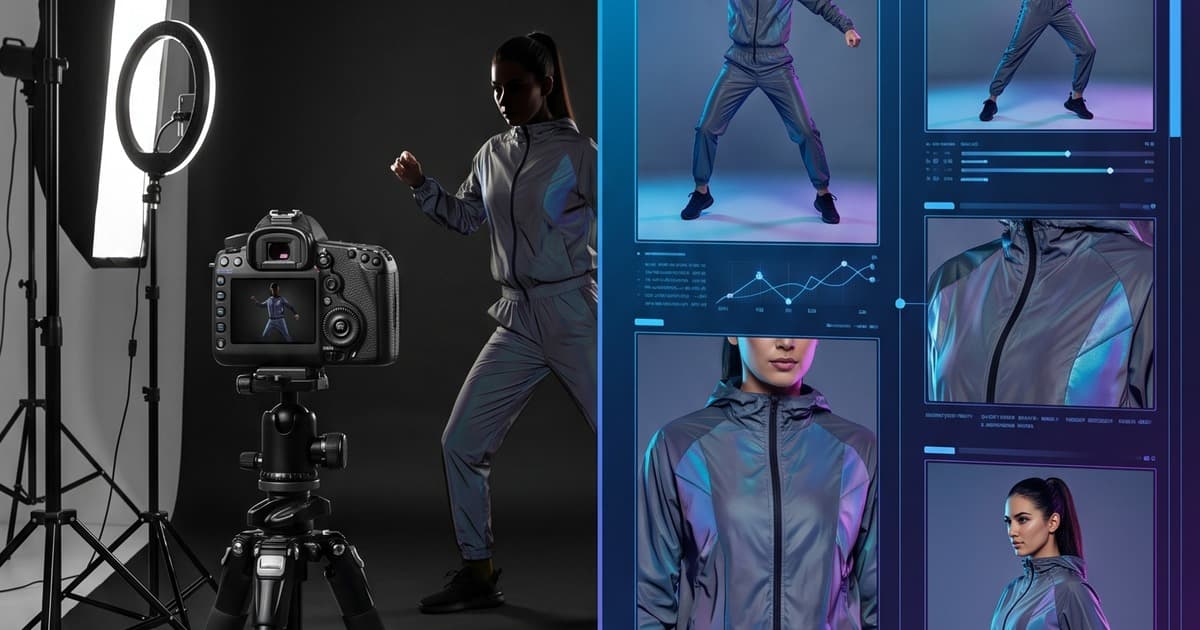
Let's skip the hype in both directions.
AI fashion photography has genuinely transformed what's possible for ecommerce brands. But it hasn't made traditional photography obsolete. And claiming otherwise — in either direction — is doing a disservice to the brands trying to figure out how to actually run their content operations in 2026.
This post is a real comparison. Where AI photography outperforms traditional. Where traditional still holds the edge. How generic AI differs from brand-trained AI (this part matters more than most brands realise). When to use each. And why the most effective fashion brands are combining both.
What We're Actually Comparing
Before getting into it, let's define the comparison properly.
Traditional fashion photography covers any shoot involving a live photographer, physical models or mannequins, studio or location, lighting rigs, stylists, and post-production retouching. It includes:
- In-studio on-model shoots (white cyclorama, controlled lighting)
- Location/lifestyle shoots (outdoor, interior, editorial context)
- Flat-lay and ghost mannequin product shoots
- High-end editorial and campaign photography
AI fashion photography covers tools that generate on-model or styled product images from garment inputs — no physical model required. This breaks into two meaningfully different tiers:
- Generic AI tools — off-the-shelf platforms where you upload a product and get a model image. No brand customisation, no style training.
- Brand-trained AI — custom models built on your brand's specific aesthetic, model preferences, lighting style, and garment types. The output looks like your brand, not just "a fashion photo."
The difference between those two AI tiers is significant. We'll come back to it.
Where AI Photography Wins
Speed That Changes What's Possible
A traditional on-model shoot takes weeks from brief to published images. You book the model, lock the studio, coordinate the stylist, shoot, send to retouching, review, approve, export. For a mid-size brand doing seasonal launches, that cycle runs 4–6 weeks per batch.
AI-generated photography collapses that to hours.
Upload your product. Select your AI model. Generate. Review. Done. For a brand managing 200 SKUs per season, that difference isn't incremental — it's a fundamental shift in operating rhythm. Products can go live the week they arrive in the warehouse instead of six weeks after.
This speed advantage compounds across the launch calendar. Flash sales, new arrivals, restock alerts — all of them need fresh visual content. With traditional photography, you batch what you can afford and live with gaps. With AI, you can shoot everything.
Cost at Catalog Scale
Traditional fashion photography costs are deceptive. Brands budget for the photographer's day rate and forget the rest — model fees, studio hire, stylist, makeup artist, art direction, retouching, and the inevitable reshoot when something didn't work.
A realistic fully-loaded day rate for a mid-tier on-model studio shoot runs $5,000–$15,000. For a brand with 300+ SKUs, even ambitious shoot scheduling leaves significant chunks of the catalog with flat lays or no model imagery at all.
AI-generated photography changes the cost structure entirely. The marginal cost of generating an additional product image is near zero once your model is set up. That means 300 SKUs and 3,000 SKUs cost roughly the same to generate — which is simply not true with traditional photography.
For brands running large catalogs, the economics are not even close.
Scale and Consistency Across a Catalog
Traditional photography introduces variation. Different shoot days mean slightly different light. Models have different days. Retouching is never perfectly consistent across a large batch. For a Shopify store where every product page exists in isolation (customers aren't viewing your catalog in sequence), inconsistency gets overlooked. But it adds up to a weaker brand impression.
AI-generated images, when run through a properly configured system, are consistent by design. The same lighting setup, the same model appearance, the same background treatment — applied uniformly across your entire catalog. For customers bouncing between product pages, the visual cohesion signals professionalism and brand maturity in a way inconsistent traditional photography never can.
Diversity Without the Logistics
Showing your product on multiple body types, skin tones, and model profiles is important — and in traditional photography, it's expensive. Each additional model type means additional booking fees, additional shoot time, and additional post-production.
With AI model swap technology, you can render the same product across a diverse range of AI models without any additional shoot. Add five model variations to every product image for the cost of generating five images. For brands that have wanted to improve their representation but couldn't justify the budget, AI removes the barrier entirely.
Where Traditional Photography Still Has the Edge
Editorial and Campaign Work
There's a reason the best fashion brands still invest in traditional photography for their hero campaigns.
Editorial photography — the kind that lands in campaign lookbooks, homepage headers, and brand storytelling contexts — requires something AI currently struggles with: genuine creative spontaneity and the weight of a real moment.
The best editorial images have texture that comes from the combination of a skilled photographer, a model who actually inhabits a space, natural or carefully constructed light, and the thousands of micro-decisions made in-the-moment on set. Current AI models can produce beautiful images, but they're generating from patterns in training data — they're not discovering a moment.
If your brand's identity lives in the quality of its editorial aesthetic, traditional photography for campaign-level work is still the right call.
Lifestyle and Environment Integration
Showing your product worn in a real context — a model in an actual apartment, walking an actual street, sitting at an actual café — still reads differently from AI-generated lifestyle scenes.
AI lifestyle photography is improving rapidly, and for background environment generation (studio-to-lifestyle transitions), it's already highly usable. But for compositions where the model is deeply embedded in a real, specific environment with genuine depth, texture, and light interaction, on-location traditional photography has advantages that are meaningful to audiences who look closely.
For brands where lifestyle authenticity is central to the product story — outdoor gear, sustainable apparel, heritage brands — this edge is worth preserving.
Complex Fabric Behaviour and Movement
Some garment types are still challenging for AI. Heavily structured tailoring, extreme drape fabrics, knitwear with unusual texture, and garments that rely on movement for their visual impact are areas where traditional photography has a reliable advantage.
A trained photographer knows how to position a suit jacket to show shoulder structure. A skilled model knows how to move so a flowy dress reads correctly. AI systems are improving at fabric physics simulation, but there are still categories where the safest choice for your hero shot is a human on set.
Bespoke Creative Direction
Traditional photography lets you iterate in real time with a creative team. You can change the angle, adjust the light, reposition the garment, try a completely different treatment — all in the same shoot day. That creative flexibility is valuable when you're building a new aesthetic direction or troubleshooting something that isn't working.
AI generation requires prompting and iteration cycles that are efficient but different in character. For exploratory creative work where you don't yet know exactly what you want, a shoot allows a kind of discovery that prompting doesn't fully replicate.
The Quality Gap: Generic AI vs Brand-Trained AI
This is the part that most general comparisons get wrong — and it matters enormously for fashion brands evaluating AI photography.
Generic AI tools are trained on broad datasets of fashion photography. They know what "a model wearing a jacket" looks like in aggregate. But they don't know what your jacket looks like — how your specific fabric drapes, what your garment construction does to silhouette, how your brand's signature model aesthetic reads. The results are often recognisably "AI fashion" — technically impressive but aesthetically generic.
Brand-trained AI models are built on your brand's actual visual library. They learn:
- Your garment types and how they behave on a body
- Your preferred model aesthetics and body proportions
- Your lighting and colour treatment signature
- Your background and environment preferences
- The visual language that makes your brand yours
The output difference is stark. Generic AI gives you content that could be from any fashion brand. Brand-trained AI gives you content that's unmistakably yours.
| Generic AI | Brand-Trained AI | Traditional Photography | |
|---|---|---|---|
| Speed | ✅ Fast | ✅ Fast | ❌ Weeks |
| Cost per image | ✅ Low | ✅ Low | ❌ High |
| Brand consistency | ❌ Generic | ✅ On-brand | ⚠️ Variable |
| Fabric accuracy | ⚠️ Varies | ✅ Strong | ✅ Strong |
| Editorial depth | ❌ Limited | ⚠️ Improving | ✅ Best-in-class |
| Scale capability | ✅ Unlimited | ✅ Unlimited | ❌ Budget-limited |
| Model diversity | ✅ Easy | ✅ Easy | ❌ Expensive |
| Lifestyle authenticity | ⚠️ Improving | ⚠️ Improving | ✅ Strong |
The right comparison for most brands evaluating a move to AI photography is brand-trained AI vs traditional — not generic AI vs traditional. Generic AI is a different tool for a different use case.
When to Use Each
This isn't a binary choice. The brands getting the most out of their visual content operations are running a deliberate mix.
Use AI Photography For:
Catalog-scale product coverage. Any SKU that needs on-model imagery but doesn't justify a full shoot allocation — which, for most brands, is the majority of the catalog — is an AI use case. Fast turnaround, consistent quality, low marginal cost.
New arrivals and restocks. Products that need to go live fast can't wait for shoot scheduling. AI-generated imagery lets you publish on arrival.
Variation coverage. Colour variants, size variations, model diversity expansions — all scenarios where you need multiple versions of a product image without multiple shoot bookings.
Social and paid content at volume. Ad creative requires volume. You need fresh images regularly for testing, seasonal relevance, and platform algorithm freshness. AI photography makes volume sustainable.
Flat lay to on-model conversion. If you have a backlog of flat-lay or ghost mannequin product images from previous seasons, AI can generate on-model versions of all of them — retroactively expanding your catalog's visual quality.
Use Traditional Photography For:
Hero campaign imagery. Your brand's annual campaigns, your homepage hero, your brand story content — these are worth the investment in traditional production for the editorial quality they deliver.
New category launches. When you're introducing a new product category and need to establish the aesthetic language for it, a traditional shoot gives you the creative flexibility to figure out what works.
Genuinely complex garments. Heavily structured tailoring, unusual fabrics, movement-dependent pieces — schedule these into a traditional shoot budget.
Video and motion content. AI video for fashion is a separate and rapidly evolving capability, but for certain types of motion content — particularly anything requiring authentic human movement — traditional video production is still the benchmark.
Why Most Fashion Brands Will Use Both
The conversation about AI vs traditional photography often gets framed as a replacement story. It isn't.
What's actually happening is that AI photography is expanding what's achievable within a given budget — not eliminating the value of traditional photography where it does things AI can't.
Think about it this way: most brands have been making forced choices with traditional photography budgets. They shoot the hero products well and compromise on the long tail. They get great campaign imagery and weak product page coverage. They have consistent quality for their top sellers and variable quality for everything else.
AI photography removes the forced choices. You can have great campaign imagery and full catalog on-model coverage and diverse model representation and fast turnaround on new arrivals — because each of those now has a different cost structure.
The question isn't "should we use AI or traditional?" The question is "which use cases in our content operation are best served by each?" and "how do we build a workflow that combines both effectively?"
Brands that figure this out early are building a structural content advantage over competitors still treating it as an either/or decision.
What to Look for in an AI Photography Solution
If you're evaluating AI photography tools, here's what separates the ones worth using from the ones that will frustrate you:
Brand training capability. As discussed, generic AI output is recognisably generic. Look for platforms that train on your brand's visual library and produce output that's consistent with your existing aesthetic.
Garment accuracy. The tool should preserve your garment details — texture, colour accuracy, logo placement, stitching — not approximate them. Test this with your actual products before committing.
Output consistency. A single good image isn't useful. You need consistent quality across hundreds of generations. Look for platforms that have solved for consistency, not just peak performance.
Workflow integration. How does the output slot into your existing content pipeline? Good tools integrate with how your team actually works — Shopify connections, batch processing, direct-to-PDP export.
Support for your specific categories. AI systems trained heavily on one garment type may perform poorly on others. Evaluate with your actual product mix.
The Bottom Line
AI fashion photography is not a replacement for traditional photography. It's an expansion of what's possible — particularly for catalog-scale production, speed, cost efficiency, and model diversity.
Traditional photography is not made obsolete by AI. It retains genuine advantages in editorial quality, lifestyle authenticity, creative spontaneity, and complex garment scenarios.
The brands that will win on content in 2026 aren't picking a side. They're building hybrid workflows: AI for volume and velocity, traditional for campaigns and creative benchmarks. They're using brand-trained AI (not generic tools) for the AI side of that equation. And they're treating the question of which tool for which job as a strategic decision, not a philosophical one.
Want to dig deeper into the numbers? The full traditional vs AI cost breakdown covers every line item in honest detail. And for the technical side of what brand-trained AI can do for your specific garment types, the custom AI models guide is the right next read.
Try AI Fashion Photography with Tellos
Tellos AI Photo Studio is built specifically for fashion and apparel brands on Shopify. It converts your existing flat-lay, ghost mannequin, or plain-background product photos into studio-quality on-model AI images — at catalog scale, with your brand's aesthetic intact.
What Tellos delivers:
- Brand-trained AI models — output that looks like your brand, not generic AI fashion
- Hyper-accurate garment rendering — fabric texture, drape, colour, and fit preserved in every generation
- Model diversity — generate product images across multiple body types, skin tones, and aesthetics without additional shoot costs
- Batch processing — handle your full catalog in hours, not weeks
- Flat-lay to on-model — convert your existing product image library to on-model imagery instantly
Stop choosing between great campaign photography and great catalog coverage. Use the right tool for each job — and let AI handle the scale.